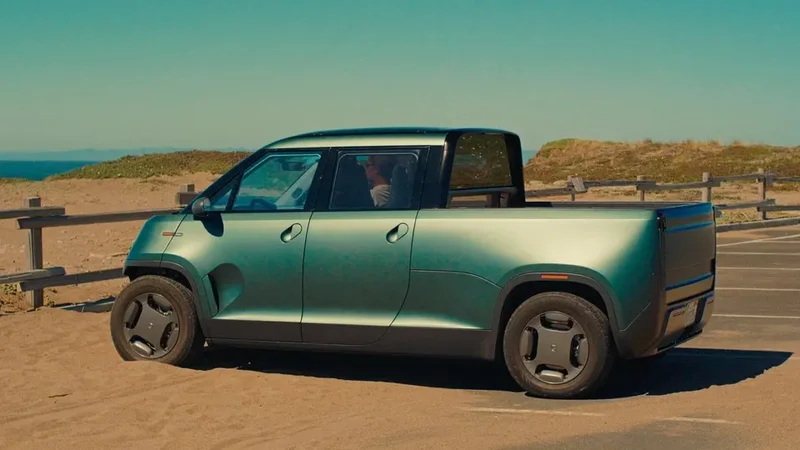
TELO's electric mini pickup is about the same size as BMW's MINI Cooper.
TELO
Twenty years ago this month, Tesla introduced itself to the world with the electric Roadster, the $100,000 sports car that kickstarted the modern EV era. Now the company’s two original founders are betting on TELO, an EV startup with an aesthetic rebuttal to Tesla’s brutalist Cybertruck swagger.
Rather than start with another compact crossover chasing Tesla’s top-selling Model Y, San Carlos, California-based TELO – located in the same Silicon Valley office park where Tesla was headquartered when it launched the Roadster – is coming to market with a whimsical truck roughly the size of a MINI Cooper. Priced from $41,520, the MT1 looks like something from the world of Japanese anime, with none of the militaristic menace of Tesla’s pickup. But TELO is borrowing one important page from Tesla’s original playbook: start small and build slowly. CEO and cofounder Jason Marks told Forbes the company initially plans to make just 500 units, and then scale up to a 5,000-vehicle-per-year run rate after a year or so. And even at that relatively low volume, he thinks the company can turn a profit.
“A lot of EV companies that came after Tesla went right for high-volume manufacturing out of the gate. But that's not what Tesla did. If you look at their playbook, they built 2,400 Roadsters. Then they built 10,000 Model S’s, and then scaled from there,” said Marks, whose cofounder, Forrest North, is a former Tesla engineer. “Our intention is very much the same. This first mid-market product we're launching is really to show the world that mini can be mighty. We're not going to come out of the gate building a high-volume product.”
TELO cofounders Forrest North, left, and CEO Jason Marks.
TELO Trucks
Like Tesla in its early days, TELO is also starting with modest funding. It has raisedabout $27 million so far, including a $20 million round last September that was backed by Tesla cofounder Marc Tarpenning’s Spero Ventures and fellow Tesla cofounder and former CEO Martin Eberhard. Though additional fundraising is likely this year, the company doesn’t need as much cash as Tesla or Rivian to get into production, as it’s not building a factory. Instead, it’s contracting production of the MT1’s body to Michigan-based Schwab Industries and will install the battery pack and other components it designed in San Carlos.
“Over time, we'll bring more and more of that capability inhouse and we'll use more and more advanced manufacturing technology that we're kind of sitting on right now, but don't have the capital to deploy,” Marks said. The goal is to ship the first vehicles by the end of this year or early 2027, and scale up slowly.
Tarpenning, a cleantech investor since leaving Tesla in 2008, is also a member of TELO’s board. Both he and Eberhard, who Musk forced out of the company in late 2007, think the U.S. EV market is ready for new types of products and willing to take a chance on new players. Especially products people see as fun or cute.
Tesla cofounder Marc Tarpenning, left, discusses the Roadster with ex-Australian foreign minister Alexander Downer, center, and former U.S. Secretary of State Condoleezza Rice in 2007.
MediaNews Group via Getty Images
“This goes back to Steve Jobs, who said you have to delight the customer. And that means everything about it–the look and the feel of it; the materials; the service experience; the sales experience. With all of that you want to delight the customer,” Tarpenning said.
“When we started [Tesla], people would go, ‘There's no way we're going to buy a Tesla because that's not a car company. There are only three car companies in America.’ I think people now accept that there are a lot of different car companies, and the willingness to give it a try is much, much higher,” he said.
Assuming the MT1 goes into production as planned, it will be sold in two variations based on battery range. The base model will go 260 miles per charge, while a pricier $45,500 long-range version gets 350 miles per charge. Add an additional motor for more speed and performance and the cost rises to $50,000.
Though that’s less than the industry average of $55,000 for new EVs, Tarpenning concedes that the tiny truck isn’t cheap. Pricing won’t be a barrier for TELO’s initial low-volume targets, but will likely have to come down over time to gain broader mass-market appeal, he said.
Crash testing will happen later this year, and CEO Marks is confident the truck will perform well, despite its small size, based on the computer modeling it’s done. That’s largely because the M1T’s flat battery pack, with integrated motors, is designed to help strengthen its frame.
Tesla co-founder and first CEO Martin Eberhard at a conference in Seoul, South Korea, in 2025.
NurPhoto via Getty Images
“We could rethink car architecture that's existed for the last 60 years,” he said. “We started with the fundamental physics question of what's the minimum required frontal crash zone required to get a five-star crash rating–and how can we package a fully functional vehicle in the smallest footprint behind that?”
Eberhard, who’s also an advisor to Swiss minicar-maker Microlino, was introduced to TELO by Tarpenning. He’s convinced the time is right for companies to go after new market niches, as TELO and Slate, with a low-priced, stripped-down electric pickup, are doing.
“Nobody in the EV space needs to prove that an EV works or that an EV can be fun or that an EV can be fast. That's been done already, and to try to do that again is stupid,” Eberhard said. “TELO tickles my main interest in EVs in that they're seeking out a different market segment that's not head-to-head up against Tesla or the Chinese or somebody else. They found their own little niche. And if they can actually deliver on that, I think they'll find a market.”
While both Tesla founders are proud of that company’s success over the past two decades, they’re disappointed by its loss of global EV dominance to Chinese rivals as Musk pivots its focus to robotaxis, robotics and AI. And neither is a Cybertruck fan.
“I personally think Tesla's lost its way a bit, especially with the Cybertruck,” Tarpenning said. “I’ve got to think Elon had his fingers in that really, really deeply because no designer would've come up with that.”
More From Forbes
ForbesA Beefed-Up Golf Cart And An Anti-Cybertruck: Cheap, Quirky EVs Are ComingBy Alan OhnsmanForbesCalifornia Will Give You $3,500 To Buy A New EVBy Alan OhnsmanForbesGM Doubles Down On Energy Business To Serve Data Center Electricity DemandBy Alan Ohnsman