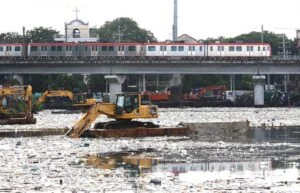
Sea of trash: Where the buck stops
The rainy season always exposes the sordid reality of Metro Manila’s waste management crisis. Yet, despite the recurring catastrophes, lessons have not been learned and long-term solutions have not been adopted; only the endless cycle of finger-pointing.
Last weekend, residents of Parañaque City woke up to a “sea of trash” after nonstop rains enhanced by “habagat” (monsoon rains) brought large volumes of garbage into the Redemptorist Water Channel in Barangay Baclaran and clogged the city’s waterways. The trash did not just originate from the city but also from neighboring areas like Pasay City and Manila Bay, where high tides pushed the debris to the artificial coastal waterway.
The amount of waste and debris collected in just three days, from Aug. 10 to 13, was enormous: 2,246.6 cubic meters or 748.87 metric tons, contained in more than 200 dump trucks, according to the Metropolitan Manila Development Authority.
Article continues after this advertisement
The massive haul has led to renewed calls from environmental groups for the government to ban single-use plastics. It has also underscored a worsening waste problem despite laws and ordinances, raising questions about their implementation and the need for stiffer penalties for littering and improper garbage disposal.
Imposing fines is pointless
President Marcos quickly shut down calls for additional penalties, pointing out that a proper waste management system must come first. His main point was: imposing fines is pointless if there are no facilities where the public can properly dispose of their garbage. “Sometimes, the problem is just that simple,” he said.
But where does the buck stop in implementing a solid waste disposal and management system? Republic Act No. 9003, or the Ecological Solid Waste Management Act of 2000, simplifies the issue of accountability. It stops with the local government units (LGUs).
Section 10 of RA 9003 assigns primary waste management responsibilities to LGUs: barangays are responsible for waste collection and segregation, while municipalities and cities are tasked with the collection of nonrecyclable materials and special wastes. Section 16 also mandates LGUs to prepare a 10-year solid waste management plan consistent with the national solid waste management framework to be reviewed and updated every year. The law also explicitly states that barangays bear the responsibility of “ensuring that a 100-percent collection efficiency from residential, commercial, industrial and agricultural sources … is achieved.”
Article continues after this advertisement
Innovation and political will
However, as the Parañaque City case has shown, implementation of RA 9003 and other relevant laws and ordinances has left so much to be desired. How many LGUs have a solid waste management plan to begin with, and how many barangays actually follow an efficient collection plan?
There should be no excuse for lacking a plan with the resources that LGUs are given through their huge share of the National Tax Allotment (NTA). In next year’s proposed P7.2 trillion budget, this share is poised to increase by 11 percent to P1.32 trillion. The NTA is allocated in the following manner: provinces (23 percent); cities (23 percent); municipalities (34 percent); and barangays (20 percent). Their share is supposed to go into basic public services, including solid waste management, as mandated under Section 17 of RA 7160 or the Philippine Local Government Code of 1991.
Some LGUs, like Marikina City, have shown that an effective solid waste management plan is doable and is just a matter of innovation and political will. The Marikina local government schedules regular garbage collections in every barangay and implements proper segregation to determine which can be recycled and which shall go to a sanitary landfill. It also turns food waste into compost, while styrofoam, stretchable plastics, and used cooking oil are used to make eco bricks or eco pavers for some of its infrastructure projects.
Article continues after this advertisement
Garbage crisis
Without action from the LGUs, this waste disposal problem will become even more unmanageable. Per the Department of Environment and Natural Resources, at least 48 percent of the 65,000 tons of waste generated daily nationwide ends up in waterways, bodies of water, and streets. The problem manifests when heavy rains come, like what happened last weekend, when they block drainage channels and cause severe flooding.
Looking at the situation in Parañaque, the President said: “Does that look critical to you? It does to me … I wouldn’t call it a garbage crisis. But that is the problem that we are facing.”
Mr. President, it IS a crisis, and reflects an utter neglect of public service. It exposes the sheer incompetence of our leaders in handling a basic responsibility such as collecting and managing waste, and raises questions about the misuse of funds that should have gone into essential public infrastructure—as simple as providing waste segregation and sorting bins, for example. Unless the national and local governments confront this head on, the whole country might one day drown in a sea of trash. /cb