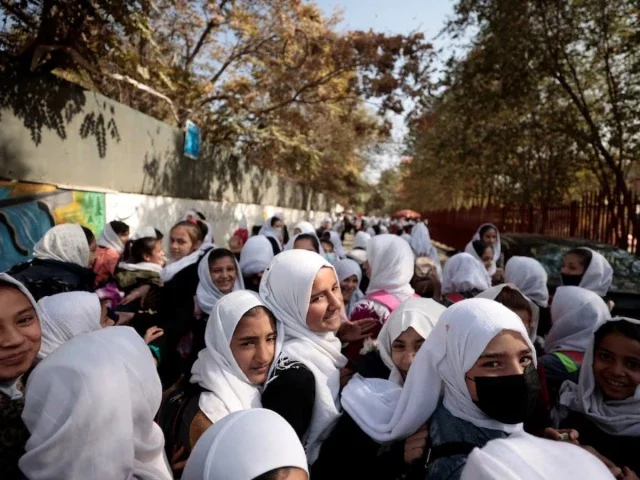
Taliban have barred 2.4 million Afghan girls from school since 2021, UNESCO says
Afghanistan the only country banning girls from secondary school and women from university
The Taliban have barred an estimated 2.4 million Afghan girls from secondary education since they regained power in Afghanistan in 2021, the United Nations Educational, Scientific and Cultural Organization said on Tuesday.
The Taliban are preparing to mark the fifth anniversary of their return to power this week, as some nations expand ties with the government despite deepening human rights concerns among watchdogs.
Afghanistan is the only country where girls and women are formally banned from secondary and higher education, UNESCO said in its statement. It "risks condemning Afghanistan to decades of lost potential, deepening poverty, and irreversible harm," the agency said.
UNESCO estimates the ban on female secondary and higher education could cause 600,000 Afghan women to leave the workforce by 2066, lead to $9.6 billion in cumulative income losses and increase the risk of early marriage.
The Taliban-run Ministry of Education did not immediately respond to a request for comment.
Schools closed to girls in 2022
When the Taliban returned to power in 2021 amid the withdrawal of the United States and its allies, they repeatedly assured the international community that women would remain free to go to school and to study.
Despite those promises, secondary schools were closed for girls in March 2022, followed by a ban on women studying in universities in December 2022. The Taliban described both bans as temporary, but they have remained in place.
Taliban restrictions also limit women's employment and their movement.
Also Read: Taliban mark five years in power as aid groups warn of crisis
The Taliban argue they respect women's rights in accordance with their interpretation of Islamic law and Afghan culture.
Restrictions on women pursuing higher education in Afghanistan are also expected to exacerbate a shortage of female teachers, with more than 2 million primary school children already out of school for reasons other than the bans on girls and women, UNESCO said.
UNESCO estimates Afghanistan will have a deficit of more than 11,000 qualified female teachers by 2030.
"Many teachers have left the country ... and those who were in the system are banned from continuing teaching," Hoda Jaberian, the UNESCO programme coordinator for education in emergencies, said in a briefing.
"This decision to ban women from teaching boys has not only, of course, removed a substantial number of qualified teachers and educators from the education system, but it also resulted in boys being taught by unqualified male teachers," Jaberian added. "We are left with unqualified male teachers or no teachers at all."
UNESCO said over 90% of 10-year-olds cannot read a simple text, with national literacy rates at 37%.
Many schools are overcrowded and poorly equipped. Nearly half of schools lack water, sanitation or heating, UNESCO said.
In 2025 alone, 3 million people returned to Afghanistan, either forcibly or voluntarily, placing further pressure on the schools. Since 2021, natural disasters including earthquakes and floods have forced the closure of 1,000 schools, UNESCO said.
UN flags deepening curbs on Afghan women
Meanwhile, according to data released by UN Women, half of Afghan women now leave their homes only once or twice a month as Taliban-imposed restrictions curtail their freedom of movement and participation in public life.
"Half a decade after the Taliban takeover in August 2021, Afghanistan has systematically dismantled the rights of half its population, making it a global outlier with no parallel in the modern world," UN Women said in a statement.
Saif-ul-Islam Khyber, spokesperson for the Ministry for the Propagation of Virtue and Prevention of Vice, which enforces many of the government's rules on women, told Reuters that reports of women not feeling safe to leave their homes were false and that women in the country have access to all their rights.
Also Read: Human Rights Watch urges Taliban to release detained UN, NGO staff
“This is the first time in approximately 50 years that all citizens of Afghanistan feel that they are living in safety and security,” he said, adding that the situation of women’s rights in the country was moving in a "positive direction."
UN Women said the Taliban authorities have issued more than 100 decrees targeting women and girls since taking power, institutionalising discrimination and deepening what it described as the world's most severe women's rights crisis.
The Taliban argue they respect women's rights in accordance with their interpretation of Islamic law and Afghan culture.
More than half of women surveyed by the UN agency reported leaving home twice a month or less, while nearly three-quarters said they felt unsafe going out without a male guardian, known as a mahram.
The restrictions have also fuelled a worsening mental health crisis, according to the UN agency. Seven in 10 women described their mental health as "bad" or "very bad", citing isolation, loss of opportunities and limited access to support networks.
The agency warned that recent decrees had further weakened women's legal protections. Measures introduced this year abolished legal equality between men and women before the law, strengthened men's authority within marriage and made it more difficult for women to seek divorce, it said.
Women also remain largely excluded from the economy. Only 7% of women are employed compared with 84% of men, according to the UN Women report.
The agency said its report was based on a door-to-door survey of 2,190 people in February to March 2025 and telephone surveys of 2,811 people conducted in April to May 2026.