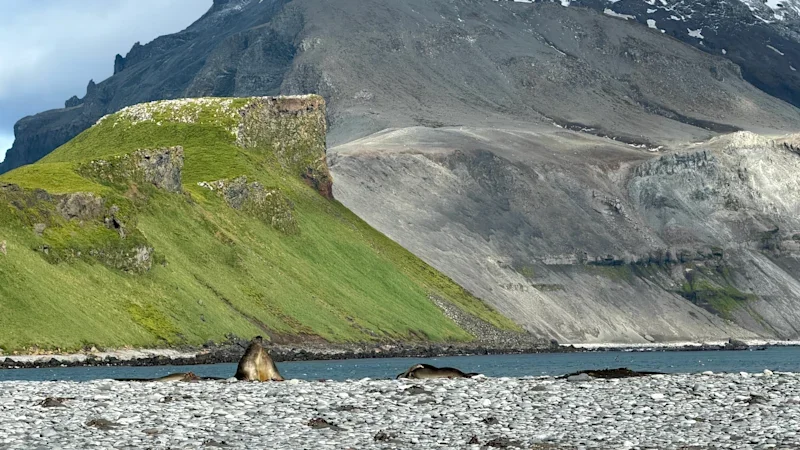
Grass is spreading across some regions of the Antarctic as ice retreats, threatening Southern Ocean islands with the prospect of wildfires in another sign of how human-caused climate change is warping the polar wilderness.
Australian scientists systematically reviewed a raft of existing datasets and papers, and found an overall increase in grass populations in the icy but fast-warming region. They presented the preliminary findings this week at the Scientific Committee on Antarctic Research (SCAR) conference in Oslo.
Professor Melodie McGeoch, an ecologist from Monash University who supervised the research, said the different strands of evidence come together to “raise the prospect of a dramatically and rapidly changing Antarctic region, and in particular this prospect of fire”.
A wildfire in January last year ripped across 55 per cent of Amsterdam Island, an island of the French Southern and Antarctic Lands, and in 2024 a fire also burnt on Bird Island in the sub-Antarctic.
“They’re cold, wet, boggy, icy, and the vegetation across many of these places is pretty sparse, and so the idea of fire in these areas is quite remarkable,” McGeoch said of the islands.
Grass is more flammable than other types of vegetation in the region, and both invasive bluegrass and native species seed and spread rapidly after a fire. “Grass-dominated systems are more likely to burn,” McGeoch said.
Native hairgrass grows naturally on the Antarctic continent, particularly on rocky parts of the western Antarctic Peninsula – the part that branches off the continent like a tentacle – and the nearby South Shetland Islands.
But the area is one of the fastest-warming regions in the southern hemisphere, and increasing temperatures have likely driven grass growth on the peninsula and nearby islands normally dominated by hardy mosses and lichen.
“Suddenly, we’re starting to see grasses do well, or better than they used to,” Monash PhD student and research leader Noemie Sheppard said, as ice retreats and exposes soil, grass can colonise.
While the overall trend implies a net increase in grass across the region, the story is complex and it varies between different locations, particularly between sub-Antarctic islands.
In some places grasses are decreasing, while different factors including the eradication of invasive rabbits from some islands have also influenced vegetation cover, Sheppard said.
“Every single island is undergoing its own mini-climate change. Some are drying, some are wetting, some are increasing in temperature, so all the grasses across these islands are undergoing different changes,” Sheppard said.
The researchers turned their attention to grass after noticing Azorella macquariensis, a species of cushion plant, was doing poorly on Macquarie Island while other grasses seemed to thrive.
Antarctic hairgrass is increasing at a faster rate than invasive bluegrass, according to the preliminary research which is yet to be peer-reviewed. However that could change as the climate grows warmer.
Climate change, driven primarily by the burning of fossil fuels, has warmed the Antarctic peninsula by 3 degrees and amplified rare atmospheric warming events such as one in 2024 that saw temperatures in east Antarctica shoot 28 degrees above average.
The idea of whether Antarctica is “greening” in response to warming, and to what degree, however, is hotly debated by scientists.
A 2024 Nature paper reported vegetation cover on the Antarctic Peninsula had grown from less than 1 square kilometre in 1986 to 12 square kilometres in 2021, and the “rate of greening” had accelerated by 30 per cent between 2016 and 2021.
Other scientists said the study over-egged the trend, and used satellite imagery critics deemed unreliable because of persistent cloud cover and poor resolution not suited to capturing Antarctic’s small and patchy vegetation, which may have led to an overestimation of greening.
Researchers argued in a new Nature comment paper published on Friday the reported greening rate was theoretically impossible and, while vegetation cover was expected to increase with warming, it was likely to do so at a more moderate rate.
McGeoch, a chief investigator with the Securing Antarctica’s Environmental Future research group, said more boots-on-the ground research across Antarctica was desperately needed in a crucial region that’s notoriously difficult to study.
“We’re at a point in time where there’s this awful acceleration of very rapid changes that are difficult to anticipate the ultimate consequences of,” she said.
“But at the same time, we’re at a point where all our technologies, our data capability, our high-performance computing, the advances in AI and so on are accelerating, which excitingly gives us the opportunity to answer some of these questions quite rapidly.”