If Gregor Samsa had been born in Pondicherry, he wouldn’t have awakened as a cockroach but as a chameleon. He would have been named accordingly, such as Jean-Grégoire Samoussapoullé, Grégoire Samikkannu, Grégorius Samassamy-Mudaliar, or, with a touch of aristocratic eccentricity, Grégoire-Marie Samassamy de Oulgaret.
Because of a colonial absurdity dating back to 1962, thousands of people find themselves in this Kafkaesque limbo, caught between two nations, two cultures, two identities, and two flags. They wake to the opening bars of La Marseillaise and go to sleep humming Jana Gana Mana. Their identity eludes both France and India, while the truly schizophrenic Franco-Pondicherrians sing neither anthem correctly. As the sun sets, they forsake both anthems for Marie, le pêcheur, an old Creole tune that drunkards sing off-key in the city’s countless bars. This timeless melody, appropriate for no nation, belongs to everyone and nowhere at once.
“My father moved with ease between the language of Molière and that of Thiruvalluvar, while my uncle knew only Tamil. The former was French, the latter Indian. This anomaly stemmed from an absurdity inherited from colonial power in 1962.”
I wrote that sentence long before I ever encountered Mounissamy, the subject of Pankaj Rishi Kumar’s documentary To Die a Frenchman.
When Le Thinnai was released, I was taken aback to find that scholars, filmmakers, documentarians, and artists were captivated by the same subjects: Pondicherry, its colonial legacy, and the gradual process of decolonization. I was introduced to Pankaj Rishi Kumar through his earlier film Two Flags, which explores the delicate balancing act of being both French and Indian. This ambivalence had already been woven into the opening lines of this piece. My father was fluent in switching between Molière and Thiruvalluvar, while my uncle spoke only Tamil.
A Colonial Anomaly
I am acquainted with many households in Pondicherry that grapple with this dichotomous existence. Within the same family, one world may be entirely Indian, while another is Franco-Indian. Under the same roof, with the same name and the same blood, one branch became French and another Indian. It would be wrong, however, to imagine that the Indian branch chose that identity out of some patriotic conviction.
More often, the opposite was true: many quietly regretted not having acquired French nationality, aware of all the doors it could have opened – pensions, mobility, schooling, and an entire economic infrastructure that remained closed to them. What prevented them from crossing over was not usually a matter of principle. It was a misunderstanding, a lack of knowledge about the process, and sometimes a stubbornness disguised as new patriotism for a nation still finding its way. By the time they understood what they had missed, the window had already closed.
The legacy of colonialism has perpetuated a form of violence that extends beyond economics and infiltrates the very fabric of the mind. This intangible wound has torn families apart, fostering animosity, envy, and deep fissures among those who should have stood united.
Frantz Fanon understood this painfully well: colonisation does not merely appropriate land and labour; it infiltrates and subjugates the mind, ingraining social hierarchies that persist long after the coloniser has left. The colonised continue to perpetuate these divisions, even after the flag has come down.
I have seen this play out in my own family, as Mounissamy portrays it on screen. I now realise I was not creating an oddity for my fictional tale. Instead, I was conveying the truth of my family, watching Mounissamy at a bureaucratic window, still clinging to the hope that the colonisers might finally keep their promise.
The premise, and the wound underneath it
After completing his first documentary, Pankaj recognised that deeper scars remained. Decolonisation had left these wounds unhealed, exposed, and throbbing, mirroring the brutality and injustice of a system that had ignored them. Mounissamy embodied one of these wounds, a man who spent much of his life searching for a cure. For six years, Pankaj followed him closely, sometimes from afar, through the surreal and suffocating bureaucratic maze that left Mounissamy powerless.
Consulate waiting rooms heavy with silence, letters that disappeared into the void, files that were lost or resurfaced at a bureaucrat’s whim, and forms demanding proof of existence that no record had truly captured – these were part of the maze that left Mounissamy powerless. The camera does not amplify the drama; rather, it gently follows Mounissamy’s dogged determination as he repeatedly confronts a system that failed to provide answers.
Pankaj directs with subtlety and dignity, avoiding sensationalism and enabling Mounissamy to lead his own battle. The camera remains objective, neither condemning nor praising; it simply stands by, mute and unwavering, bearing witness to the fight of a man who refused to give up. It follows him into the heart of his family, onto the street, into offices – everywhere Monsieur Mounissamy encounters rejection, discomfort, and bewilderment.
A Man Full of Contradictions
What makes this film so compelling and deeply moving is Mounissamy himself, a man full of contradictions. He rails against the colonial system that left him behind, yet he longs for Marianne, the very spirit of France, to embrace and comfort him. In the end, he hopes she will grant him the promised piece of land. Who promised him this, and when, remains unknown. Mounissamy’s delicate physique traverses the streets, attempting to rouse others to his cause and, defying all odds, assembles a small group of people also stuck in limbo.
There is a touch of Don Quixote in Mounissamy: he charges against overwhelming, indifferent foes, unwilling to concede that the world has already deemed his quest futile. Instead of encountering windmills like Quixote, Mounissamy confronts consulates and pension offices, those bureaucratic giants he challenges, folder in hand, because to stop would be to admit the promise was a mirage.
His Dulcinea is not a woman but a patch of earth and a slip of paper. It’s an idealized France so noble and so distant from reality that only a fierce, protective hope can keep it alive – not madness, but a stubborn loyalty to a dream the world has long since abandoned. The people he brings together are his Sancho Panzas, less sure of themselves than he is, following out of loyalty as much as conviction. They know the journey might end in the same folder, the same window, the same silence.
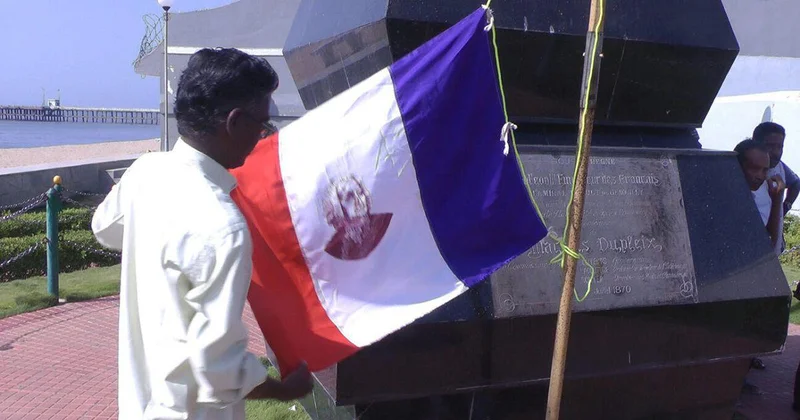
It bears considering the shape his quest took. Mounissamy and his companions founded an association – The Puducherry French India Senior Citizens’ Association – complete with a flag: blue, white, and red, the French tricolor, with Dupleix’s portrait at its heart.
The movie presents a scene so bizarre it borders on absurdity. Mounissamy and his companions set out on Goubert Avenue to adorn the statue of Dupleix with garlands, as if paying tribute to a monarch, a holy figure, or a founding father. Undoubtedly, the Quixotic nature of this character shines through.
Dupleix himself met an ignoble end, deserted by the very French Crown he served, his grand aspirations reduced to rubble and unacknowledged – a windmill mistaken for a colossus even in his own day. The most heartbreaking image in the film is Mounissamy, who should garland this statue, laying flowers at the feet of a coloniser whom France itself discarded. He becomes the film’s most quietly heartbreaking image.
Two men, separated by centuries, both cling to the hope that loyalty to an idea of France would one day be rewarded. I invoke Frantz Fanon and his idea of psychological violence to mean this: a man who still longs to be cherished by the system that shaped his suffering, garlanding its very statue.
As the movie progresses, a subtle doubt emerges: is Mounissamy truly sane? The determined, disillusioned fighter slowly reveals a more vulnerable, fragile self – a man willing to go to any length to pursue his dream.
The film captures this psychological state with striking clarity: even after the colonisers have left, the colonised continue to honour them. They are convinced that only the former oppressors can save them. Pankaj excels here: he plunges into the hidden, intimate layers of colonial violence, refusing to remain on the surface.
The Violence That Leaves No Mark
The crux of my writing is challenging the perception of France cultivated in India. I aim to dismantle the myth of the benevolent, gentle coloniser, believed to be above reproach because of a supposed lack of violence. This notion persists, preventing generations of Pondicherians from scrutinising French rule in India. They are conditioned to associate violence only with physical harm, oblivious to the fact that colonialism can cause just as much mental trauma.
Mounissamy’s own life shows little awareness of the history of French brutality in Pondicherry, the very foundation for questioning French colonisation. The factory where he spent most of his life, Savana Mill, bore witness to one of the most heinous crimes of French colonialism in India.
In 1935, its workers went on strike, demanding a ten-hour day, doubled wages, an end to child labor, and paid leave for women. They endured shifts of twelve to fourteen hours for a handful of annas.
The strike lasted 84 days before the mill conceded some of the demands, but not the right to organise. When workers struck again the following year to demand the same rights, the French colonial administration responded with police violence that left twelve mill workers dead – a massacre remembered locally as Pondicherry’s Shooting Day.
The workers eventually won the eight-hour day in 1937, the first in Asia, but at the cost of twelve lives. Mounissamy’s ability to work in the same mill for an entire career without acknowledging the history of French benevolence is not a personal shortcoming. Rather, it speaks to the power of colonial mythology, which had managed to erase even its most violent chapter from the memory of the very workers whose legacy it represented.
If he had known this history, would Mounissamy have felt the same bond with France? Would he have continued to request citizenship from a state that had killed and massacred his own brothers and sisters?
A Film of Questions, Not Answers
The film’s allure lies not in providing answers, clarifications, or remedies. Rather, its purpose is to foster contemplation by posing profound questions. Chief among them, as Mounissamy himself asks, is a deeply troubling enigma: why did a man born in 1946, who was 16 when the French departed and the bizarre “option” unfolded, wait until 2009 – nearly 50 years later – to begin his journey toward Frenchness?
No one can say unequivocally, not even his own family – who watched as he gradually descended into a bureaucratic abyss, slowly fading until only the hope of dying in France remained. Even his own family might not have known.
The film’s title, ‘To Die a Frenchman’, is steeped in irony. It seems to promise the ultimate realisation of a long-desired identity, a death that brings fulfillment. Yet what unfolds is the opposite: a man who dies while still becoming, still begging, still unknown to the country he considered his own, French only in his unwavering conviction. The title becomes not a summary of events but a testament to Mounissamy’s ultimate grasp.
Life had played him a cruel trick. Even death, which should have put an end to all disagreements, refused to grant him the ultimate kindness. The film’s title clings to his death rather than to his life, as if the only document it could provide were a frigid tombstone.
He spent his life trying to die French, but only managed to die Indian.
Ari Gautier is a French writer and poet of Indian and Malagasy origin, born in Madagascar and raised in Pondicherry. He is the author of Carnet secret de Lakshmi, Le Thinnai, Nocturne Pondichéry, and Songes des archipels silencieux, and the initiator of the kréyofuturisme literary movement.
We welcome your comments at letters@scroll.in.