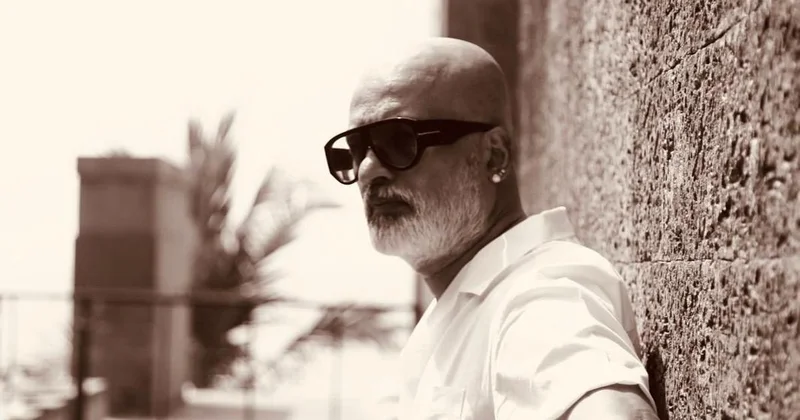
Strange shadows fall on poet-novelist Jeet Thayil’s face as his photos are clicked. Stranger images appear. In one, his face looks too dark, almost invisible. He likes it the best. After all, he has negotiated many shadowy labyrinths in his life, in his work. Thayil whispers that he always feels grateful whenever poetry comes to him – considering one never knows when a verse will arrive, or if it ever will.
The conversation was to start with his latest book, The Elsewhereans: A Documentary Novel, where family history, geography, memory, and imagination come together, resisting any categorisation – and beneath it all, a peculiar longing. However, it refused to be linear, just like his works. Excerpts from a conversation with many pauses, several beginnings, and no conclusion:
Considering The Elsewhereans is based on your parents’ lives and archival material, did writing it change your perception of your own family – especially after the writing process was over?
What changed things was the fact of my parents’ passing in the last year of writing the book. I saw my parents for who they were – small-town Indians finding a way in the world, fearless in many ways, making the most of their street smarts and native skills, trying to do the best by their children. The loss of one’s parents is a cataclysmic event that changes the weather in your head. You are never too old to feel like an orphan. The sense of losing those you had always counted on, of being newly alone, mortality looming in the near distance – it’s a bullet no one can dodge.
The perpetual sense of dislocation in the book jumps out of every page. Do you think “elsewhere” is almost a permanent state for writers today?
It might be a permanent state for most people these days. You don’t have to step out of your house to feel dislocated. For poets, this is a useful state – it keeps the work honest. For others, I don't know. It can be useful if you’re open to the experiences that come your way.
Cities, countries, coastlines – you have lived in them all. Has that perpetual movement enriched the imagination?
Probably, but imagination is its own country, its own sovereign state. It allows you to immerse yourself wherever you may find yourself. It’s as much a blessing as a curse. Rootlessness allows you to pick up and leave, but it also makes it difficult to commit to a place, a person, or an idea.
Narcopolis captured Bombay of a peculiar era. When you go to that city now, do you still see pieces of that world? How has your relationship with it changed?
I try not to go to that city if I can help it. Most often, I can’t. When I’m there, I try not to think about how the city used to be – there’s nothing more annoying than a nostalgist. But who can help being nostalgic about Bombay, about particular neighbourhoods that have vanished without a trace? I never miss it, except when I’m there.
There is a certain submarine gloom in your writing. Is that deliberate, or is it simply your natural landscape?
I’d say subterranean, but yes, submarine works just as well. Nothing on purpose about it. I mean, who would choose gloom as a model or mood? You’d have to be pretty gloomy to begin with. Melancholy is a privilege.
Has your relationship with poetry changed from your first book of verse to your most recent?
I hope so. I hope I’ve gotten better. I think I’ve learned to override the anxiety of influence. As you get older, your anxiety revolves around your own standards – or lack thereof.
You say you wait for poetry to “come” to you. Have you learned to be patient for those moments, or is there anxiety?
Having said that I wait for it to come, it’s also true that I create the circumstances ideal for its arrival – which is really a question of showing up to work, sitting alone, and listening to the silence.
As a person who lives within music, would you say that its structure – improvisation, repetition, silence – has influenced the way you build a poem or a novel?
Yes, it has, and it continues to do so, but only on good days. There are days when the music is inaudible, in which case it’s better not to attempt any kind of building. I like to stretch rhythm. I’m aware of anaphora, caesura, crescendo. I overwrite, but only on the first draft. For subsequent drafts, I let the editor into the room.
What is your writing routine like today? Are you more disciplined now, or do you still rely on bursts of inspiration?
More disciplined, I’m sorry to say.
And when you are writing fiction and poetry simultaneously, do they meet at some bend? Does a certain exchange happen?
Many times, ideas from a novel decide to leave an imprint on a poem under construction. No one else will ever notice this, but there are instances when I steal phrases, words, and ideas from the novel for a poem.
Many of the poems in I’ll Have It Here engage with the socio-political times we are living in. In this climate of self-censorship, how important is it for a poet to remain engaged?
I think poets are always in touch with the times, most especially when they claim not to be. It requires a certain kind of empathy, receptiveness, and vulnerability to allow a poem ingress. How do you let that happen without a sense of the socio-political climate? How can you have antennae without engagement? Don’t believe artists who say they are all about art for art’s sake – it’s a mask, as much a political standpoint as activism. Poets are activists, whatever their claim.
You say reality is often stranger than fiction. Does that make the novelist or poet’s task tougher?
It makes the novelist’s task pretty much insurmountable when imagination cannot match reality. Nothing Orwell imagined equals the reality of Trump. Which leads to the question: how does fiction stay relevant? I don’t know the answer to that. It’s one reason to keep writing.
Given the contemporary social and political climate, would you say writing has become more challenging altogether?
It has now become impossible to compete with reality. Who can make up the things Trump does in a single day? Tell me – can any novelist have that kind of demented imagination? There is so much competition now from daily life.
What about Indian writing in English – are there younger poets whose work excites you?
Always. If you look at The Penguin Book of Modern Indian Poets, published four years ago, you’ll see many younger poets who are producing fine work.
Do you feel more free now than in your thirties?
It’s liberating when you know that nothing likely to happen will change your life.
Sukant Deepak is a cultural writer, essayist and translator. After working with major news organisations, where he re-launched their features verticals and also reported from the Farmers’ Protest, CAA Protests and Kashmir, he now works with a Chandigarh based think-tank, Institute for Development and Communication (IDC). He co-founded the arts collective Elsewhere Foundation. Though he fantasises about writing a play, the fear that he would be “compared” to his father Swadesh Deepak holds him back.
We welcome your comments at letters@scroll.in.