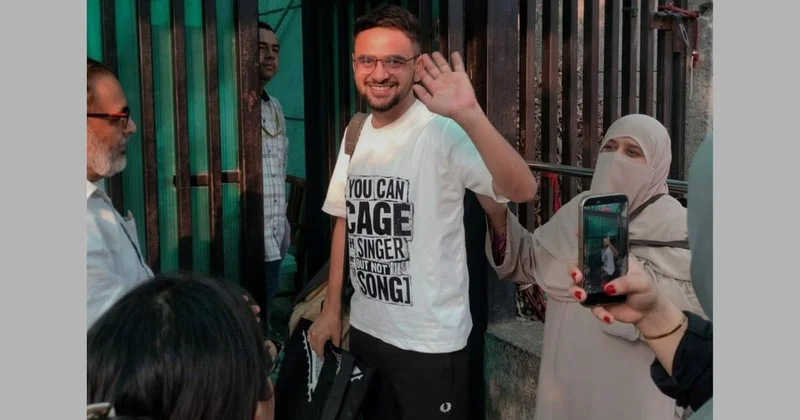
In recent weeks, the authorities in several Indian cities have taken action against protesters who have reportedly displayed support for jailed activist Umar Khalid.
On August 7, the police in Mumbai arrested Abhirup Paul, a former student of the Tata Institute of Social Sciences, for allegedly chanting slogans in support of Khalid at a campus event.
Two days later, in Delhi, Jawaharlal Nehru University officials withdrew permission for a discussion on Khalid’s book, Fractured Communities: Adivasi Histories and the Politics of Power.
Last month, while youth protesters were demanding the resignation of the education minister, a first information report was filed against a demonstrator in Bengaluru for carrying a poster that said “Umar Khalid zindabad”. Long live Umar Khalid.
Around the same time, Instagram complied with a demand made by the Modi government and restricted access to a profile named “Free Umar Khalid” in India.
Shortly after, two protesters in Goa were detained for expressing their support for Khalid at an event to celebrate the education minister’s resignation.
Legally, there is no basis for these actions, asserted Arvind Narrain, a Bengaluru-based lawyer, academic and president of the Karnataka unit of the People’s Union for Civil Liberties. “At worst, he [Khalid] is an accused,” he explained. “Article 19 of the Constitution includes the right to advocate for the release of those accused under any law, including the Unlawful Activities Prevention Act.”
Article 19 guarantees the right to freedom of speech and expression. Khalid is accused under the Unlawful Activities Prevention Act.
It is the Hindutva framing of Khalid as an “anti-national” that has rendered those supporting him vulnerable to such state action, Narrain added.
This framing dates back to February 2016, when Khalid and two other Jawaharlal Nehru University students were embroiled in a controversial sedition case. Since then, he has come under fire, quite literally, for his persistent opposition to Hindutva politics.
Khalid’s admirers say that despite these attacks, his popularity has only grown, making him a sore point for Hindu nationalists. The support for him, they argue, is driven by his refusal to be boxed into any single identity, be it Muslim or communist.
But the “anti-national” label is no longer effective in stigmatising the activist, given that he has spent nearly six years in prison without trial, Narrain said.
“Umar Khalid’s name was taken every day at the protest in Bengaluru,” Narrain pointed out. “It’s not like the FIR killed the discourse. People were still talking about him.”
In April, when the People’s Union for Civil Liberties organised a discussion in Bengaluru on a book about Khalid, the venue was “jam-packed”, Narrain said. It is precisely this burgeoning support for Khalid that had triggered the clampdown, contended the activist’s partner, Banojyotsna Lahiri, a researcher based in Delhi.
Soon after Khalid was arrested for his purported role in organising the 2020 Delhi riots, some of his friends had begun campaigning for his release on social media and offline. Though the campaign had few supporters in the beginning, the police did not try to stop them, Lahiri recalled.
“Why now, after all these years?” she asked. “It is because the support and acceptance for Umar is becoming mainstream. People are becoming fearless and speaking out. That is why the state is flexing its muscles.”
The recent youth protests showed that the ruling Bharatiya Janata Party views anybody opposed to the policies of the Modi government as “anti-national”, Lahiri said. She urged those who sympathise with Khalid to become more vocal instead of getting intimidated.
But this is easier said than done. At the Cockroach Janta Party’s protest in Delhi, for example, the prolonged incarceration of activists such as Khalid was a taboo topic. Throughout the 36-day sit-in, the movement’s spokespersons ducked questions about Khalid, arguing that this threatened unity on the demand for the education minister’s resignation.
It is not as if the tactic went unnoticed or unopposed. Nabiya Khan, one of Khalid’s friends, sharply criticised the Cockroach Janta Party for its position.
“With this logic, Umar is a distraction,” she wrote in The Quint. “And a movement against the corporatisation and degradation of higher education must not mention a political prisoner who emerged from a university campus and student movements.”
An activist from the All India Students’ Association, a left-wing student outfit that was closely involved in organising the protests, had discussed the issue with this reporter in Jantar Mantar.
“If Sonam Wangchuk can bring up Ladakh, why can’t we talk about Umar Khalid and Sharjeel Imam?” this person asked. The dispute was eventually settled with both sides agreeing to stick to education alone.
Clifton D’Rozario, a central committee member of the Communist Party of India (Marxist-Leninist) Liberation, said that Khalid is an “ideological threat” to Hindutva. He explained: “He does not respond only as a Muslim, but also raises the questions of caste and class. He is scary to them because he is an intellectual.”
D’Rozario summed it up elegantly. “Every authoritarian era produces its own defining political prisoner who faces persecution, but also embodies hope,” he said. “Umar Khalid epitomises that idea for this era.”
Here is a summary of last week’s top stories.
FCRA bill under review. The Lok Sabha on Wednesday referred the 2026 Foreign Contribution Regulation Amendment Bill to a joint parliamentary committee for detailed examination. Registration under the Foreign Contribution Regulation Act is mandatory for a non-profit organisation to receive foreign funds.
Among the key provisions under the amendment bill is one that allows the Union government to take control of an organisation’s foreign funds and assets if its FCRA registration lapses or is cancelled. The bill was introduced in Parliament in March during the Budget Session.
The proposed legislation was sent for wider consultation in the wake of protests by Opposition parties, who said that the bill grants “sweeping and disproportionate powers” to the executive without adequate constitutional safeguards.
Phase two of Census 2027. The Census 2027 will ask respondents if they belong to a Scheduled Caste or Scheduled Tribe, and will also include an open-ended question for other communities about the caste that they belong to. This will be the first time in independent India that caste will be enumerated across communities. Until now, Census exercises only recorded the population of Scheduled Castes and Scheduled Tribes.
Among the 40 questions notified on Friday are also those seeking information on the place where respondents received their Covid-19 vaccination, the total number of bank accounts they hold and digital literacy. The form also seeks information on Aadhaar numbers, mobile numbers, passport numbers and voter IDs.
Row over invite to CJI. After students of the National Academy of Legal Studies and Research opposed Chief Justice Surya Kant’s participation as a chief guest at their convocation, the Bar Council of India on Thursday issued an order directing state bar councils to defer the enrolment of any student from the university graduating in 2026. Hours later, it withdrew the order following a backlash.
Last month, a group of students had urged the university authorities to reconsider Kant’s invitation after his response to a petition alleging police excesses against protesters in Delhi on July 20. On Friday, Kant criticised the council’s decision as “uncalled for”. “It’s a dialogue between students and me. Who are they to raise an issue?” he said.
Also on Scroll last week
Scrolllast week
- Why disability support still evades those with blood disorders
- NHPC knew of risks at Sikkim tunnel before deadly July blast, documents show
- ‘She had stepped out to buy food’: Another Bengali woman forcibly pushed to Bangladesh from Mumbai
- True Story: Food companies are lying to you. The regulator failed to stop them
- What happened to Modi’s $5 trillion economy promise?
- Does ‘Vande Mataram’ need the threat of criminal law to be honoured?
- Kanwar Yatra’s deafening noise goes unheard by the state
- Should India apologise for caste injustice, like Nepal did?
- In Pakistan, Prisoner No 804 seems to be everywhere
- How Moscow tried to make Soviet cinema popular in Cold War India
Follow the Scroll channel on WhatsApp for a curated selection of the news that matters throughout the day, and a round-up of major developments in India and around the world every evening. What you won’t get: spam.
We welcome your comments at letters@scroll.in.