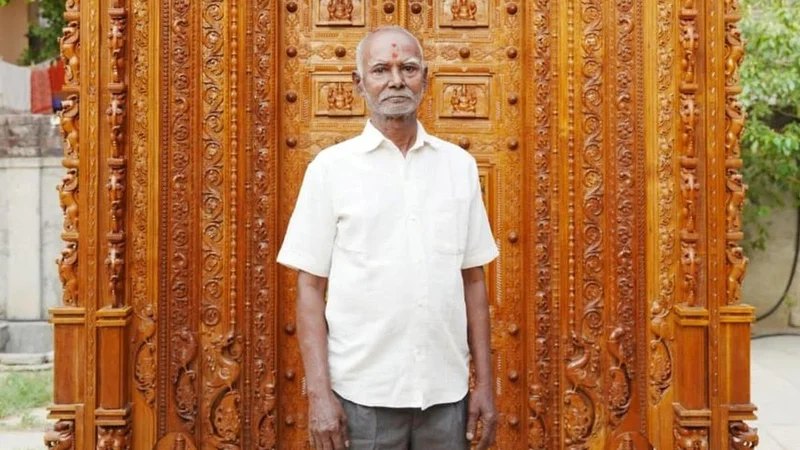
Veteran sculptor and master craftsman Chandrashekhar Y. Shilpi died at a private hospital in Kalaburagi in the early hours of Saturday (August 15, 2026). He had been admitted to the hospital on Thursday (August 13) after developing pneumonia and suffered a severe heart attack while undergoing treatment. His last rites were performed at the Rudrabhoomi crematorium in Raghavendra Colony in Kalaburagi on Saturday (August 15) evening.
Also read | Chandrashekhar Shilpi wins National Handicraft Award
He is survived by his wife, a son and a daughter, apart from a large number of students and admirers. His daughter, Gayatri Shilpi, is also a sculptor who has earned recognition in the field of traditional sculpture and woodcraft.
Chandrashekhar Shilpi was known for preserving Kalyana Karnataka’s sculptural heritage through his intricate traditional wood and stone carvings. He received the prestigious National Award for Master Craftspersons for 2024 from the Handicrafts Department under the Union Ministry of Textiles. President Droupadi Murmu presented the award to him at a ceremony in New Delhi on December 9, 2025.
Born into a poor traditional blacksmith family at Kakkera village in Surpur taluk of Yadgir district, Shilpi overcame economic hardship through dedication and a lifelong commitment to art. He underwent 18 years of rigorous training in traditional wood sculpture through the Gurukul system at Gonal village under renowned master craftsman Nadoja Naganna Monappa Badiger. Though formally trained in woodcraft, he later acquired expertise in stone sculpture and Panchaloha art through self-learning and continuous experimentation. He later relocated to Kalaburagi, where he lived and worked for more than four decades.
Deeply inspired by the sculptural traditions of the Chalukya, Hoysala, Chola, Rashtrakuta and Pallava periods, Shilpi developed a distinctive style rooted in the principles of Shilpa Shastra and Vastu Shastra. His works included intricately carved temple doors, pillars, mantapas, traditional wooden halls, ornamental frames and idols of various Hindu deities.
He travelled extensively to historic temple centres such as Belur, Halebidu, Kalagi and Shirwal to study classical temple art. His works reached different parts of Karnataka, Tamil Nadu, Andhra Pradesh and Maharashtra, besides countries such as Dubai and Scotland.
Shilpi served as a member of the Karnataka Shilpakala Academy from 1998 to 2001 and was also a member of the selection committee for the Amarashilpi Jakanachari Award. He trained several young artists and disciples, including his daughter Gayathri Shilpi, who also earned recognition in traditional sculpture and woodcraft.
He was conferred the Karnataka Shilpakala Academy’s honorary award in 2012 and the Karnataka Rajyotsava Award in 2014, besides receiving several other honours from cultural organisations and institutions.
Even in his later years, Shilpi continued to work from his residence and workshop in Kalaburagi, dedicating himself to the preservation and promotion of India’s traditional sculptural heritage.
Published - August 16, 2026 10:33 am IST