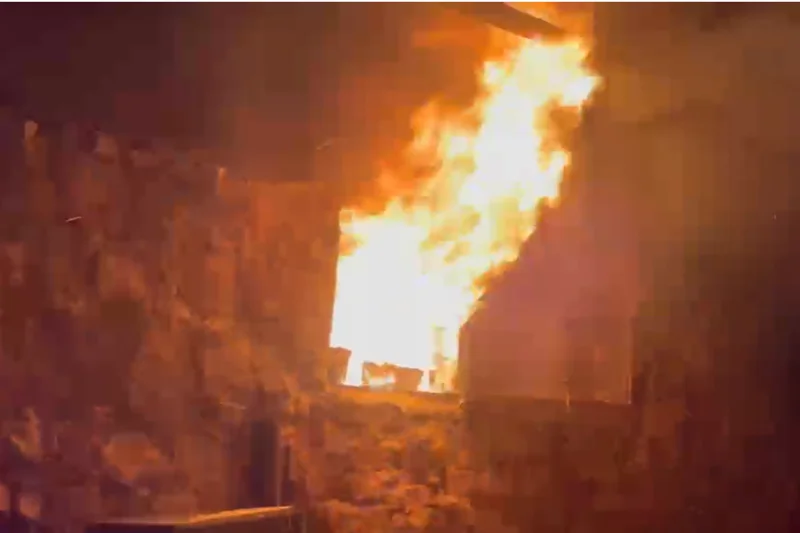
Running through his West Bank village as it burnt, Hamza Abu Jundeya watched as vicious flames burst out of the windows of his cousin’s home.
The small village of Al-Tuba, in the southern Masafer Yatta region, was in the midst of a violent rampage by Israeli settlers, who set fire to homes and targeted its residents in an unprovoked attack on the night of Wednesday 5 August.
“You cannot imagine the sheer terror, the dread,” says Jundeya, a resident of the town, whose cousin Radwan and his family were inside their home when it was set alight, including 8-year-old Razan who was hospitalised with a nose injury. “It was a harrowing night.”
Witnesses say around 40 masked and armed settlers were part of the attack, hurling stones, smashing windows, and setting fire to homes while children were still inside. Two young children and a pregnant woman were hospitalised, including 8-year-old girl Razan, Radwan’s daughter, who was struck in the nose by a stone, and Joud Mahmoud Awad, 10, who witnesses say was choked and kicked.
Mohammad Hesham, a local resident and activist who arrived when the town was already burning, describes witnessing a “nightmare” unfold in front of him. “We saw little children screaming, young guys also screaming. It was like a nightmare.
“You cannot imagine seeing your own house is getting burned, and to think your family are getting burned inside the inside.”
The Israeli military says a police investigation has been opened after police “entered the area under IDF protection to collect testimonies, findings, and evidence for the investigation” - but it did not confirm whether any arrests had been made.
The last few weeks in Masafer Yatta, says Hesham, whose own home was set on fire in a separate 19 July incident, is the “worst time I ever remember”.
Settler violence has dramatically increased in 2026. Serious incidents of ‘nationalistic crime’ have surged by 63 per cent during the first half of 2026 with 660 attacks recorded by Israeli authorities, Israeli public broadcaster Kan reported on Monday. This does not include many daily acts of aggression that go unreported, some even supported by Israeli troops, locals and human rights organisations say.
During Thursday’s attack, Jundeya’s cousin, 36-year-old Radwan, was in the family home with his 37-year-old pregnant wife, Rana, and daughter Razan, when settlers charged into the home and began setting it alight.
“To feel safe in your own home one moment, and the next to see gasoline being poured over your house and children, with no provocation, it was an indescribable horror,” says Jundeya.
Rana was beaten, suffering a severe head wound and two arm fractures, he said. Razan suffered a nasal fracture after being struck in the face by a stone.
Settlers had set fire to the area of the house where the pair were located, with Jundeya fearing they were trapped inside the burning building before discovering they had escaped.
Their young neighbour, 10-year-old Joud Mahmoud Awad, was choked, kicked and dragged out of his burning home by several settlers, witnesses say. His sister had been asleep in the house, and hid in a bathroom as smoke filled her home, until the attackers left the area.
Solar panels were destroyed, while hay bales and livestock feed were lit up in flames, dramatic footage showing the block of food burning in the dark.
The surge in West Bank attacks has prompted an outpouring of international and domestic condemnation, including from the White House. But West Bank Palestinians remain unprotected from intensifying assaults, which settlers appear to be carrying out with impunity.
Benjamin Netanyahu’s office told Channel 13 last month that settler violence is a “grave phenomenon caused by a small handful who do huge damage to the State of Israel in the world”.
And yet critics say Israeli authorities are enabling, ignoring, or supporting the attacks, and that verbal condemnation from Israel’s leadership is futile given that no serious action is taken.
On Monday, a group of UN experts, including special rapporteur for the occupied territories Francesca Albanese, said settler attacks are “not spontaneous”, adding that they occur “with the protection, and often the participation, of the Israeli occupation forces... sustained and encouraged by members of the Israeli cabinet”.
A damning June report by Amnesty International said the Israeli government is carrying out a state-led campaign of ethnic cleansing in the West Bank, and condemned the “increasing state-backed settler violence aimed at displacing its Palestinian residents”.
Witnesses to the al-Tuba attack say they were even threatened by arrest by Israeli soldiers, with footage showing the troops shouting at locals to "go behind the car".
The military, which denies that it supports settler violence and says its tightening control is necessary to guarantee security for the settlements, did not respond when asked why it had threatened Palestinian residents with arrest after the attack.
It said that its soldiers “searched the area and identified burnt structures, graffiti, and damaged property” but that the “suspects had fled before the troops arrived”.
It added: “In cases of legal violations by Israelis, the primary authority responsible for handling such allegations is the Israel Police. The IDF’s mission is to safeguard the security of all residents of Judea and Samaria [the West Bank], and to act to thwart terrorism and enforce law and order in the area.” The Israel Police have been contacted for comment.
In a separate incident last weekend, Israeli settlers besieged two Palestinians families in the central village of Qusra, cutting them off from water, power and food. The military says it is still in control of the situation, but one of the residents told The Times of Israel that they have still not left their home.
The attackers were condemned as “Israeli terrorists” in an unusually strong rebuke by US ambassador to Israel Mike Huckabee on Thursday. Although the US has called on Netanyahu to publicly condemn the siege, the Trump administration was accused by Democrat lawmakers earlier this month of not doing enough to pressure Israeli into combatting settler violence and contributing to a “climate of impunity”.
For Hesham, widespread diplomatic condemnation has no material impact on his life.
Just weeks before the al-Tuba attacks, Hesham believed his family were going to die when settlers set fire to his home in at-Tuwani.
“I was watching my family are getting burned inside the house. Then I thought I'm going to lose my family. But I saw the same scenes yesterday, so I can feel what they were feeling,” he says.
Hesham says the the attacks follow a similar formula. “The settlers are about 20 minutes inside the village, still burning, still destroying, killing, doing whatever they want to do. And then they go back with full impunity to their outposts,” he says.
“The soldiers knew that the terrorists went to the illegal outpost, and they knew where they are right now. But instead of going to arrest them, they came to us and threatening us of arrest.” The Israeli military did not respond when asked by The Independent why Palestinians in al-Tuba had allegedly been threatened with arrest.
“This is show you that it's a coordinated campaign between all parts of this occupation, settlers, soldiers and police, to focus on one goal, which is to displace and force Palestinians from their homes and to rule the life of the Palestinians,” he adds.