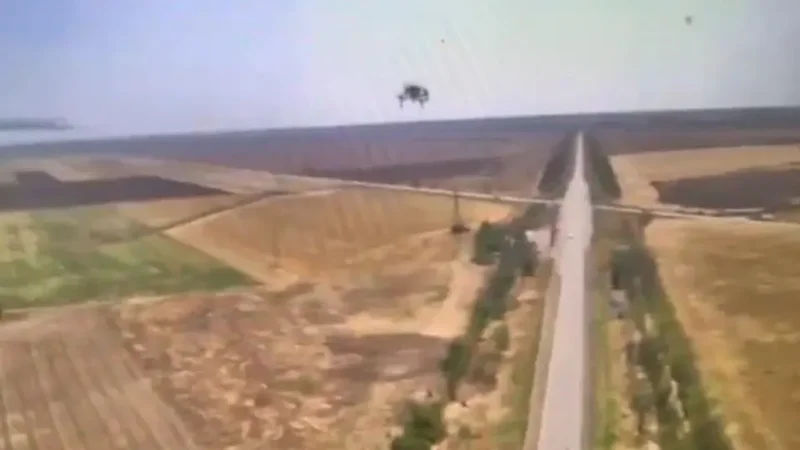
Ukrainian forces have reportedly started using balloons to deliver FPV drones equipped with Starlink Mini terminals deep into Russian-occupied territory in southern Ukraine. This emerging tactic was reported by Архангел Спецназа (Arkhangel Spetsnaza), a Russian military blogger, on his Telegram channel. In an August 12 post, he stated that balloon-delivered Ukrainian FPV drones were being used to attack Russian logistics vehicles traveling along a highway leading toward Melitopol in Zaporizhzhia Oblast. The tactic caught Russian forces off guard because FPV drones have generally been concentrated closer to the front, where they are employed in large numbers. By extending the reach of these inexpensive strike systems, this approach could provide Ukraine with another means of expanding its intermediate-range strike campaign against Russian logistics networks.
Implications Of Extended-Range FPV Drones
If this tactic proves effective, Ukraine will expand its use against intermediate-range targets in the Russian rear. In southern Ukraine, it could augment the current strike campaign by further disrupting Russian resupply moving through logistics hubs such as Melitopol and Mariupol. Ukraine could also expand the tactic to other areas of the front to target logistics routes, staging areas, and command centers. However, the approach is less practical for long-range strikes because uncertainty in wind speed and direction increases over distance, making it more difficult to predict where and when a balloon will reach its intended operating area.
Russia could also adopt a similar approach, although it lacks access to Starlink and would need an alternative means of maintaining communications with the FPV drone. Russian forces already employ FPV drones on a large scale and have repeatedly adapted Ukrainian drone concepts for their own use. Additionally, they have used larger drones to carry FPVs deeper into Ukrainian territory while serving as communications relays for the smaller drones. Russia has separately experimented with balloons as platforms for temporary communications networks. Combining these concepts could allow Russian forces to develop a similar balloon-delivered FPV capability using an alternative communications system.
At the same time, Russian forces will likely develop countermeasures if balloon-delivered FPVs become a persistent threat. These could include improved balloon detection, changes to logistics routes and movement patterns, or new methods for disrupting Starlink-connected drones. Ukraine would then modify the system in response, continuing the cycle of technological adaptation that has characterized the war.
More broadly, the tactic reflects an underlying theme of the Russia-Ukraine War in which new capabilities do not always require entirely new technologies. Balloons are among the oldest forms of military aviation, while satellite communications and FPV drones are products of the modern battlefield. Combining these technologies allows Ukraine to overcome limitations that each system would face on its own. As the war evolves, Russia and Ukraine will both continue combining old and new technologies to overcome the challenges of an increasingly dynamic battlefield.