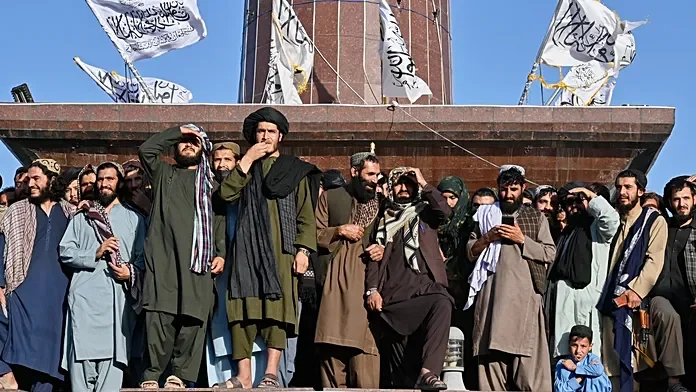
Hundreds of supporters gathered outside the former US embassy, with flowers thrown down from military helicopters. Critics of the Taliban, however, fear worsening human rights abuses.
On the fifth anniversary since regaining power in Afghanistan after US troops withdrew from the country, the Taliban celebrated what they call 'restored stability and an end to decades of conflict'.
Thousands of Afghans gathered on the streets of Kabul on Saturday in celebration, with cars draped in flags. Outside the former US embassy, a parade of athletes took place, featuring only men due to women being banned from participating in sport.
Celebrations were also held in other Afghan provinces, with Taliban flags and posters showing slogans that praise the Taliban’s return to power.
Five years on, some countries hold unofficial relations with the Taliban administration, though only Russia has formally recognised it as Afghanistan's legitimate government.
On Saturday's anniversary, Zia Ahmad Takal, a Taliban foreign ministry spokesman, invited more countries to "invest, and make extensive use of the available economic opportunities" in Afghanistan.
A worsening humanitarian crisis
In a video message posted to social media, the United Nations's special rapporteur on the human rights situation in Afghanistan, Richard Bennett, said the country was undergoing a deep human rights crisis.
UNESCO, the UN’s education and culture agency, estimates that some 2.4 million girls have been excluded from secondary education. The UN World Food Program said child malnutrition has reached critical levels in a third of Afghanistan’s provinces and is expected to worsen due to funding shortfalls.
Almost immediately after taking power in 2021, the Taliban defied promises to allow women to access education and employment, imposing a ban on girls’ education beyond the sixth grade and later banning higher education for women altogether
Now, women are severely restricted from public spaces, and are banned from areas including like parks and gyms. They are outright banned from taking part in sports and travelling to other locations without a male present.
The Taliban’s treatment of women and girls remains one of the main barriers to wider international recognition of its government.
The withdrawal of US troops
The Taliban took power in 2021, after US and allies withdrew following a war lasting two decades and costing an estimated $1 trillion, according to then-US President Joe Biden that year.
The withdrawal led to chaotic scenes at Kabul airport as crowds of people tried to flee the country in desperation.
In a statement over the weekend, the French Foreign Ministry reaffirmed its solidarity with Afghan citizens, insisting there would be no normalisation of the Taliban rule as long as they do not respect their international obligations for the upholding of human rights, the fight against terrorism and inclusive governance.
In a statement of its own earlier in the week, the European Union reiterated its position that it "does not recognise or legitimise the Taliban-run de facto authorities but it maintains operational contact with them on its core values and interests, including women’s and girls’ rights."
Nevertheless, EU officials and Taliban representatives met in Brussels in June to discuss speeding up the deportation of Afghan migrants to the country, in a move that was criticised as "normalisation" of ties with the regime.