Hurricane Lala lashes Hawaii's Big Island with heavy rain, strong winds
Storm skirts Big Island without making landfall , rainfall could produce flooding, mudslides
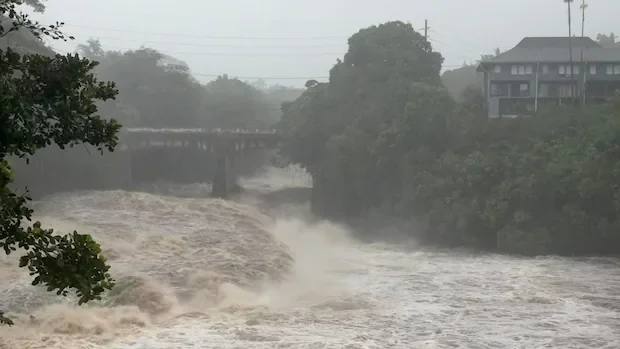
Hurricane Lala skirted Hawaii's Big Island on Saturday without making landfall and is expected to gradually weaken after lashing the region with strong winds and drenching rain that flooded roads and turned rivers into raging torrents.
The possibility the island could witness its first direct hit from a hurricane in 155 years faded as the eye of the storm passed the island's southern tip. Landfall is not expected at this point, said National Weather Service meteorologist Joseph Clark.
However, hurricane-force winds were expected to continue into the overnight hours, with the strongest wind gusts likely in areas of higher terrain, the National Hurricane Center said. Heavy rainfall into Sunday could produce flooding and mudslides, while powerful waves pound the coast.
Tropical storm warnings remain in effect for Maui, Molokai, Lanai, Kahoolawe, Oahu, Kauai and Niihau as the storm moves west. The Big Island is the state's largest, with a population of about 210,000.
Whitecap surf slammed ashore nonstop, howling winds whipped the tops of palm trees and waterways swelled with fast-moving run-off from relentless rain that blew nearly sideways.
Gov. Josh Green said at least one person died in a car accident in the South Point area of the Big Island, while 19 roofs were lost and 190 flights were postponed.
"You definitely want to be home, do not be out on the roads."
Forecasters said higher elevations on the island, dominated by the towering Mauna Kea volcano, could get as much as 63.5 centimetres of rain. That could cause life-threatening mudslides in a mountainous area where people live off the grid in improvised housing.
Earlier, the governor called it an "enormous storm," capable of destructive flooding and even the possibility of wildfires kicked up by strong winds across the island chain.
Tens of thousands of homes were without power.
'Hunker down, cross my fingers'
Bobby Camara, a 75-year-old lifelong resident, said he planned to "hunker down, cross my fingers, hope the lights don't go out" at a care home just outside Hilo. He said gas stations were busy as people sought fuel for chain saws and vehicles.
"I think stocking up is part of life over here. ... You learn to be self-reliant."
Mike Caputo, who lives in Keaau, near the Big Island's east coast, said his power generator was ready and a 37.8-kilolitre home water tank was full.
He said the main concern was flash flooding and fallen trees, especially albizia, a common tree.
"They're not very sturdy, but they grow extremely large," said Caputo, 50, a local fire captain. "They can make roads impassable."
Warnings posted everywhere
Lala intensified from a tropical storm into a hurricane early Saturday as its maximum sustained winds increased to 120 km/h, the hurricane centre reported, making it a Category 1 hurricane. The Big Island is Hawaii's largest and has a population of about 210,000.
A hurricane last made landfall on the islands in 1992, when Iniki — a Category 4 storm — lashed Kauai.
"It did $3 billion worth of damage. It destroyed thousands of homes, and it did kill six people," said Green. "We just can never know if a storm is going to turn."
The Big Island was last hit directly in 1871, when a Category 3 hurricane hit the northeast corner, according to research by a University of Hawaii atmospheric scientist.
On Saturday, shelters were opened, events were cancelled and ranchers were urged to leave their cattle in pastures, rather than structures that might collapse.
Christine Matsuda, who lives in Waimea on the northern side of the island, said "big gusts every few minutes rattle the whole house."
"We're finding unexpected leaks in places that don't see water under normal conditions."
The hurricane centre predicted 20.3 to 30.5 centimetres of total rainfall across Maui and the lower elevations of the Big Island, and 10.2 to 15.2 centimetres across the island chain.
Many Hawaii residents are still dealing with the aftermath of devastating floods in March.