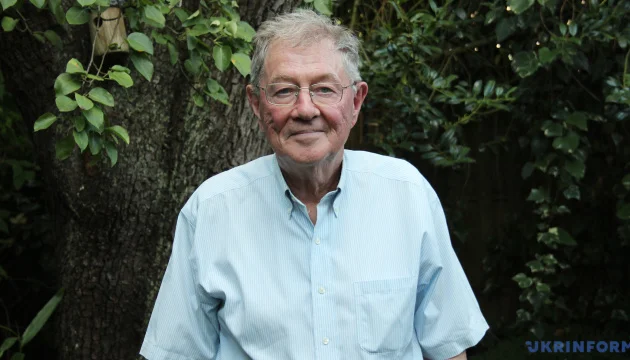
He expressed this view in an interview with Ukrinform.
Recalling his appointment in 1992 as the first ambassador of the Netherlands to Ukraine, Serry said: "Already then I started to realize that I had been appointed to a country that would change Europe. I do not mean that in the tragic sense in which events are unfolding today, but I immediately felt that Ukraine would be of great importance for European security and that an independent Ukraine would be the best counterweight to Russian imperialism."
According to him, Ukraine's turbulent and tragic history created the conditions for the country to assert itself as an independent European state in 1991.
"I began to feel the importance of what had happened while traveling through newly independent Ukraine. I saw that it was not only in the West, where the Ukrainian national movement had traditionally been stronger, that a distinct identity existed; there was also something that united the entire country across all its regions. I must also confess that I fell a little in love with Ukraine. It is a beautiful country with enormous potential," the diplomat said.
Read also:First Dutch ambassador to Ukraine: Kyiv has trump cards no one saw coming a year ago
At the same time, he admitted that he did not expect relations between Russia and Ukraine to turn into such a horrific war.
"On the contrary, those were more optimistic times, when it seemed possible to find some accommodation between Russia and Ukraine. Those were the Yeltsin years, which made it possible to address many of the problems between the Russian Federation and newly independent Ukraine. Think of the Black Sea Fleet, Crimea, and other issues that were then being dealt with through negotiations," Serry said.
According to him, the issue of the nuclear weapons left on Ukrainian territory after the collapse of the Soviet Union was a major concern for Western partners, particularly the United States, "and eventually agreements were reached on how to resolve it."
Asked whether that decision had been the right one, the diplomat said that Ukraine's options at the time had been very limited.
"First, Ukraine did not in practice control those nuclear forces, because command remained in Moscow rather than in Kyiv. Second, Ukraine’s cooperation with the West, the IMF, and the World Bank also depended on the decision to give up those weapons. All of this took place under very difficult circumstances. And here the United States played a much more important role than the European countries," Serry said.
In his opinion, the main difference between Ukraine and Russia is that after gaining independence, Ukrainians wanted to preserve it at all costs.
"In Russia, unfortunately, something very different happened: disappointment with change, because the Yeltsin period also represented the failure of Russia's economic and democratic transformation. Then Putin came with a completely different vision. And, by the way, Putin is not the only person in Russia who believes that Ukrainians are so-called 'malorosy'," Serry said.