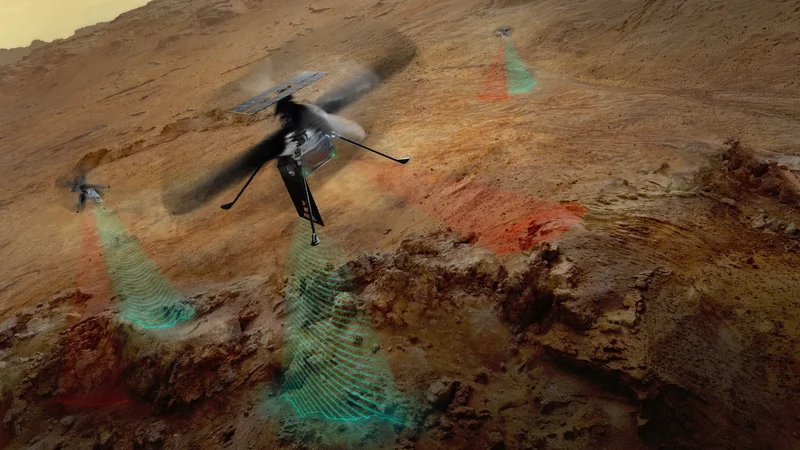
If you just can’t wait for NASA’s new Mars helicopters to get to work, you can now see what they would look like in action. This week, the agency released an artist’s concept of the SkyFall aircrafts flying over the red planet.
SkyFall is set to launch aboard NASA’s Space Reactor-1 Freedom in late 2028. NASA will use what it describes as a “daring mid-air deployment” to deliver three helicopters equipped with advanced instruments for subsurface and infrared surface mapping, visible light imagery, temperature monitoring, and much more.
The new image shows the three helicopters scanning the Martian surface. According to a statement from NASA, the green frequency waves emanating from the antennae depict the collection of subsurface radar data while the red beams depict the collection of near-infrared imagery data from crushed rock and dirt and other surfaces.
The antennas you see in the image needed a lot of work to become a reality. The helicopters will be fitted with a unique flexible antenna covered in polyester and Vectran, a high-performance manufactured fiber used to make landing airbags for Mars rovers. The design, which recently cleared a round of testing at the Jet Propulsion Laboratory, is made to allow the helicopters to fly close enough to the ground without interfering with landing or breaking on impact.
“The only way to detect shallow subsurface ice remotely is to fly close to the ground,” explained Adrian Tang, SkyFall’s ground-penetrating radar lead instrument scientist. “By flying low and slow, a SkyFall helicopter could capture radar images that resolve the fine layering where dry soil gives way to ice, detecting its presence and mapping its extent.”
While NASA’s first autonomous Mars helicopter Ingenuity needed to use the Perseverance rover as a relay station, SkyFall can independently transmit information to spacecraft orbiting Mars.
Now, we just need to wait to see what’s under the Martian surface.