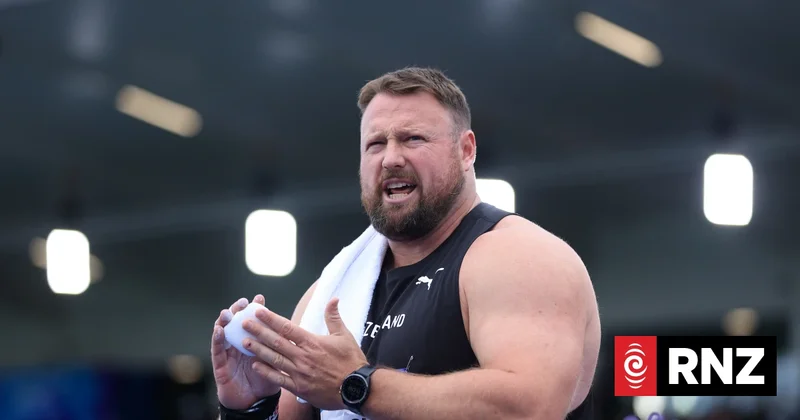
In the unforgiving world of elite sport, athletes are always looking for an edge even when they have got their eyes closed, with sports men and women increasingly conscious that what happens when they are unconscious can have a big impact on their performance.
Tom Walsh has been among the very best shotputters on the planet for more than a decade and knows the value of rest.
"Without sleep, you're not recovering, and so it's pretty important to get right." he said.
Walsh likes to get between eight and half to nine and a half hours sleep a night while in heavy training, and said he gets a better sleep when he is in bed early.
"If I'm going to bed at midnight and waking up at 9 or whatever it is, that's very different sleep than if I go to bed at 9 and wake up at 6".
That observation is borne out in science, according Geoff Passfield, a lecturer at Auckland University of technology's School of Sport, Exercise and Health.
He said the early night was where you gain most of your deep sleep, which was the phasing of sleep that was synonymous with physical recovery.
Black Fern Maia Joseph also likes to turn in early, although that is partly influenced by her studies. The 24-year-old is in her fourth year of a medical degree at Otago University.
Like many of her teammates, Joseph uses a whoop, a device that monitors the duration, stages, and quality of the wearer's sleep.
Joseph said her entire Super Rugby Aupiki team - the Matatu - were given Whoops as part of a study.
"With that came a lot of, I guess, education around sleep that's particularly to do with hormones and like menstrual cycles."
Overseas travel is common for elite athletes, and can play havoc with sleep schedules. Walsh said he used melatonin to adjust to different times zones and also avoided having his phone in bed.
Sprinter Tiaan Whelpton employs blue light filters on his devices once it gets dark, but searches out the sun upon waking.
"The first thing I like to do in the morning when I get up out of bed is go and open my curtains and just look at the sky for a little bit".
Another trick Whelpton uses when travelling is to start acclimatising prior to leaving the country.
"Let's say I'm heading over to Europe, I'll go to bed one hour later every night for maybe three to four nights, just to kind of kick start that."
Male shotputters are known for their imposing physiques, but that can lead to difficulties at competitions like the Olympics, where single beds are the norm.
"It doesn't probably necessarily stop me from getting to sleep, but I do sometimes wake up with a sore arm or something like that because it's hanging off the side of the bed," Walsh said.
While not quite as broad as Walsh, Whelpton is 193cm tall, so getting a good sleep often has to be a case of mind over mattress.
"Quite often you're having to sleep on an airplane or sleep on a tiny little bed or in a bunk bed or whatever it may be, if you're at a random small meet in Europe. So I've adapted to be less picky and less fussy with where and what I'm sleeping on. I find that since I've started to care a little bit less about that stuff, I'm actually sleeping better because I'm just not worrying about it," said Whelpton.
But even having a fretful night before a big competition does not mean an athlete, amateur or elite can not perform well, said Passfield.
"The sleep you get the night before isn't the be-all and end-all of your sleep and your performance. What actually matters more is the sleep you get two nights before.
"Because most people, the night before their first 5K or before maybe an Olympic debut, you're going to have that thought in your brain and getting it out of your head is going to be challenging.
"So if you get that poor night's sleep the night before, it's not the end of the world if your sleep is consistent."