The Municipal Administration and Urban Development (MA&UD) Department of Andhra Pradesh is caught in the time warp of archaic administrative measures. But now it seems the light has dawned as it tries to catch up with the times.
A top official of the department, at the recent Green Andhra Summit organised by the Indian Green Building Council, noted in disbelief that one of the most laughable things about urban local bodies was its imposition of a ‘tree guard fee’. The audience went into a fit of giggles as the official continued to say that about 45 different types of charges are being collected by the MA&UD Department. He stated that he has since sought to make systemic changes with a new sense of urgency in order to achieve sustainable development.
An overhaul
The government is streamlining a whole lot of procedures and doing away with redundant ones in keeping with the Swarna Andhra 2047 Vision.
A significant step towards transforming cities and towns into cleaner urban agglomerations is a mandate to apartment complexes, if the waste generated per day exceeds 100 kilos, to set up their own in-situ solid waste management units. This has not yet been made formally mandatory, but it is a welcome move as the government intends to rid cities and towns of waste.
To complement this move, the department contemplated giving incentives for using treated wastewater, like it is done in some advanced countries across industrial, commercial, and drinking purposes. The Reuse of Treated Used Water Policy, 2026 has been approved by the government to boost long-term water security, reduce freshwater dependence, and promote a circular water economy.
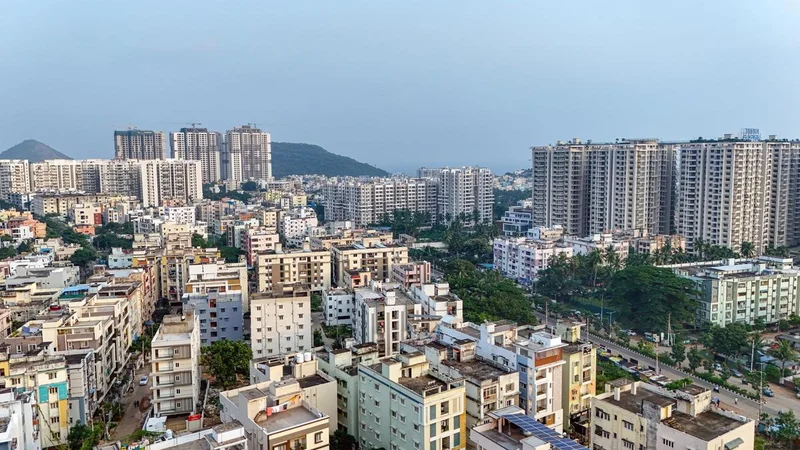
Additionally, the existing model of developing slums is being reworked to achieve the twin objectives of improving the quality of life for the slum dwellers and making cities look beautiful. Towards this, the Greater Visakhapatnam Municipal Corporation is embarking on the redevelopment of a slum on the DBFT (Design, Build, Finance and Transfer) basis under the Visakhapatnam Economic Region Program through suitable amendments to the Andhra Pradesh Building Rules of 2017. It involves the construction of a high-rise building which should accommodate 177 housing units. This is a first-of-its-kind project taken up anywhere in the State as a result of the slew of relaxations made in the Floor Space Index (FSI) norms in order to make projects viable for developers in small slum areas.
A green economy
The MA&UD Department has also laid greater thrust on green buildings by encouraging the use of green materials at the design stage itself as well as for necessary modifications in existing buildings; various incentives are also being planned to accelerate this adoption such as giving discounts in development charges, irrespective of the types of use (residential or commercial). The focus on green buildings is in tune with the growing need to reduce the carbon footprint of the construction sector, and in the process facilitate the unobstructed transmission of natural light and free flow of air, which makes the buildings energy-efficient and thereby economically viable.
Keeping in view the multiple benefits of green buildings, the government is extending the initiative to ordinary houses, schools, hospitals, and commercial establishments like never before. It has also stipulated hefty penalties in case of violations.
These things apart, the government has prioritised the optimisation of land use (utilising vacant private land for public spaces) and transit-oriented development to incentivise transit corridors and stops. The MA&UD has already eased the zoning regulations and reduced the number of zones from 15 to 10 for the sake of flexibility in urban development.
The whole idea, as per the MA&UD official, is to make the city grow rapidly and be adaptive, like it happened with London and Paris among other great global cities.
A decisive shift is thus underway towards deep-tech governance, fiscal self-reliance, and environmentally resilient urban living, keeping in line with the theme ‘build faster and better and grow green’. This can already be seen in Amaravati, the emerging greenfield capital city of Andhra Pradesh.
raghavendra.v@thehindu.co.in
Published - August 17, 2026 12:25 am IST