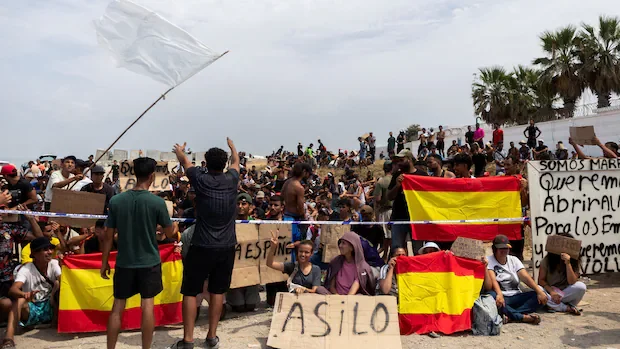
Hundreds of migrants in Spain's Ceuta enclave protest for asylum, against deportation to Morocco
Many cite poor working conditions in Morocco for fleeing to nearby Spanish enclave
Hundreds of migrants who recently entered Spain's North African enclave of Ceuta staged a protest on a popular urban beach on Sunday, urging Spanish authorities to grant them asylum instead of sending them back to Morocco.
They were among the estimated 5,000 to 8,000 who remain in Ceuta after the mass border crossing two weeks ago that saw over 72,000 people surge into the tiny territory of about 80,000. The vast majority returned voluntarily in the following days.
With the city's resources overstretched, most migrants were living in precarious conditions on El Trampolin beach or the city's outskirts while awaiting a chance to journey on to continental Europe.
"We're sleeping next to the sea, with cold and bad smells. We're suffering a lot," said Ayoub Elarroud from Morocco's Tetouan, adding that police were blocking migrants from going to the city centre.
The protesters held up Spanish flags and banners reading, "We don't want to go back to Morocco" and "We are also human," while chanting slogans such as "We're tired" or "We need a solution."
WATCH | Dozens of 60,000 people who crossed in Ceuta have died:On the rocky shores behind them, some migrants washed their clothes while others fished with makeshift bamboo rods.
Earlier this week, Interior Minister Fernando Grande-Marlaska said migrants who had entered irregularly wouldn't be allowed to stay in the enclave, travel to mainland Spain or obtain legal status, except in rare cases involving extreme vulnerability.
Health services under strain
The head of Ceuta's medical board, Enrique Roviralta, told Onda Cero radio that the city's limited health-care workers were exhausted, and criticized what he described as a slow response by the central government.
Roviralta added that diseases such as infectious diarrhea and scabies were breaking out, and violence-related injuries such as broken noses or stab wounds were rising.
On Sunday, Health Minister Monica Garcia rejected suggestions that local health services had "collapsed," but acknowledged they were under pressure.
"To associate migration with illness is unjust and xenophobic," she told reporters in Ceuta, adding there was a moderate risk of epidemic outbreaks for migrants and a low one for residents.
Migrants say they face poor work conditions
Most of the Moroccan migrants interviewed by Reuters said they were driven by poor working conditions in their country, despite many holding higher qualifications.
Mohammed Ouanzar, a 39-year-old automation specialist from Fez, said average monthly salaries of 3,000 dirham ($450 Cdn) made it impossible for him to buy a home or start a family.
"Once I reached Spanish soil, I felt like I was born again," he said. "I'd rather die than return."
Hicham Chikir, 25, said most people were eager to work in Europe.
"If anyone is bad, the police can send them back."
Emmanuel, a 30-year-old electrician who fled conflict-ridden northeastern Nigeria, said he decided to embark on a perilous four-month journey across Niger, Algeria and Morocco because his children had stopped going to school over fears of being kidnapped.
"I'm fighting for a better life for them," he said, adding he would take any job he was offered.
WATCH | Desperation brought thousands of migrants to Ceuta:Mohammad Ismail Hossain, 34, left Bangladesh over two years ago following the 2024 mass uprising. He traversed India, Pakistan, Iraq, Syria, Egypt, Libya and Algeria — mostly on foot — and saw many companions die of thirst in the desert.
Ousmane, from southern Senegal, said he was seeking asylum because he suffered persecution over his sexual orientation, but had yet to obtain a reply from the local NGOs he had contacted.
"The worst thing is waiting all day with nothing to do, checking my emails constantly" he said.