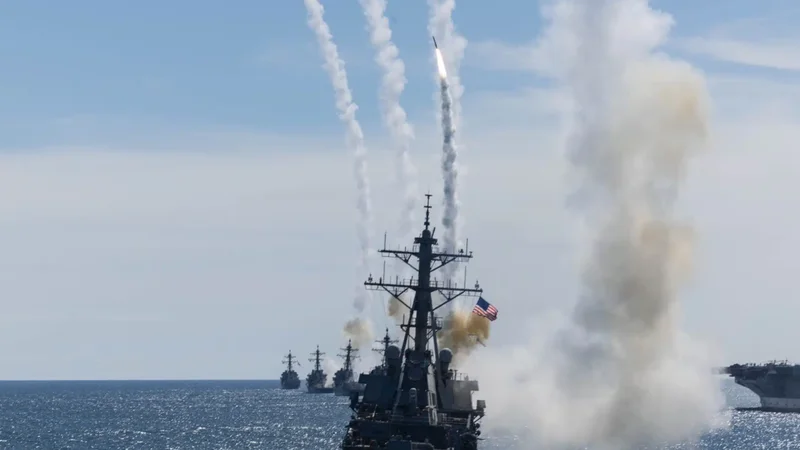
- DARPA wants hypersonic missiles capable of surviving increasingly sophisticated enemy air defenses
- The new program seeks major gains in range, speed, and survivability
- Russia's Zircon gives Washington an existing hypersonic cruise missile benchmark
The Pentagon is pursuing a new hypersonic cruise missile concept designed to survive increasingly capable enemy air defense networks.
The Defense Advanced Research Projects Agency (DARPA) Next Generation Hypersonic Cruise Missile (NGHCM) program wants contractors to design a hypersonic scramjet cruise missile capable of evading enemy interceptors.
The effort comes as U.S. forces intercept Iranian retaliations from its attack, increasing concerns about existing stand-off weapons facing sophisticated defenses.
DARPA seeks a survivable hypersonic cruise missile
DARPA says advanced integrated air defense systems could increasingly restrict American forces and weaken existing stand-off strike capabilities.
Its request for information seeks concepts capable of achieving significant improvements in range, cruise speed, altitude, or other operational characteristics.
The agency specifically wants a demonstrator that could establish the basis for producing future missiles in substantially larger quantities.
The proposed system would use scramjet propulsion, allowing atmospheric air to support combustion during sustained high-speed flight.
DARPA has not specified a precise velocity requirement, although hypersonic flight generally refers to speeds exceeding Mach 5.
The request instead emphasizes broader performance, survivability, affordability, and development speed rather than prescribing one fixed technical configuration.
“Future U.S. military operations face increasingly significant challenges from the rapid proliferation and advancement of highly capable Integrated Air Defense Systems,” DARPA said.
The agency also asks companies to consider how payload, range, speed, altitude, maneuverability, signatures, and launch-platform capacity could influence overall effectiveness.
Potential launch arrangements include tactical fighters, heavy bombers, surface-based vertical launch systems, and larger ground-based platforms.
DARPA also encourages participation from emerging tech companies and contractors outside the traditional defense industry.
Testing and rapid development are major priorities
DARPA is seeking a development schedule capable of moving important technical milestones toward flight testing faster than conventional acquisition programs.
Companies responding to the request must identify ways to accelerate development while maintaining the technical reviews required for major program decisions.
The agency also wants advances in air-breathing propulsion, high-energy-density fuels, advanced boosters, high-temperature materials, thermal management, and power systems.
Testing is another major concern because DARPA wants flight evaluations capable of generating useful data without creating excessive indicators before testing occurs.
The agency says proposed concepts should support rapid collection of critical flight data while reducing observable signs associated with imminent tests.
The requested mission scope covers distances from 250 nautical miles to 2,000 nautical miles, although DARPA has not specified detailed missile performance requirements.
That range would allow the agency to examine whether a common technological foundation could support substantially different mission requirements.
Russia has already deployed the 3M22 Zircon, a hypersonic cruise missile using air-breathing propulsion, creating an existing example for comparison.
DARPA's proposed NGHCM is an effort to develop a future missile capable of operating against increasingly sophisticated defenses.
Via Defense News
Efosa has been writing about technology for over 7 years, initially driven by curiosity but now fueled by a strong passion for the field. He holds both a Master's and a PhD in sciences, which provided him with a solid foundation in analytical thinking.