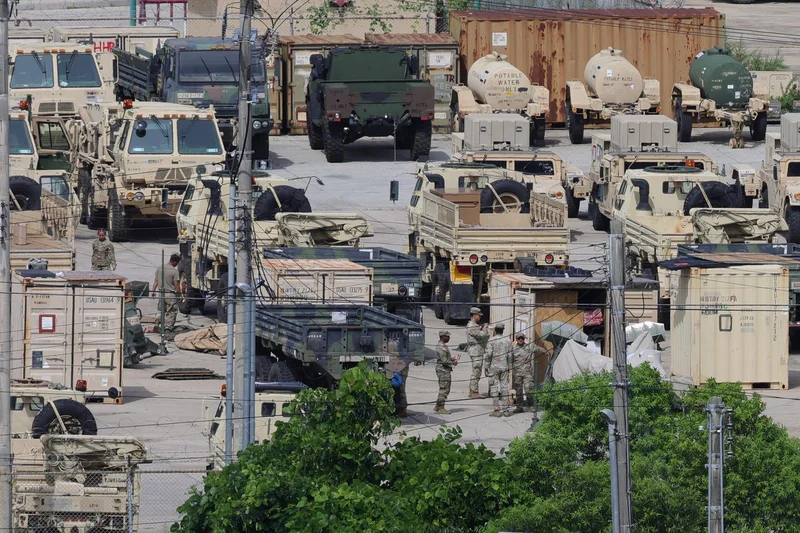
South Korea and the United States kicked off their key summertime combined exercise Monday, with Seoul seeking to use the drills to accelerate efforts to regain wartime operational command (OPCON) from Washington.
The annual Ulchi Freedom Shield (UFS) exercise will run until Aug. 27, featuring combined and all-domain operations to boost the allies' readiness and capabilities by incorporating realistic threats reflecting the rapidly changing modern warfare.
The UFS is a flagship combined exercise conducted by the allies every year to train for contingencies against North Korea, along with the Freedom Shield (FS) that takes place in spring.
This year's UFS comes as South Korea is seeking to retake wartime command from the U.S. before the Lee Jae Myung administration's five-year term ends in 2030, or reportedly even as early as next year, although differences appear to remain with the U.S. over the timeline.
The South's military said it expects the latest UFS will serve to support ongoing preparations for a "conditions-based" OPCON transition. Seoul and Washington are working on the OPCON transition based on a three-phased plan, with the evaluation process for the second stage currently under way.
The UFS is regarded as a testing ground where the allies can evaluate South Korea's capabilities to lead the combined forces once Seoul retakes wartime OPCON from Washington.
Contrary to some previous UFS drills, this year's UFS will not involve training in which the South Korea deputy commander of the Combined Forces Command (CFC) takes over the role of the CFC commander, currently held by the U.S. Forces Korea (USFK) commander.
This has given rise to the view that the U.S. remains cautious over Seoul's push to expedite the OPCON transition. Washington has expressed concerns its Asian ally may be rushing the process for political reasons.
Capt. Jang Do-young, spokesperson for the South's Joint Chiefs of Staff (JCS), said in a press briefing last week that the allies plan to conduct a joint evaluation of South Korea's capabilities during the UFS period to advance the OPCON transition and that the military is focusing "all of its capabilities" on that end.
USFK spokesperson Col. Ryan Donald highlighted that specific OPCON capability assessments are being handled through bilateral channels, suggesting that the UFS exercise is primarily aimed at training execution.
Field training exercises, a core part of the UFS, have also been scaled back from last year's drills. The allies will conduct 14 battalion-level field training, dubbed the Warrior Shield, compared with 17 conducted during the 2025 UFS.
The Lee administration has reduced the field training in an apparent effort to help ease tensions with North Korea, which has long decried the exercises as war rehearsals.
In a statement by a foreign ministry official Friday, the North denounced this year's UFS as preparations for military confrontation with the regime, warning of responses "with a new level of a deterrent."
The North also fired short-range ballistic missiles toward the East Sea over two separate launches, on Aug. 6 and last Wednesday.
Meanwhile, the U.S. Eighth Army, a core ground headquarters of the USFK, described the UFS' focus as "modernizing the alliance" and "shaping the security environment in Northeast Asia," suggesting the scope of its role potentially expanding beyond the Korean Peninsula.
South Korea has maintained the UFS exercise is conducted strictly for the defense of the peninsula.
The United Nations Command (UNC), which administers the Armistice Agreement that ended the 1950-53 Korean War, is sending around 70 personnel from 12 of its 18 member states to support the UFS exercise.