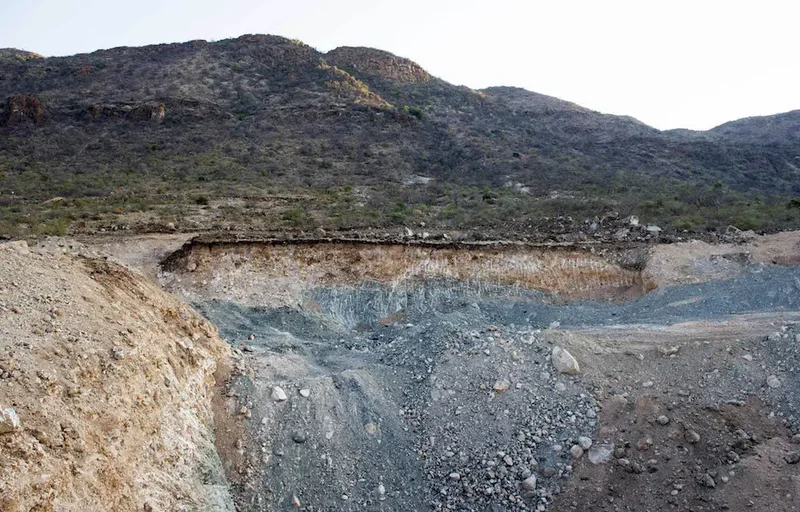
The deaths of at least 14 miners after the collapse of a disused mine at Nkaneng near Rustenburg this week have once again highlighted the deadly consequences of South Africa’s illegal mining crisis.
The tragedy came as the government moved to strengthen laws against illicit mining, with the General Mining Laws Amendment Bill proposing substantially tougher penalties for illegal prospecting and mining and for people who assist the activities.
But while the government and the mining industry say tougher laws are urgently needed to tackle an increasingly organised and violent criminal economy, labour, environmental and mining-affected community groups argue that criminal enforcement alone will not address the poverty, abandoned mines and criminal networks that continue to feed illegal mining.
The South African Federation of Trade Unions (Saftu), responding to the Nkaneng tragedy, said the deaths could not simply be dismissed as “illegal miners” dying in an abandoned mine.
The union said South Africa had allowed thousands of abandoned and inadequately secured mines to become “death traps, environmental hazards and breeding grounds for organised criminal syndicates”.
“The Nkaneng tragedy once again demonstrates the terrible human price of failing to confront the crisis comprehensively,” Saftu said.
This week, Justice and Constitutional Development Minister Mmamoloko Kubayi provided an update on the Bill, which was approved by Cabinet for publication for public comment.
Kubayi said the Bill was intended to address a gap in the current law: although illicit mining is prohibited, “illicit mining and the activities related to illicit mining, are not criminal offences” in themselves.
The proposed penalties are significantly higher than those currently provided for in some of the legislation. Under the MPRDA, certain offences would attract a maximum fine of R100 million and up to 30 years in prison, compared with the current maximum fine of R100 000 and two years’ imprisonment.
Penalties under the Diamonds Act would also rise to as much as R100 million and 30 years in prison, while the maximum penalty under the Precious Metals Act would increase from a fine of up to R100 000 and 20 years’ imprisonment to R100 million and 30 years.
“The Bill,” Kubayi stressed, “does not seek to criminalise authorised artisanal miners, meaning small-scale miners with permits, from engaging in mining activities.”
The Bill would also create a new offence covering people who assist illegal mining, including anyone who unlawfully and intentionally conspires with, aids, abets, induces, incites, instigates, instructs, commands or procures another person to assist or provide a service to someone committing illegal prospecting or mining activities.
Kubayi said illicit mining was harming communities and infrastructure, threatening water security and contributing to sinkholes. She also linked it to human trafficking, forced labour and violent crime.
The Minerals Council South Africa supported the tougher approach, arguing that illegal mining has become closely intertwined with organised crime. “Illegal mining and organised crime are inter-related.”
The council said illegal miners and the syndicates employing them were often heavily armed and used explosives, ambushes and booby traps, particularly when trespassing on operating mines.
Illegal mining also imposed significant costs on the state and formal mining sector through lost revenue, taxes, employment opportunities, capital expenditure, exports, foreign exchange earnings and procurement.
“The need for dedicated legislation to define and punish illegal mining and the associated crimes is critical,” the council said.
It supported the formalisation and regularisation of legitimate artisanal mining in selected communities where it is practised, saying this would allow artisanal and small-scale miners to operate as “legitimate, tax paying, law-abiding entities”.
But the council stressed that formalisation “is not a process that will legitimise illegal mining syndicates”.
Mariette Liefferink, the chief executive of the Federation for a Sustainable Environment (FSE), said that while she supported the purpose of the Bill, she did not support it in its current form.
Liefferink argued that criminal enforcement must be accompanied by a functioning framework for legitimate artisanal and small-scale mining, proper mine closure and rehabilitation, social protection and measures to address the socioeconomic conditions driving vulnerable people into unregulated mining.
One of her central concerns is that the Bill refers to an “artisanal mining permit” without establishing the complete mechanism through which an artisanal miner could obtain such a permit.
“The minister’s statement says that authorised artisanal miners will not be criminalised, yet the Bill does not create the complete legal mechanism through which an artisanal miner can obtain the contemplated authorisation,” she said.
Liefferink called for a complete artisanal and small-scale mining framework, including accessible application procedures, community consultation, environmental and safety requirements and access to lawful markets.
She also warned against treating artisanal miners and criminal syndicates as interchangeable, saying unemployment, poverty, retrenchments and poorly managed mine closures contributed to unregulated mining.
The debate over the Bill centres partly on whether tougher penalties will reach the people who organise and profit from illegal mining, rather than primarily those who work underground.
David van Wyk, the lead researcher at the Bench Marks Foundation, said the proposed legislation did not address what he regarded as some of the underlying issues driving illegal mining.
“In the first instance, it does not address the issues of mine closure and mine rehabilitation, which, by law, is a requirement.
“Secondly, it deals again with trying to curb the people who are underground, who are basically super exploited labour — former mineworkers, people who didn’t receive their pensions and benefits and so on — and live in squatter camps around mines, who very often are pushed into the mines at gunpoint and if not … they are recruited as if they were going to work in formal mines.”
Van Wyk said the people arranging payments, food, water and other supplies for miners underground were part of a “managerial class on the surface”.
“The legislation doesn’t address that issue, it addresses what we do with guys that we find in an abandoned mine, we can’t charge them with trespassing because the mine is ownerless, so most of these cases get thrown out. It tries to tighten up on that aspect but it doesn’t tighten up on the surface syndicate activities behind it all.”
Saftu made a similar argument, saying the illegal-mining economy extended far beyond the people physically entering mines.
“There is an illegal mining economy above the ground,” it said, pointing to financiers, recruiters, suppliers, transport networks, buyers of illegally extracted minerals, processors, exporters and people laundering the proceeds.
“The poorest worker underground is frequently the most visible and disposable link in a much larger economic chain,” Saftu said.
It called for law enforcement to “follow the money”, arguing that arresting impoverished miners while financiers, buyers, smugglers, exporters and syndicate bosses remained untouched would not eliminate illegal mining.
Mining Affected Communities United in Action (Macua) and Women Affected by Mining United in Action have raised a similar concern.
It argued that the government was focusing too heavily on people at the bottom of the chain. “Where is the equivalent urgency to follow the money?” Macua asked.
It also questioned whether the government’s formalisation pathway for artisanal miners would be accessible to the poorest miners, questioning whether an “indigent artisanal miner with rudimentary equipment, no capital, limited technical capacity” could realistically enter the legal system.
“Thirty-year prison sentences will not redistribute mineral wealth, create livelihoods or make mining communities less poor,” Macua said.
Mine closure and rehabilitation have emerged as another major point of contention. Van
Wyk said the legislation should address what happens when formal mines reach the end of their productive lives.
“The law should change in that it should make it impossible for a mining company to walk away from a mine when it reaches the end of life and not sell it.”
He argued that mines were increasingly being transferred to less-capitalised operators as they became less profitable, while rehabilitation liabilities remained a concern.
“Now, unless you start off at that particular point and make sure that people apply the law in terms of mine closure and rehabilitation and obtain actual closure certificates and rehabilitation certificates from the department of mineral resources. I don’t think any have been issued so people just walk away from their responsibilities,” he said.
Liefferink similarly called for proper mine closure and rehabilitation, arguing that abandoned, derelict, liquidated or inadequately secured mines create opportunities for unlawful entry.
Van Wyk also argued that the Bill did not adequately address the full illegal mining value chain.
“The legislation doesn’t really deal with the issue of the full value chain from taking the gold or diamonds or whatever minerals out from underground to the processing … getting it formalised, getting it out of the country and so on,” he said.
The Minerals Council said tougher laws, effective policing and improved crime intelligence were needed to reach the leaders and masterminds of illegal mining syndicates.
Liefferink said criminal enforcement must be combined with accessible legalisation, responsible mineral markets, mine closure and rehabilitation and enforcement against those who profited from illicit mineral flows.
For Saftu, the Nkaneng disaster should be a turning point and “not simply another statistic.”