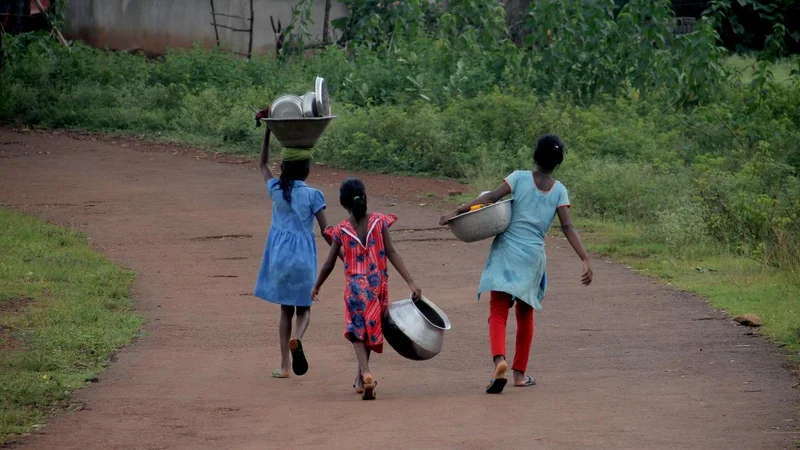
In a recent interaction with women aspiring to become entrepreneurs in rural Haryana, it was found that other than social and cultural norms, the biggest practical problem constraining the women’s’ ability to do more paid work was that a large share of their time was tied up in cooking and completing household chores. Strikingly, their daughters, rather than their sons, were already sharing this burden by helping them in the kitchen and other chores. The next generation, it seemed, is already learning to reproduce the gender gap in invisible, unpaid work.
India’s Time Use Survey (2025) highlights that the division of labour that emerges in adulthood begins much earlier, through childhood conditioning. What starts in childhood widens with age, reaching its peak in the prime working years.
The time women spend on housework begins to rise around the age of 10 and continues through the late teens and twenties, reaching a peak of nearly 460 minutes (7.5 hours +) a day around age 30. The male curve, however, never crosses 65 minutes at any age between six and 75. Adolescence, in this sense, is not separate from adulthood; it is when the adult pattern begins to take shape. Data shows that at age six, Indian boys and girls spend almost the same amount of time on domestic and care work at about five minutes a day. Their trajectories remain relatively close through early childhood. Thereafter, however, they diverge sharply.
Around age 10, the girls’ curve begins to pull away. Girls spend about 15 minutes a day on domestic and care work at age 10, 75 minutes at 15, and around 130 minutes by age 17. Boys, meanwhile, move from roughly five minutes at age six to only about 17 minutes by the end of childhood. The result is a dramatic widening of the gender gap. The girl-to-boy ratio in unpaid work rises from 1.6 among children aged 6–9, to 4.5 among those aged 10–14, and to 7.5 among adolescents aged 15–17.
Little control over time
The cost is leisure. Between ages six and 17, girls’ housework rises by roughly 124 minutes a day, while their leisure time falls by around 115 minutes. For boys, the decline in leisure is much smaller but the time they spend on housework changes relatively little.
This matters because the cost of girls’ domestic work is often framed primarily as a trade-off with schooling and education. But data shows that girls, in fact, are spending slightly more time on learning than boys at most ages. They, therefore, remain in school but still pay a substantial price in leisure time that could be spent on sport, friendships, rest, exploration and simply having discretionary control over their own time. These are not economically irrelevant activities. They are part of how children build confidence, social networks, physical capability and even a sense of agency, all of which influence their ability to build career trajectories later in life.
Cooking lies at the centre of this divergence. Among adolescents aged 15–17 years, 42.4% of girls report cooking, compared with only 2.9% of boys. Girls in this age group spend close to an hour cooking, while boys spend just two minutes. Cleaning and laundry also become increasingly gendered, with wide gaps in both participation and time spent. The only tasks where adolescent boys match or exceed girls are farm work and shopping; activities that are more outward-facing (the field and market), rather than inward-facing into the kitchen.
Between childhood and adulthood, therefore, girls are being trained for the household while boys are being trained for the world outside. This helps explain why childhood conditioning can later appear as an “efficient” gendered allocation of household work. One of the clearest manifestations of these gendered expectations is women’s absence from the labour force. In the 2025 PLFS, childcare and domestic responsibilities were the single most-cited reason women gave for staying out of the labour force, reported by 52.5% of urban women and 40% of rural women, compared with less than 1% of men.
Most policy interventions address women’s unpaid work in adulthood through childcare, community kitchens, safe mobility infrastructure, flexible work and social protection, among others. But the Time Use Survey suggests that policy must also start much earlier, by addressing the unequal assignment of domestic work between boys and girls.
The objective is not to remove domestic work from children’s lives, but to remove its gender assignment. Schools can help by giving every child, boy or girl, equal opportunities to learn practical life skills, from cooking and home management to stitching, carpentry and financial management.
India has invested heavily in keeping girls in school and improving their educational outcomes, but equal attention must be paid to what happens to their time outside school. Otherwise, by the time young women enter the labour market, years of gendered conditioning and unpaid work may already have narrowed their choices. If we want a different workforce tomorrow, we may need to start by giving boys and girls a different childhood today.
Authors work at the Indian Council for Research on International Economic Relations (ICRIER). Views expressed are personal
Published - August 17, 2026 08:00 am IST