Dear readers, it will come as no surprise to regular consumers of this column that I routinely receive several hundreds of emails every day from people just like you.
Okay, fine. When I say several hundred, I mean three, and when I say every day, I mean since February. But still, this is nothing to scoff at. Please control your jealousy.
Earlier this week, I received an email from a young reader of this column. “Dear Mr. Vadukut,” she wrote. “I need your urgent, and wise, help with something. There are a few things happening these days in India that I am unhappy about. I have been discussing this with my friends. We are thinking of organising a protest of some kind. But I am not sure if this is a good idea. Can you please help?”
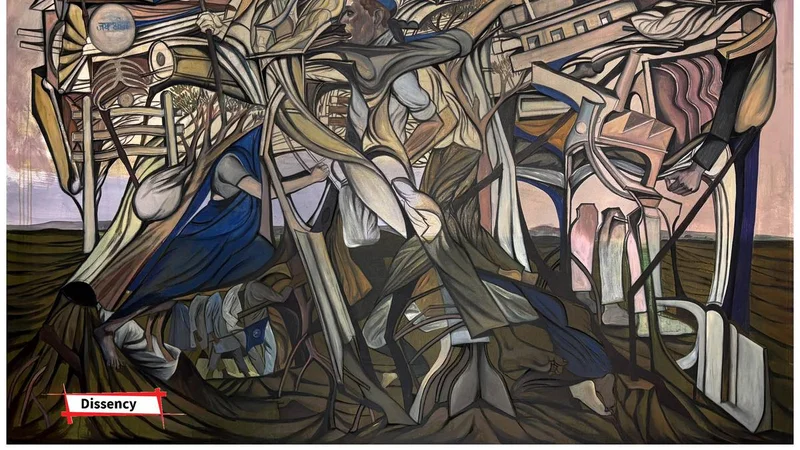
Vikrant Bhise’s In the Shade of Mangroves, We Rise – 5.
\| Photo Credit:
(Courtesy the Artist and Experimenter)
Readers, what do you think my response was to this email? Exactly. As a patriotic Indian, I immediately sent her details to the Intelligence Bureau and the Research and Analysis Wing.
As a famous poet once said: Where the mind is without fear and the head is held high;/Where knowledge is free... but don’t do nonsense things, we will file an FIR.
This letter from the reader did make me think, however. Protesting in India is a very complicated thing. You have to think about it very carefully. And ideally from abroad after emigrating.
First of all, you should never protest against the honourable Prime Minister or any other senior ministers. These are all offices that deserve the highest dignity and we should not do anything to bring disrepute to these offices by way of criticism. Questioning them is an insult to the whole country itself.
Secondly, should you protest against government agencies such as the Army, Navy, Air Force, police, CRPF, CISF, Indo-Tibetan Border Force or Coast Guard? What are we? A banana republic? Absolutely, totally, 100% you should not. These are all men and women who are proudly serving the people of this country. They are sacrificing their today so we can enjoy our tomorrow. Just because they serve the people of India, does not mean that the people of India can sit on their heads. This is not allowed.
Thirdly, we should never protest about some issue that has been reported in the news or on social media. You may be thinking: but Mr. Sidin, isn’t the function of media to help us identify problems in the country?
Absolutely 100% wrong. The function of the media is to make sure that every Indian citizen is proud of the country. Sometimes, this means being suspicious of our fellow citizens. But that is perfectly fine. Eternal suspicion is the price of liberty. In fact, if you ever see anything on the Internet that is critical of India, then it is highly likely that it is a conspiracy by foreign countries to undermine the India story. Which country? There are so many. Everyone is so jealous. Please avoid such protests.
Fourthly, it might be tempting to protest things like floods, potholes, broken bridges, leaked exam papers and the like. I understand the temptation. But it is important to keep in mind that these things also happen in other countries. How is it fair to protest for such reasons when people in other countries are not protesting? Also on a per-capita basis, how many potholes are there in India? Four? Five? That is nothing. It is important to have a sense of proportion when you think of protesting.
In fact, the more I think about this, the more I am convinced that we need a word to describe the kind of issues and topics that are legitimate reasons for protests in India. This will make it much easier for people, especially the youth, to choose carefully before challenging the status quo.
And that word is: dissency.
Example sentence: “The students demonstrated remarkable dissency by cancelling their protest against the leaked exam papers and instead organising a gratitude march thanking the examination board for creating greater academic challenge and motivation by distributing the papers in advance.”
Have you thought of protesting recently? How dare you!
The writer helps early stage companies communicate better. He blogs at www.whatay.com.
Learn more about Indian art
Vikrant Bhise’s painting ‘In the Shade of Mangroves, We Rise – 5’ (featured in the article) is a visual collage of memory, migration and activism. Vikhroli, the Mumbai suburb where Bhise grew up, has been an active neighbourhood for the Dalit movement and carries a rich social and cultural history. The Godrej Enterprises Group has been a significant force in conserving the mangroves, and is also the prime employer of the labourers who reside in the area. Using visuals from immediate surroundings, history, and memory, this work represents the spirit of Vikhroli.
Published - July 23, 2026 06:10 pm IST