Sign in. It’s quick, free and it’s up to you.
An account is an optional way to support the work we do. Find out more.
THERE’S NO DENYING it any longer. Back-to-school time is upon us, and whether you’re a parent who is counting the hours down to your child’s return to the classroom, or you’re a bit like me with your head in the sand, the next week is going to be all about checking things off that list.
One thing I don’t have to worry about, however, is getting a new school uniform for my two children. Having had experience of both uniform and non-uniform schools, I can tell you that being free from the itchy, expensive, constricting set of identical clothing five days a week has been a revelation, and it’s one I wish more schools would cotton on to.
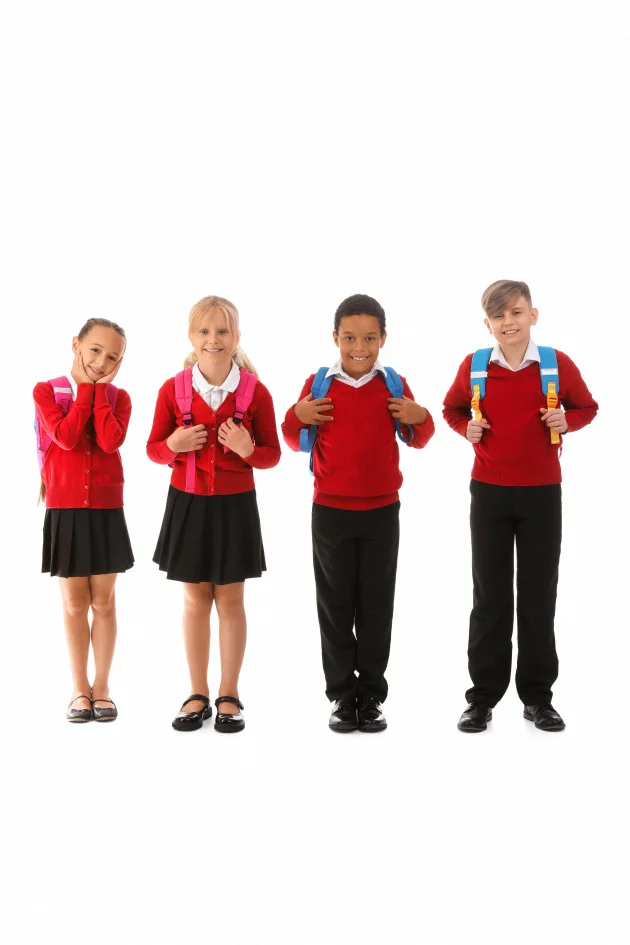
The argument for school uniforms is that they create harmony, school identity and improved behaviour and concentration for our children. Uniforms are touted as the easy and convenient choice for kids and families. They are often held up as the ultimate leveller that will eliminate children picking on others because of what they are wearing.
However, the evidence for any of these is sketchy at best, and it feels as though the prevalence of school uniforms is simply a traditional hang-up from a bygone era, driven by fear of what will happen if we remove them.
But in the words of the children of Springfield, “Down with uniforms!” Why are we pretending that children wearing their own clothes or expressing a smidge of individuality is going to lead to uproarious rioting like the kind we saw in that 1996 episode of The Simpsons when Bart rocks into Springfield Elementary with a “Down with homework” T-shirt on?
Principal Skinner’s solution to the sudden expression of defiance is to put them all in uniforms to knock the individuality out of them, instead of addressing the reason for the slogan in the first place. His plan goes as well as you’d expect, until it starts to rain.
Three decades later, many Irish primary schools are still taking the Seymour Skinner approach, believing that making every child wear the same clothes, which are often stuffy and formal even at primary level, making them look like tiny businesspeople, will result in children being better behaved, more focused or less likely to bully one another. The research isn’t terribly convincing for any of these arguments, though.
In one of the largest studies of primary-aged children in the US, involving 6,320 pupils, researchers found no general improvement in behaviour or attendance among children required to wear school uniforms. School uniforms have also been found to be disproportionately challenging for learners with additional needs, backed up by last year’s Government Review of The Education for Persons with Special Educational Needs Act. Plus, in a recent study from the University of Limerick and Dublin City University of 1,439 students across 18 Irish secondary schools, uniforms were seen to be an unpopular barrier to children getting active and engaged in sports.
Fear seems to be a big driver in the reluctance to remove uniforms, and many parents worry that their children might be picked on for what they are wearing or not wearing in school. Anecdotally, this can be an issue for some schools, but as much as we like to think uniforms will hide inequality, they are not a panacea.
Uniforms don’t hide shoes, school bags, pencil cases, coats, phones, the ability to go on school trips or even birthday parties.
The argument is that many families cannot afford to send their children into school in designer or branded clothing every day. The Barnardos’ Back to School Survey found that the average cost of a school uniform for a primary school child is between €110 and €140 and over €200 to €230 for a secondary school student. So, when a compulsory crested uniform costs families hundreds of euros, can we really describe it as an equality measure? Having been the parent in the past who had to shell out between €20-€30 on a single crested jumper for one child, in theory I could have spent that money on an Adidas or Under Armour designer jumper and still had change.
Having no uniform has been a definite saving for our household, and so far, we’ve had no issues with clothing comparisons. Granted, I’m dressing boys, and some will argue that makes life easier, but in my experience most primary school children who don’t wear uniforms are all wearing the same clothes from Dunnes and Penney’s, as opposed to high-end clobber. If you lose a jumper, good luck claiming it from lost property without a name on it, because all the clothes are from the same shops.
You might also assume that since the government now pays for schoolbooks and has funded the hot school lunch scheme, that uniforms are the only cost left for parents, but you’d be wrong. Books are a huge help with the finances, but most schools will still ask for a stationery fee, plus there are voluntary contributions, swimming or activities payments, as well as school trips. The hot lunches are so divisive and vary hugely from school to school that they do not eliminate the need for parents to send in lunches and snacks regularly, if not daily. And let’s not forget the costs around digital devices like tablets.
The fact is, crested/branded uniforms continue to be a financial concern for parents. The Barnardos’ survey found that over two-thirds (70%) of parents said they were somewhat or very worried about meeting the cost of uniforms this year. Fewer than one third (30%) of primary and 9% of secondary school parents said their school offered an affordable uniform option. If schools don’t want to get rid of uniforms altogether, then at least let parents buy non-branded tracksuits from Dunnes, Tesco or Lidl that are cheaper and easier for children to move about in, rather than the more formal trousers, kilts, ties, shirts and blazers.
The sheer convenience of a uniform is often cited by parents as a huge bonus. Having been there, done that and washed the t-shirt many times, I can tell you that ensuring you have a clean set of uniform for your children five days a week meant I spent my whole life washing and drying the uniforms or shelling out a fortune to have five sets.
None of the arguments for scrapping uniforms needs to be thought about in the abstract or remain purely anecdotal, however; you’ve simply got to look at the rise of the Educate Together Schools model, which does not require students to wear a uniform. They are the fastest-growing school sector in the country, and the recent government Youth and School Survey found that there is strong demand (almost 42%) for multi-denominational schools like these.
From the start, the Educate Together schools have been non-uniform, and according to Edward Platt, Schools Development Officer for Educate Together, “the feedback from parents and children has consistently been that they prefer not having a school uniform,” he explains.
Some of the common reasons often cited include “freedom of expression, feeling comfortable when learning and parents saying that not having to have specific school clothes ready for Monday morning can make life easier,” he says.
So, what happens then when you remove uniforms from the classroom? Do the children still read, learn maths, play in the yard and resist the urge to revolt through individuality every day like the Simpsons?
Reassuringly, the sky hasn’t fallen in at any of these schools. “There’s no evidence from our schools that not having a prescribed uniform negatively affects students’ behaviour or concentration,” explains Platt.
“Our approach to behaviour is rooted in mutual respect for oneself and for others rather than in what students wear. Allowing students to express their individuality through their clothing, while respecting the agreed dress code, supports their identity and reflects our child-centred ethos,” he adds.
Finally, the big one that often strikes fear into parents’ hearts is the issue of potential bullying due to clothing, but again, Platt has not seen this to be the case. “Children who are wearing comfortable clothing that they feel happy in don’t seem concerned about how others are dressed. This might be something that happens in specific cases, but it certainly hasn’t been a widespread problem in Educate Together schools,” he adds.
To embed this post, copy the code below on your site