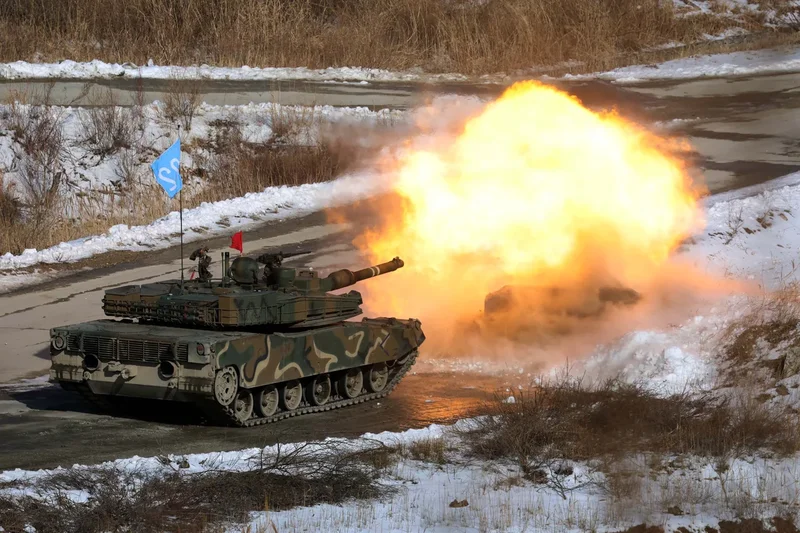
Donald Trump said he is scaling back joint military drills with South Korea hours before they were to start, citing his “very good” relationship with North Korean dictator Kim Jong Un.
The 11-day joint drills between South Korea and the US military start on Monday.
The Ulchi Freedom Shield is one of the two major annual exercises between the two allies.
The war games were expected to involve about 18,000 South Korean troops alongside US forces and 12 of the 18 member states of the United Nations Command (UNC), a multinational military force formed after the Korean War to oversee the 1953 armistice.
Mr Trump also said he had asked South Korea if it would join the US efforts in the denuclearisation of Iran but Seoul declined.
In a Truth Social post on Sunday, Mr Trump said while it was too late to cancel the exercises he has instructed Secretary of War, Pete Hegseth, to “substantially reduce” the joint exercises.
“Based on my very good relationship with Kim Jong Un, of North Korea, I am not happy with the fact that the United States has, long ago, agreed to participate in Joint Military Exercises with South Korea,” Mr Trump wrote.
“These exercises are not only costly, with much of these costs paid for by the United States of America (as usual!), but send a signal that is totally inappropriate and hostile, to a country that, as long as Donald J. Trump has been president, has been unthreatening and respectful.
“While somewhat unrelated (?), I recently asked the President of South Korea if they would like to join us in the denuclearisation of the Islamic Republic of Iran, and they said, ‘No thanks!’”
South Korea's defence ministry said it was proceeding as "previously notified and scheduled" with the annual exercise.
On Saturday, Mr Trump posted a picture of him and Mr Kim taken during the US leader’s visit to North Korea in 2019.
He said: “Despite the unfriendly look on this particular picture, there are many where we’re smiling, Kim Jong Un and I get along GREAT!”
The picture sparked speculation over Mr Trump’s attempt to have a fourth summit with Mr Kim or renew diplomacy.
However, Pyongyang has not reciprocated with similar outreach efforts amid its deepening economic, diplomatic, and military cooperation with Russia as well as ties with China.
Mr Trump has previously suspended major US-South Korean military exercises in his first term in White House following his first summit with Mr Kim in 2018. He cancelled the Ulchi Freedom Guardian exercise while other drills were suspended or scaled back.
Leif-Eric Easley, a professor at Ewha University in Seoul, said the US and South Korea drills are essential for military forces to ensure readiness and send a message of their militaries’ capabilities against North Korean aggression.
“Scaling them back can damage alliance coordination, slow the process of South Korea taking on greater responsibility for its own defence, and weaken deterrence against possible conflicts in Asia. The cost savings from downsizing drills are marginal, while the diplomatic benefits for relations with North Korea are doubtful,” Mr Easley said.
“Pyongyang has shown no interest in talks with Washington or Seoul, much less in denuclearisation. Trump’s recent social media posts about Kim Jong-un suggest a willingness to reengage, but North Korea is busy profiting from Russia’s war against Ukraine while modernising its own military”, he added.
He added the Trump administration’s ongoing difficulties negotiating with Iran do not enhance its credibility with the Kim Jong Un regime, which doubled down on nuclear weapons development after the collapse of the 2019 Trump-Kim summit in Hanoi.
Democratic senator Mark Kelly, a former Navy pilot, said that "hollowing out these joint exercises is shortsighted and a mistake" in a social media post made just hours after the president's own post.
When asked about Mr Trump’s post, South Korea’s defence ministry said the joint drills would “proceed as previously notified and scheduled”.
This year’s drills were to feature scenarios reflecting threats by North Korean troops who have gained battlefield experience after fighting against Ukraine from the Russian front lines, including new drone tactics, according to officials.
“Our training accounts for that threat, that is why the exercise looks different [from previous exercises], and over the last five years it’s continually evolved.”
The move is the latest example of the president appearing to turn against an ally in favour of a leader that previous administrations have cast as an adversary.
Mr Trump and others in his administration have also railed against Nato allies over perceived lack of support for his war against Iran, even as they seek to confront an increasingly aggressive Russia in the Baltic region.
It also comes as North Korea has repeatedly warned against the exercises, launching test missiles and issuing warnings in the wake of the drills.
On Friday, the Kim regime threatened unspecified stern steps against the US and South Korea, describing their military drills as a "rehearsal for an aggressive war" that are triggering greater instability in the region.
Pyongyang has been pushing hard to enlarge its nuclear and missile arsenals since Mr Kim's high-stakes diplomacy with Mr Trump collapsed in 2019. Experts say Mr Kim likely believes a bigger weapons arsenal would increase his chances of wresting more concessions from the US in future negotiations.