How technology builds agency for both students and educators
In the age of AI, “it’s no longer about answering questions, but questioning answers.”
The year is 2026 and the Philippines is at a point where there is deep recognition that educational reforms are needed to nurture the next generation of workers. But the question is, “what is this future, and what is the future of work like?”
The past three years have seen an unprecedented shift in work. Not because of the pandemic, but because of the rise of AI and all its implications of automation and redundancy. There were fears that AI would take a lot of jobs. And in a way it did. But it also presented new opportunities for the modern worker and their ability to adapt; their ability for agency. It seems that generally speaking, the Philippines has indeed taken advantage of this with success in the BPO industry. With IBPAP’s latest numbers, there’s a consistent YOY growth – not despite of – but because of AI. The shift can largely be attributed to specialized skills training which have higher yields.
Article continues after this advertisement
But this is not really a commentary about AI, but how the Philippines can learn from examples of other neighboring SEA countries. On building capacity. On enhancing critical thinking. On developing a sense of agency. AI is but an example of a paradigm shift that happens in technology perhaps once every ten to fifteen years. Is every new batch of graduates resilient to such change?
It’s also about asking how can students in K-12 navigate a safe space with their devices. I do not just mean cybersecurity, but by treating these devices as real tools for learning. The automatic reaction of most parents would be the “iPad is the biggest cause of distraction” because of YouTube, Minecraft, and Roblox. But putting things into context, there is a different world that unlocks when parents, teachers, schools make use of tech to advance learning in meaningful ways.
Early this month, I was able to tour some best case examples of how schools have worked with the government and technology providers like Apple to enhance capacity. Together with other media and education stakeholders we toured SBPI Gombak, one of 70 public boarding schools in Kuala Lumpur where students – and teachers – have been deeply integrated into Apple Education’s system of learning tools.
I grew up with the overhead projector, acetates, and Manila paper for presentation skills. Today, students can build app prototypes on Keynote.
Article continues after this advertisement
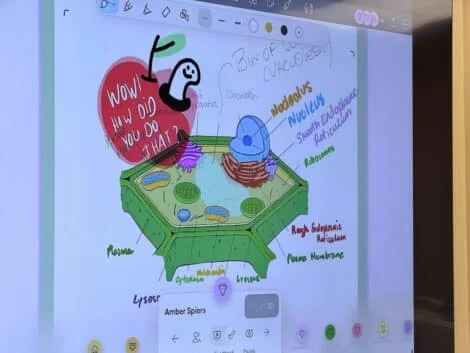
I remember my P.E teacher instructed the entire class to do the long jump, and he would mark us at the beginning and end of the year on how much farther we could jump after a year. Today, apps like My Jump Lab do the same thing by analyzing jumping data using the iPad’s camera. I saw grade school students use apps like Foxar to showcase their learnings behind finding the circumference of a circle using the radius. But what impressed me was how each student had a different creative approach using 3D modeling. One made a basketball hoop with a ball animation – how two different sized circles can co-relate. As an educator (yes I also have an MA in Development Education), I saw that each student’s output was more of a performance task and how formulas can relate to the real world. In my own children’ s school, the performance task takes up at least 50% of the total end of school year grade. So that is saying a lot on what is more important for learning.
Technology should help set higher bars, better standards
By moving from low-level thinking skills to high-order thinking skills, students learn to validate digital outputs against logical principles and external resources. The efficacy of this approach is backed by global data: a study of 20,000–25,000 teachers found that 89% believe Apple technology helps students take responsibility for their own learning. However, fostering this agency requires more than a pedagogical shift; it requires dismantling the systemic economic barriers that keep these tools out of reach for many Philippine institutions.
These were some of the talking points made by Dominic Liechti, Senior Director for Worldwide Education, Product Marketing for Apple. He stressed these in a keynote for the same Apple Education conference held in Kuala Lumpur, Malaysia. But he also made a trip to Manila where I was able to talk to him and clarify some points.
Article continues after this advertisement
I asked him how the rubrics had changed because of technology. Does mastering GarageBand make you a musician, for instance? His answer was all about ease of access.
For example, GarageBand allows students to master music theory and performance without the prohibitive cost of physical violins or guitars.
Technology for multimodal learning
Digital tools like Keynote are transformative for shy students, second-language learners, and those with learning disabilities. These platforms allow for asynchronous performance tasks, ensuring that a student’s grade reflects their mastery of the subject rather than their personality or linguistic speed. By providing diverse modes of self-expression, we ensure that engagement remains high and that the “human element” is not lost to standardized metrics.
The ultimate goal of modern Philippine education is the fusion of technology with humanity. He said that while the World Economic Forum (WEF) ranks technology literacy as a top priority, these skills are volatile, changing almost annually. In contrast, the constant skills in every WEF report are creativity, curiosity, and critical thinking.
But in the age of technology, where do these traits – curiosity, creativity, and critical thinking sit? Well, enter the humanities, a topic that Liechti and I discussed briefly.
The humanities and sciences provide the complex context required to hone these enduring traits. Technology is an enabler, but the liberal arts provide the human insight that changes lives. Whether a student is using digital tools to present a history project or explore scientific principles, the technology serves only to amplify the human element.
In the Philippines, schools like Xavier have adapted into the Apple ecosystem, with teachers able to integrate apps like Apple Classroom into the learning environment. Facilitators are able to command the room by having full control of devices – to lock and unlock learning tools during class, to individually check work, and to project output directly onto the digital whiteboard.
Building the education value engine
Again, as an educator, I had to press on – as the majority of Philippine schools do not have the best means to acquire technology, I wanted to see how Apple – a premium brand – a preferred brand – according to the numbers, carve into the education system?
According to Liechti, we must shift the conversation from initial sticker price to a Total Cost of Ownership (TCO) model. Strategic financial mechanisms, such as Apple Financial Services (AFS), allow schools to manage capital expenditure through leasing programs. These initiatives, often facilitated by local partners like Power Mac or Senco Link, provide the follow-through and training necessary for sustainability. If you work in the education sector and wish to upgrade and upskill, these partners are your first introduction into the ecosystem.
Institutions like Xavier School are already exploring these models. With the breakthrough price of the MacBook Air and a “Design to Last” philosophy, the hardware becomes a long-term investment rather than a disposable expense. Furthermore, a 1:1 rollout is not a prerequisite for innovation. Schools can implement innovation labs, shared device carts, or checkout systems to provide high-quality access while managing budgets. This flexibility allows schools to transition from hardware acquisition to the democratization of opportunity.
The Macbook Neo is a great example of this, as the industry was rocked to find an affordable Macbook that could cater to schools. In my personal opinion, I feel that the Neo is a herald of a new philosophy by incoming Apple CEO John Ternus for more affordable Apple devices in the future, as he led the project as former SVP of Hardware Engineering.
Enabling the future
There’s a certain kind of elegance for how Apple approaches education. As an enthusiast that has covered Apple for over two decades, the imprint is familiar. It’s curated and deliberate. But it’s also very effective. There are clear advantages to owning both the hardware and the ecosystem and it’s great to see that Apple does collaborate with the education sector to become agents of change to the next generation. Getting them hooked into their ecosystem is a bonus.
At the end of the day, the quote that really stuck to me was about questioning answers, and not just answering questions. We now live in an age where an answer is one ChatGPT prompt away. The skill we have to nurture for the new generation of learners is to learn how to be your own critic, and perhaps approach the world with some form of cynicism, of having everything handed to you on a silver platter. Or a Trojan Horse.