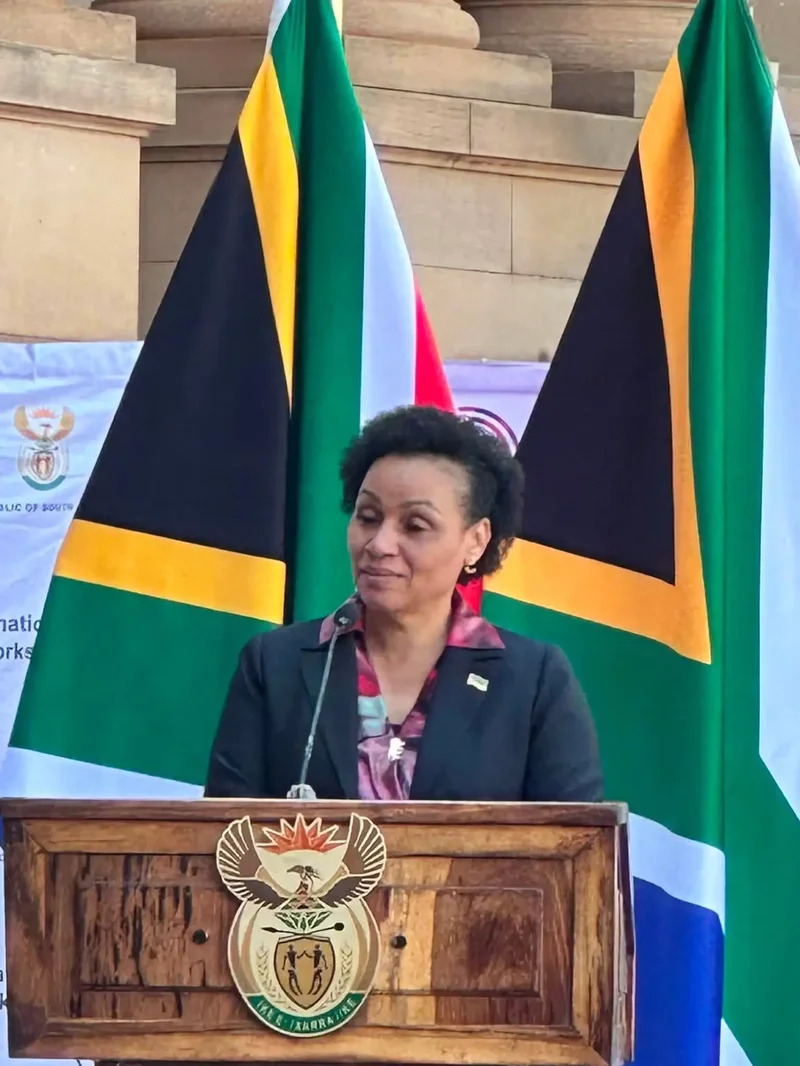
At the historic Union Buildings in Pretoria, women who have shaped nations, challenged injustice and opened doors for generations to come took centre stage as the Portraits of Power exhibition was officially unveiled.
Hosted by the Charlotte Mannya-Maxeke Institute (CMMI), in collaboration with the Presidency of the Republic of South Africa, diplomatic missions and international partners, the exhibition forms part of South Africa’s Women’s Month commemorations and marks the 70th anniversary of the 1956 Women’s March.
The international unveiling brought together diplomatic representatives, government officials, artists and members of civil society to celebrate the lives and legacies of distinguished women from across the world.
Fifteen participating countries selected a woman whose life embodies courage, leadership, service and the struggle for equality. Their portraits, created by emerging South African artists, provide a powerful intersection between diplomacy, history and contemporary African creativity.
Among those honoured are Namibian President Netumbo Nandi-Ndaitwah; former Irish President Mary Robinson; Queen Marie of Romania; Panamanian President Mireya Moscoso; Kenyan environmentalist Wangari Maathai; Turkish aviator Sabiha Gökçen; Mozambican freedom fighter Josina Machel; Colombian political leader Trismila Rentería; Angolan liberation heroine Deolinda Rodrigues; Lithuanian military figure Emilija Pliaterytė; former Malawian President Joyce Banda; Singaporean activist Chan Choy Siong; and Australian Aboriginal rights advocate Mum Shirl.
The Embassy of Ireland selected former President Mary Robinson, recognising her enduring global legacy and her contribution to human rights, justice and sustainable development.
Robinson, who served as Ireland’s first woman president and later as United Nations High Commissioner for Human Rights, has maintained a particularly strong connection with Africa. During her time at the United Nations, she travelled extensively across the continent, advocating for human rights, peace, justice and accountable governance.
Her more recent work has focused strongly on climate justice and the disproportionate impact of climate change on vulnerable communities — particularly those who have contributed least to the climate crisis but often suffer its greatest consequences.
The portrait of Robinson, unveiled during the ceremony, was created by East London artist Bamanye Gugu.
Delivering remarks at the event, Minister in the Presidency for Women, Youth and Persons with Disabilities Sindisiwe Chikunga stressed that celebrating women cannot stop at symbolism.
“A portrait on your wall is a beginning, not a destination,” she said, calling for women to occupy their rightful place wherever decisions are made and power is exercised.
Chikunga urged institutions to move beyond commemorating women to creating meaningful opportunities for the next generation through access to education, capital, technology, leadership, networks and markets.
Her message was particularly poignant as South Africa reflects on the legacy of the women who marched to the Union Buildings in 1956 to protest against the apartheid government’s pass laws.
The ribbon-cutting ceremony formally opened the exhibition, with portraits unveiled by representatives of the participating countries.
The exhibition is more than an artistic tribute. It is an invitation to reconsider how history is recorded, whose stories are preserved and how the achievements of women can inspire future generations.
As Chikunga reminded guests, the question should no longer simply be: “Who is the most successful woman?” Instead, she challenged society to ask: “Who is creating the most successful women?”
The Portraits of Power exhibition will now tour South Africa, bringing these stories of courage and leadership to new audiences and ensuring that the women represented are not merely figures of history, but living symbols of possibility.
Their portraits may hang on walls, but their legacy belongs in classrooms, universities, communities, institutions and, most importantly, in the ambitions of the young women who will shape the future.