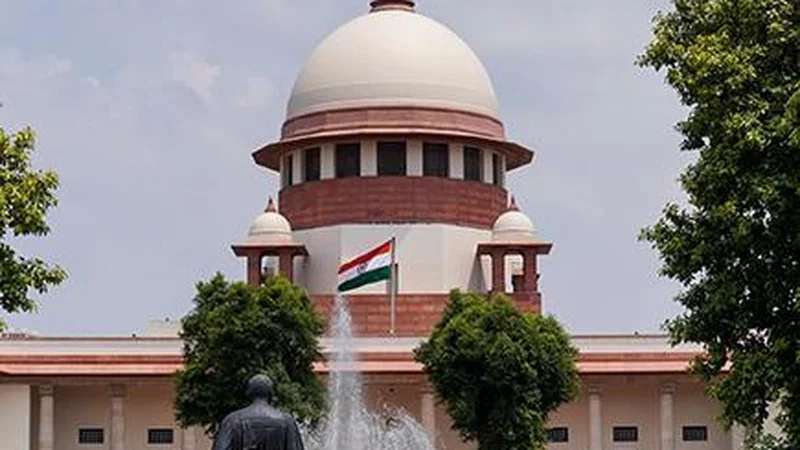
Chief Justice of India Surya Kant on Monday (August 17, 2026) said judges “walk a very thin line” after a litigant pointed out how social media “distort” what judges actually say in court to something else which exposes the judiciary to unfair criticism.
“If a Judge is wrong, the Judge may be criticised. If a judgment is erroneous, it may be challenged. If judicial reasoning is unsound, it may be dismantled by legal argument. However, if a Judge is condemned for words which the Judge never uttered, the criticism is no longer directed at the judicial record but at a constructed version of that record. This application is not an apprehension against criticism, it is an apprehension against distortion acquiring the appearance of judicial fact,” advocate-petitioner Raja Choudhary submitted in an oral mentioning.
Mr. Choudhary urged the Chief Justice to list his petition early, referring to former apex court judge, Justice K.M. Joseph’s recent speech for speedy listing and hearing of important constitutional cases.
The Chief Justice asked the petitioner to wait for the Union government’s response.
Mr. Choudhary asked “what happens when criticism is founded not upon what the court actually said or decided, but upon what the public is subsequently told that the court said?”
He said the “distinction between a question from the Bench, an observation, a submission of counsel, a hypothetical proposition, a rhetorical expression and an actual judicial finding is fundamental to the integrity of the judicial record”.
Highlighting the need for judicial intervention, he submitted that an oral courtroom exchange could rapidly be reduced to a short clip, headline, screenshot, meme or a social media post detached from the context in which the words were spoken.
“Once such a representation enters the public domain, its repetition may acquire an authority independent of the original proceedings,” Mr. Choudhary submitted.
On August 11, the apex court had sought a response from the various central Ministries on Mr. Choudhary’s petition seeking a Central Bureau of Investigation (CBI) probe into the “activities” of a “digital-political formation”, Cockroach Janta Party, and the commercial exploitation, trademark appropriation and monetised circulation of oral remarks made in court proceedings.
A three-judge Bench headed by Chief Justice Kant had issued notice on the petition which had arraigned the Union government, the Ministry of Electronics and Information Technology, Bar Council of India and the CBI as respondents in the case.
The CJP protests over the NEET-UG paper leaks and the Delhi Police crackdown on agitating students and youths in the national capital using pellet guns on July 20 had snowballed into a political flashpoint.
CJI Kant’s reported references to “cockroach” in reference to fake law degree holders during the hearing of a writ petition on May 15 spawned a public furore and a viral online platform, ‘Cockroach Janta Party’ (CJP).
The Chief Justice had clarified the next day in a statement that he was misquoted by sections of the media and had the greatest concern and respect for the youths of the country.
The petition had said that vernacular, culturally direct and non-elite modes of institutional speech associated with rural and non-metropolitan traditions are increasingly subjected to disproportionate ridicule within elite digital ecosystems. It argued that the spontaneous use of metaphorical expressions like ‘cockroach’ only reflected institutional frustration and procedural anxiety at the deterioration of legal professionals’ standards.
Mr. Choudhary has asserted that metaphorical references involving animals, insects, vermin, creatures or symbolic imagery have historically existed within literature, jurisprudence, constitutional discourse, political theory and legal philosophy.
Published - August 17, 2026 12:19 pm IST