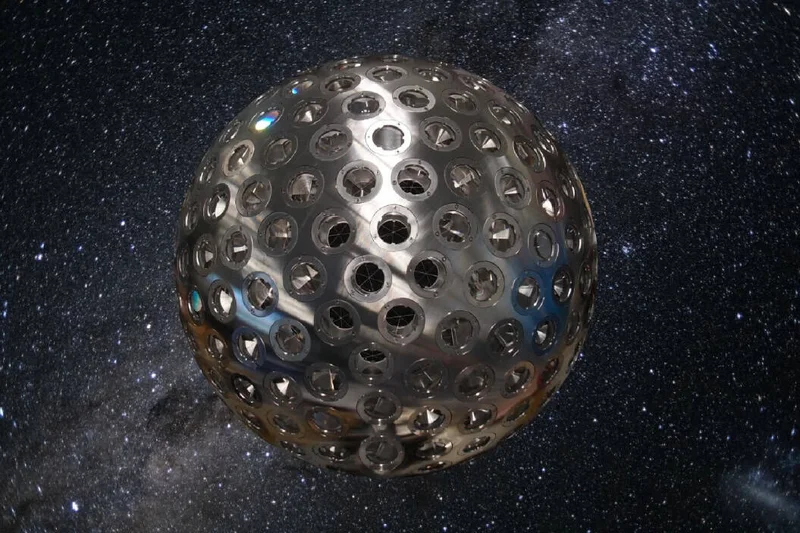
A laser-ranging technique has allowed physicists to measure the frame dragging of the Earth with an uncertainty approaching one part in a thousand, representing the highest precision yet for this parameter. The new result not only provides one of the most stringent confirmations of Einstein’s theory of general relativity in the near-Earth environment to date, it also sets stronger constraints on some alternative theories that have been put forward to explain the unsolved mystery of the universe’s accelerated expansion.
Frame dragging, also known as the dragging of inertial frames, is one of the predictions in Einstein’s theory of general relativity. Here, a massive, rotating object not only curves spacetime, it also drags it around as it rotates. The effect is very large around huge objects like black holes but is much smaller around Earth. It can be detected, however, by monitoring the motion of certain satellites in orbit around our planet.
There is a problem though in measuring the very tiny shift of the orbital plane around the Earth predicted by general relativity because the Earth is not a spherically symmetrical body, explains Ignazio Ciufolini of the Chinese Academy of Sciences, who led this new study. He and his colleagues overcame this difficulty by analysing motion data from the recently launched Laser Relativity Satellite 2 (LARES-2), developed by the Italian Space Agency, and its predecessor LAGEOS.
The combined orbits of these satellites act like a huge gyroscope and their position can be measured via laser ranging: a laser pulse is emitted towards the satellite and reflected back from the retroreflectors covering its surface. “By measuring the time it takes the laser light to come back, we can very precisely determine the position of the satellite,” says Ciufolini.
LARES-2 is a small, spherical satellite with a radius of 0.212 m and it is extremely heavy, weighing in at nearly 295 kg. Its orbit, he notes, is therefore perturbed only by the Earth’s gravitation and to a much lesser extent by non-gravitational effects, such as the push of the photons from the Sun and the Earth.
Removing the influence of Earth’s lunisolar tides
One of the difficult steps in the measurements, Ciufolini explains, was removing the influence of Earth’s lunisolar tides. These are the subtle distortions in the Earth’s gravity field caused by the tides raised by the Moon and Sun, which would otherwise hide the signal the researchers were looking for. “The most challenging part was to get rid of the orbital influence of Earth’s ‘K1 tide’, which biases the precision of the frame-dragging measurement,” he says.
“Thanks to this precise measurement, which is an order of magnitude better than previous Solar System measurements, we have been able to set stronger limits of validity to some theories alternative to general relativity proposed to possibly explain the great mystery of the accelerated expansion of the universe,” he tells Physics World. “Some of these theories predict something that may be related to quintessence (a mysterious time-dependent scalar field).”
While these theories predict the same so-called post-Newtonian weak-field effects as general relativity, they predict a different frame-dragging effect, he adds. Increasing the accuracy of frame-dragging (and indeed other tests of general relativity) can therefore place further limits on these other theories. It could also shed more light on phenomena like the flow of time around rotating black holes, where frame-dragging is extremely pronounced.
Laser gyroscope measures tiny fluctuations in Earth’s rotation
Laser-ranged satellites remain in orbit for many decades (LAGEOS was launched by NASA in 1976) and will carry on providing data for a very long time. “The more time we have, the more observational data we can obtain and therefore tests of general relativity (not only frame-dragging but also other tests) can be carried out with much increased precision,” says Ciufolini. “This data could also improve our knowledge of the Earth and allow, for example, improved determinations of the Earth tides and its centre of mass, which is useful for the Global Positioning System.”
The study is detailed in Nature.