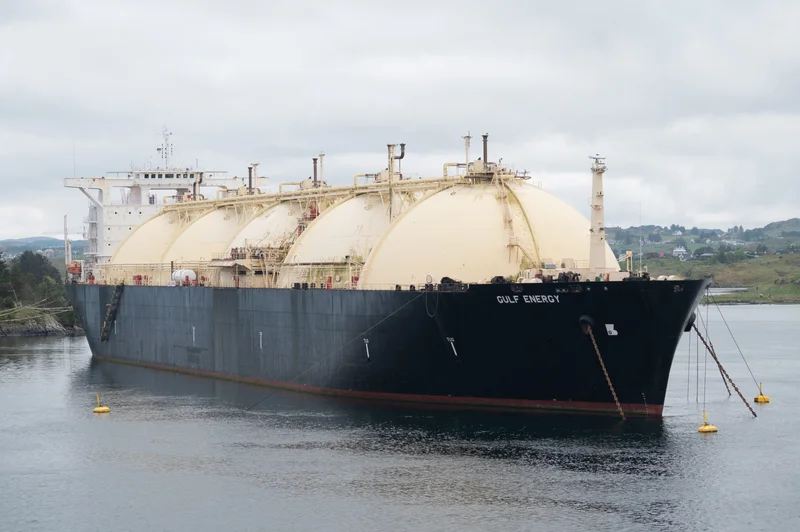
Argentina LNG Export Deal With Germany Is Now Binding
Argentina · Energy
Key Facts
- Binding contract:SESA and SEFE signed a Sales and Purchase Agreement on 4 March 2026.
- First deal:It is Argentina’s first long-term LNG export contract — a framework deal came first, on 1 December 2025.
- Volume agreed:2 million tonnes of LNG a year, for eight years, from late 2027.
- Seven billion:The US$7 billion figure is an estimated revenue total over eight years — not a guaranteed price.
- Floating plants:Two ships will chill the gas at sea in the Golfo San Matias, off Rio Negro.
- Ship moving:The Hilli Episeyo left Cameroon on 4 August 2026 for a refit in Singapore.
- Dollar case:Argentina’s energy trade surplus hit US$5.076 billion in the first half of 2026.
Germany lost Russian pipeline gas and went shopping. It found a seller in Patagonia that has not loaded a single export cargo yet.
Argentina has signed its first long-term contract to export LNG, and it is binding rather than a statement of intent. The buyer is SEFE, the gas company owned by the German state.
What Was Actually Signed, and When
The seller is Southern Energy S.A., known as SESA. It is an Argentine consortium put together in 2024.
Its shareholders, as reported by industry press, are Pan American Energy with 30% and YPF with 25%. Pampa Energia holds 20%, Harbour Energy 15% and Golar LNG 10%.
The buyer is SEFE Securing Energy for Europe, a company owned by the German state. It is the former Gazprom Germania, which Berlin took over in 2022.
Step one was a Heads of Agreement, signed on 1 December 2025. That is a framework deal — it sets the terms but still needs a final contract.
Step two was the binding Sales and Purchase Agreement. Trade press dated the signature to 4 March 2026.
So this is not a memorandum of understanding, and it is not a letter of intent. It is a signed, enforceable sales contract for LNG — natural gas chilled to liquid so it can travel by ship.
The US$7 Billion Figure, Handled With Care
You will see this reported as a US$7 billion deal. That number needs a caveat, and it needs it up front.
It is an estimate of total export revenue across the whole eight-year term. It is not annual revenue, and it is not the money being invested in the project.
The original Spanish wording said the contract “could generate revenue above US$7 billion over its life”. Then it added the crucial condition — depending on how international prices move.
The pricing formula has not been made public. Nobody outside the deal knows whether the price tracks Brent oil, Asian spot gas or European hub gas.
So treat US$7 billion as a working estimate, not a guaranteed sum.
How the Gas Gets to the Sea
The volume is 2 million tonnes of LNG a year, sold on FOB terms. That means the buyer takes the cargo at the loading point and arranges its own shipping.
The gas comes from Vaca Muerta, the shale formation in Neuquen province. It will travel about 500 km east on a new dedicated pipeline, the San Matias Pipeline.
That pipeline’s approved regulatory plan showed construction starting on 30 June 2026. Operations were estimated to begin on 1 May 2028.
The liquefaction happens at sea rather than on land. Two floating plants will sit in the Golfo San Matias, off Punta Colorada in Rio Negro province.
Ship one is the Hilli Episeyo — 2.45 million tonnes a year, on a 20-year charter, producing from late 2027. Ship two is the MKII unit, named Esperanza by owner Golar LNG, at 3.5 million tonnes a year from late 2028.
Together that is roughly 6 million tonnes a year. It is a large step for a country that exports no LNG today.
The only earlier exports were a handful of one-off cargoes from a small floating unit called Tango, at Bahia Blanca. Those shipped in 2019 and 2020, and that unit no longer operates in Argentina.
Where Things Stand in August 2026
Golar LNG, the owner of both floating plants, published interim results on 13 August 2026. The Hilli Episeyo delivered its final Cameroon cargo on 26 July 2026, after eight years and 156 cargoes.
It left Cameroonian waters on 4 August 2026, helped by two tugs. It is bound for Seatrium’s shipyard in Singapore for upgrades and life-extension work.
Golar has budgeted US$350 million for that refit, the repositioning, fuel, crew and insurance. The budget runs from August 2026 to the start of commercial operations in Argentina, in the second half of 2027.
Of that sum, US$71 million had been spent by 30 June 2026. Golar expects the Argentina contract to earn about US$285 million a year in operating profit, before any gain from higher commodity prices.
The second ship, Esperanza, was 74% complete at the end of the second quarter of 2026. Golar says it is on schedule and on budget, with a conversion budget of about US$2.2 billion.
Sail-away for Esperanza is targeted by the end of 2027. Production follows in the second half of 2028.
Why This Matters for Investors
Argentina is chronically short of hard currency. Energy exports have become one of its most dependable sources of dollars.
INDEC, the national statistics agency, reported a fuels and energy trade surplus of US$5.076 billion in the first half of 2026. That was up from US$3.139 billion a year earlier — a rise of 61.7%.
Energy exports in that half-year reached US$6.594 billion, up 42.5%. The main driver was a 47.7% jump in crude oil shipments, and energy imports came to US$1.518 billion.
Argentina’s total goods trade surplus for the same six months was US$13.923 billion. LNG matters because it turns Vaca Muerta gas into a year-round dollar export.
Today that gas is boxed in — the domestic market is small and demand swings with the seasons. Shipping it abroad breaks that ceiling.
That conversion is the heart of the Vaca Muerta investment case. It is also why outside money keeps arriving, as Peter Thiel’s stake in Vista Energy showed.
Be honest about the timing, though. None of this LNG revenue arrives before late 2027, and the eight-year estimate rests on prices nobody can fix today.
Do Not Confuse This With the Bigger Project
A separate and far larger plan is also moving. YPF, Italy’s Eni and XRG filed a project called Argentina LNG under RIGI, the country’s big-investment incentive regime, around 13 August 2026.
That one carries a US$51 billion investment figure and targets 12 million tonnes a year by 2031. YPF chairman Horacio Marin said on 14 August 2026 that Argentina “will export US$10 billion per year from 2031”.
It is a different project on a much later timetable. Eni is not a party to the German contract.
SESA is reported to hold a 30-year LNG export licence and Strategic Investment status under RIGI. SEFE, meanwhile, has been seeking up to US$2.35 billion in fresh capital.
That raise could open the door to partly privatising Argentina’s first European LNG buyer.
Frequently Asked Questions
Is the Argentina-Germany LNG deal signed or just an intention?
It is signed and binding. SESA and SEFE agreed a Heads of Agreement on 1 December 2025, then signed the binding Sales and Purchase Agreement in early March 2026. It is Argentina’s first long-term LNG export contract.
What does the US$7 billion figure actually refer to?
It is an estimate of total export revenue over the full eight-year term, based on price assumptions at the time. It is not annual revenue, not a fixed contract price, and not the investment in the project. The pricing formula has not been disclosed.
When do the first LNG cargoes leave Argentina?
Deliveries are due to begin in late 2027, from the Hilli Episeyo floating plant in the Golfo San Matias. No exact first-cargo date has been made public.
Who owns Southern Energy S.A.?
Industry press reports the shareholders as Pan American Energy with 30%, YPF with 25%, Pampa Energia with 20%, Harbour Energy with 15% and Golar LNG with 10%. Those percentages come from industry reporting rather than a corporate filing.
Connected Coverage
Sources: SEFE — Heads of Agreement with Argentina’s Southern Energy; Oil & Gas Journal — SESA signs offtake deal with Germany’s SEFE; LNG Industry — SEFE and Southern Energy sign LNG supply agreement; Buenos Aires Times — Argentina’s energy sector signs US$7-billion LNG export deal; Reuters — Argentina’s YPF seeks RIGI scheme for $51 billion LNG project; INDEC — Intercambio Comercial Argentino, June 2026; Infobae — Horacio Marin on Argentina LNG exports from 2031
This article was produced by The Rio Times’ automated newsroom system. How we use AI · Report an error