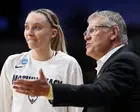
Let’s get one thing out of the way right from the jump: UConn Huskies coach Geno Auriemma says he isn’t retiring anytime in the “foreseeable future”.
That may come as a relief to fans of the program who have never known anyone else to be at its helm. Though he declined to promise an exact timeline, Auriemma made one thing clear while speaking to the Guardian last week: he’s going to be sticking around.
As he should.
At this point, and for decades prior, Auriemma and UConn have been synonymous. The history is well known, but let’s indulge: he began his coaching career at Bishop McDevitt High School in Wyncote, Pennsylvania. By 1981, he was an assistant at the University of Virginia, and he took over the head coaching job at the University of Connecticut in 1985. Auriemma was competing against many highly qualified women for the UConn job. One of those was Chris Dailey, who has coached at his side for the past 40-plus years. In that time, the Huskies have become arguably the most successful sports teams in the US.
The town of Storrs, Connecticut, and Huskies basketball, provide the backdrop for Apple TV’s three-part docuseries, The Dynasty: UConn Huskies, which premieres on Friday. The project was made with the full participation of Auriemma, who is shown in all his forms: emotional, frustrated, borderline angry, happy, thoughtful, but never reticent.
Auriemma’s decision to take part in the documentary wasn’t due to a looming sense that the end of his time at the program is near, though that’s certainly a theme that’s woven throughout, and a question that’s asked. And it’s something Auriemma clearly wanted to shut down.
“I don’t know [why we did it],” Auriemma tells the Guardian. “It came along. I think maybe the fact that it was Paige’s senior year, there were a lot of things that happened in the three or four years before that that we had to try to overcome. The timing was right. The interest was right. And no one knew at the beginning, ‘Hey, if you do it this year, you’re going to follow us and win the national championship’. Nobody knew that.”
Not only did the Huskies win the national championship – a feat the third episode of the series heavily focuses on – they did so with a 37-3 record. But the documentary is about much more than one season, and it was a challenge to attempt to condense 40 years of a truly singular story into something bite-sized and appealing to a broad swath of viewers, from UConn mega-fans to those who have never heard of the team.
“I don’t know that we could give a full 100% picture of the whole 40 years, you know, taking in stretches,” Auriemma says. “But I think it gives a pretty clear picture of what we do, who we are, what we value, what we stand for, how hard we work, how committed we are. So in that respect, I think it was pretty on point.”
Dailey is featured in the series but perhaps not as prominently as someone who has led the Huskies alongside Auriemma this entire time. That wasn’t on purpose, he says. “I think that if you’re here on a regular basis, or if you watch us, everything that we do, Chris is a huge part of everything that we do. Is it possible to do what we’ve done without her input? No, I don’t think so.”
When it comes to what UConn does, the list is exhaustive. It includes 12 NCAA Division I national championships, more than 50 conference and regular-season title, and the longest winning streak in men’s or women’s college basketball history. More than 50 Huskies have gone on to play in the WNBA; as of May, 17 were on active rosters. But that’s just the tip of the iceberg.
While the team’s coaches are crucial, the athletes who have made up UConn’s rosters over the years represent a who’s who of the women’s game, including Rebecca Lobo, Sue Bird, Diana Taurasi, Napheesa Collier, Maya Moore, Breanna Stewart, Swin Cash, Tina Charles, Paige Bueckers and Azzi Fudd. Many of them participated in the film, which underscored the idea that to speak of UConn is to speak of Auriemma, and to speak of Auriemma is to speak of all the women, from Dailey to Moore to Bueckers and more, who have been a foundational part of his legacy.
Lobo will go down in history as the first big get of Auriemma’s career, and someone who took the program from the unknown and rocketed it firmly into the known. Taurasi, whose own eponymous documentary premiered on Amazon Prime last year, was open and relaxed while looking back on her time with the program.
Taurasi, Auriemma says, didn’t want her own documentary to be a puff piece “and make her look like Lady Di”. At UConn “we talk a lot about when you’re really, really good, you don’t have to say anything. Other people say it for you.”
But it’s Bueckers who makes Auriemma’s eyes light up as soon as her name is mentioned. The pair’s up and down relationship is documented in the series, and it seems much more up than down – the pair still speak weekly, Auriemma says.
Bueckers spoke to reporters about how she’s grown as a leader while at All-Star Weekend in Chicago last month. Auriemma, who stomped that path alongside her, says that leadership was “one of the big struggles we had”.
“‘What kind of leader do you want to be?’” he says. “Paige was the best player in the country as a freshman, won every award. And she thought, ‘Well, people will just follow my example.’ Well, that’s one kind of leadership, but there’s [also] a leadership where you have to own it. You have to own what they do, too.”
Leading a team like UConn means you have to be able to be the face of the program, no matter if your teammates are older or younger than you, he also said. Leaders “make you better. They take on responsibility for you. They feel responsible for you.”
Bueckers “thought she was doing that”, and a tension grew between the two – a tension that is tangible in the docuseries’ third episode. “Today’s kids, I think, are very non-confrontational in a lot of ways,” Auriemma says. “So I always kept telling her, ‘Paige, you either do this now and we get some results or in March, we’re going to lose again in the Final Four and you’re going to wish you did.’
“So I don’t know what happened, but eventually in her senior year, she got there. And I told her, ‘You’re not going to be able to walk into a WNBA training camp. They’re going to hand you the ball and say, you’re our starting point guard and you’re going to look around and you’re going to go, OK, well, I’m not ready to lead this team. You’re not going to have a choice.’”
Auriemma says that Bueckers has since “found her voice,” and “she knows when to use it, how to use it. She still has a ways to go and some things that we talk about it every week. There isn’t a week that goes by that we don’t talk about how she’s feeling physically, mentally, emotionally, how you’re handling all this. And I’m proud of her.”
There’s another woman whose legacy looms over the series: Pat Summitt, the University of Tennessee’s legendary coach.
What began as a fun back-and-forth between two of women’s basketball’s best programs, eventually turned into a kind of cold civil war. When asked if there’s anything he wishes he’d done differently during that rivalry, Auriemma says more attention should have been paid to the players on the court.
“I think for the longest time that we [Sumitt and Auriemma] competed against each other, it was great. It was a great rivalry. It was great theater on the court, because there were so many great players playing against each other,” he says. “I think at some point, when we started playing each other twice every year, and then we played the NCAA Tournament, so that was three times, I think it got a little bit much.”
Much like some of the discourse we see surrounding women’s basketball today, the focus of the game was lost.
“And things being the way they are always, it unfortunately became Geno versus Pat. Pat and Geno, Geno and Pat, Pat and Geno, blah, blah, blah,” he says. “And the great players that were playing kind of were secondary, and I thought that was lousy. I thought that that’s not where we want this to be.”
What’s most regrettable is that Summitt, who announced her diagnosis of early-onset Alzheimer’s in 2011 and died in 2016 at the age of 64, didn’t have more time.
“I wish that we would have had another 10, 12, 15 years where it would have just been two great teams playing against each other every night, because every one of my players so looked forward to that game,” says Auriemma. “I know that they talk about how big the [women’s] game is today and these rivalries today. [But] there was nothing like that rivalry, ever.”
Auriemma has a reputation of being a stalwart supporter not only of the women’s game, but of women themselves.
“I’m a woman’s basketball coach, right? I coach basketball, and the players that play for me happen to be women, but I would coach a boys team the same way,” Auriemma says. “So the longer I’m with this, the longer I’ve been with this, I see the way the game has changed on the court, the way it’s changed off the court, and I see the difference in the way the game has been covered by the media.”
When he first started taking questions at press conferences, “if you saw a girl, young girl or woman, they were probably from the student newspaper or something, or just somebody who’s doing an internship or something,” he says. “And now you look out at the Final Four and with all the new social media outlets, it was just incredible to see a sea of young women who can look around and say, ‘I can do this for a living. I can be what used to be almost exclusively for men only.’ So I’m proud of that. I think that’s something that we’ve done at Connecticut for 40 years: try to empower women, try to get them to believe that anything, anything’s possible.”