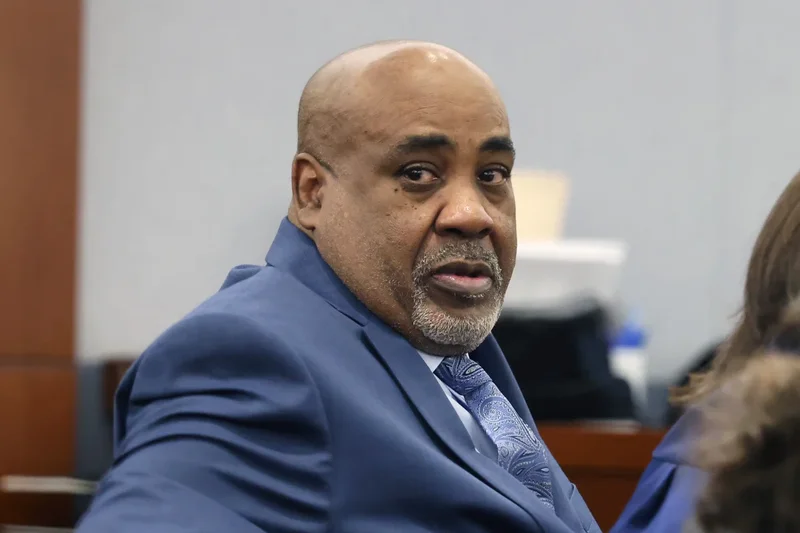
The trial of a man accused of orchestrating the killing of Tupac Shakur is set to get underway.
Duane “Keffe D” Davis, 63, is charged with murder with a deadly weapon with the intent to promote, further or assist a criminal gang in the rapper’s death.
He pleaded not guilty, but if convicted, faces life in prison.
The opening statements will begin on Monday, kicking off weeks of testimony that will revisit what happened in Las Vegas nearly 30 years ago.
Shakur was in the passenger seat of a BMW driven by Death Row Records co-founder Marion “Suge” Knight on Sept. 7, 1996, when shots were fired from a Cadillac at a red light. Knight survived but Shakur died six days later.
Despite his death aged 25, Shakur remains a cultural icon and is considered one of the most influential and versatile rappers of all time. More than 75 million of his records have been sold worldwide, with hits like California Love and Dear Mama, including several albums released after his death.
He was nominated for six Grammy Awards and was inducted into the Rock & Roll Hall of Fame in 2017.
In 2023, he received a posthumous star on the Hollywood Walk of Fame, had a street in Oakland named in his honor and inspired a character on the upcoming video game Stranger than Heaven.
The long-unsolved drive-by shooting gripped the hip-hop community, partly because no one was charged until Davis was indicted in 2023.
Over the course of the trial, which could span weeks, prosecutors plan to call between 35 and 45 potential witnesses, and the defense will call only a handful to testify.
Members of Shakur’s family are expected to be in the courtroom Monday.
Shakur’s stepbrother, Maurice “Mopreme” Shakur, recently said that sitting through the trial will be traumatizing for the family, but it's important to be there.
“We’re gonna stand by Pac as we always have,” he said.
All eyes on Tupac
Along with Shakur's family, friends and fans traveled to Las Vegas to show their support during jury selection.
A jury of six men and 10 women was selected Thursday to hear the case.
Darryl Harper, a veteran music producer who collaborated with Shakur at Death Row Records on songs released after the 1996 shooting, said he booked a plane ticket as soon as the latest trial date was set.
“He became a personal friend of mine as I worked with him almost every day of his last days here,” said Harper, who flew in from his home in Georgia.
Harper hopes the trial will reveal the truth about who was involved with the shooting.
“My prayer is that it’s the right person,” he said outside the court during jury selection. “If he’s the right person, then I’m glad that Tupac would get some kind of redemption finally. I think he deserves it.”
Shakur's cousins Kendrick Lesane and William Lesane flew in from Atlanta to watch jury selection. William Lesane said he wants someone held accountable.
“For me, justice has long left the station 30 years ago,” he said.
Prosecutors allege that Davis was the shot-caller
Prosecutors aren't claiming Davis pulled the trigger.
Rather, they say he organized the shooting to get revenge after Shakur and his entourage beat up Davis' nephew at the MGM Grand hours before Shakur was shot.
In Nevada, a person can be convicted of murder for helping another person commit the crime.
The gunfire came from a white Cadillac that Davis was in with three others, all who have since died.
In 2008, Davis spoke to investigators looking into the deaths of Shakur and Notorious B.I.G., born Christopher Wallace.
During the investigation, Davis was under an agreement that what he said about Shakur's killing couldn't be used against him.
What about Davis’ book?
In 2019, Davis published a book with those details and participated in media interviews in which he laid out his role in the shooting.
The book and his public statements revived the Las Vegas investigation and became key pieces of evidence, prosecutors say.
The case had gone cold until Davis began making public statements about it, including in a book he co-wrote in which he said he was in the Cadillac and provided the weapon used to shoot Shakur.
The state’s case hinges on the book Davis co-authored about his time in the gang South Side Compton Crips and statements he made in YouTube interviews.
"Had he decided to never write the book, he would not, probably, have ever been prosecuted for the crime,” prosecutor Marc DiGiacomo recently said.
A judge has ruled the book co-written by Davis can be used in the trial.
Davis' attorney Michael Sanft says Davis co-authored the book “Compton Street Legend” to make money, not to tell the truth.
He argues it's impossible to tell which parts — if any — Davis wrote and which parts author Yusuf Jah penned.
Jah, who is on the list of potential witnesses, recently told an investigator that he didn't believe Davis fully read his own book, according to court documents.
Prosecutors say the book is sensationalized but that they'll show “what is true, what is exaggeration, and what is an outright lie,” they wrote in court documents.
Davis recently told Las Vegas television station Fox 5 that he actually wasn't there the night Shakur was shot.
In his book though, he says he carpooled from Los Angeles to Las Vegas that night to watch the same boxing match Shakur attended. It describes where he stayed, and the events before and after Shakur was shot.
Who else is key to the trial?
In additon to Shakur and Davis, here are the other key figures in the case.
Marion "Suge" Knight
Knight, who founded Death Row Records and signed Shakur to the label, survived the shooting after being grazed by bullet fragments.
Orlando "Baby Lane" Anderson
Authorities have long identified Anderson as the suspected gunman, although he was never charged and repeatedly denied any involvement. Anderson was killed in an unrelated gang shooting in Compton in 1998.
Deandrae "Freaky" Smith
Smith, also known as "Big Dre," was riding in the back seat of the Cadillac beside Anderson. Former Davis associate Denvonta Lee testified that Smith confessed to firing the shots after taking the gun from Anderson because Anderson did not have a clear angle. Smith died of natural causes in 2004, according to the Los Angeles County Coroner's Office.
Terry "Bubble Up" Brown
Brown was allegedly driving the white Cadillac during the shooting. Investigators have said neither the Cadillac nor the gun used in the shooting has ever been recovered, leaving prosecutors to rely heavily on witness testimony, Davis' own statements and other evidence when the long-awaited trial begins. Brown was killed in a 2015 shooting at a medical marijuana dispensary in Compton.