- See more Daily Mail on Google - save us as a Preferred Source
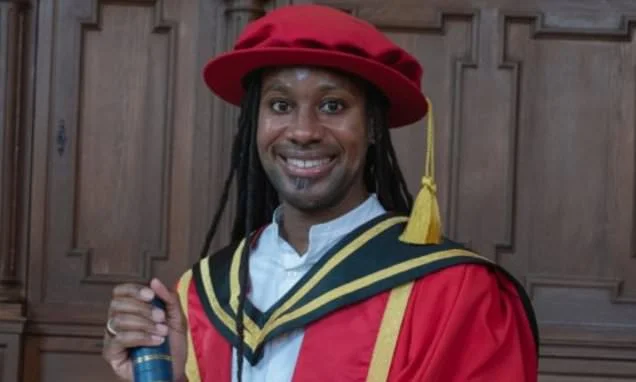
The apparent suicide of Cambridge academic Jason Arday is a terrible tragedy. What started as a story about plagiarism has ended with a shocking death.
What should we take from it? Regret, of course, that such a thing should have happened in our country. I have no doubt that journalists and broadcasters will want to reflect about the part played by the media.
Mr Arday’s defenders maintain that the case shows that we live in a racist society, and that British media are innately racist. They are accusing newspapers and broadcasters of hounding the poor man to his death.
This is not just the view of many on the Left, articulated with varying vehemence by people such as the Labour MP Bell Ribeiro-Addy, Labour London Mayor Sadiq Khan and former professor of black studies Kehinde Andrews.
Others less politicised also feel the same way. And even a few of my Right-wing friends think some papers went too far. They believe that there was an absence of mercy as a vulnerable man was dismantled in public.
Are they right? Is there truth in the charge that the media abused their tremendous power – that, to borrow from the poet Alexander Pope, they broke ‘a butterfly upon a wheel’?
I am normally happy to criticise the media whenever they err, as they obviously sometimes do. We’re not perfect, of course. But I don’t believe these dire charges are justified. I don’t doubt, though, that in the sewer of social media cruel and inexcusable things were said.
The best test of whether the Press abused its power is to ask if, amid the welter of allegations against Jason Arday, there was a single significant error of fact. To the best of my knowledge, no one has pointed any out.
Jason Arday was found dead at his home in Battersea, south London, on Friday following his resignation from his position at the University of Cambridge
Left-wing objectors recycle familiar accusations of ‘racist smears’ and ‘witch hunts’ being deployed by the Press against Mr Arday without addressing the evidence. The reason they don’t is that such evidence does not exist.
This isn’t the moment to wade through every allegation, but I’d better mention the main ones. An analysis by the Telegraph showed that there were well over a hundred passages in Mr Arday’s PhD thesis that were identical or a close match to that of another student published six years earlier.
Mr Arday had also publicly claimed to have written an academic book that was never published, and to have been a visiting professor at three universities that had no recollection of him.
There were other outlandish boasts about incredible feats of long-distance running, charity work for WaterAid that was never undertaken, and an appearance on the TV programme Seven Up that didn’t happen.
And so on. These inventions may have been in some way related to Mr Arday’s autism. Some will say newspapers should have taken account of this, and desisted.
But how was this possible, particularly in view of the ring of fire that surrounded Mr Arday? A Times Higher Education journalist who put some questions to him last year was investigated by the police for harassment and told to stop contacting him for the sake of his mental health.
After publishing a number of allegations, the Telegraph was the subject of a petition organised by the Left-wing Good Law Project, and signed by the heads of three Cambridge colleges, accusing the paper of running a Right-wing smear campaign.
How could it and other newspapers be expected to abandon their investigations into a professor whom Cambridge University had championed, with his boss lauding him after his appointment as ‘the best in the world in terms of the research you do’?
Jason Arday wasn’t some obscure don quietly pursuing his researches. Cambridge had chosen to make him a public figure, and he seemed to relish that role, acting as a guest editor of Radio 4’s Today programme, and sometimes appeared on television.
Where is the evidence of Press racism? I believe that, if an underqualified white academic had been celebrated and elevated by one of our leading universities in a blaze of publicity as Mr Arday was, newspapers would have shown an equal interest.
In fact, in 2011 a well-known white columnist called Johann Hari was suspended by the Independent newspaper, which he subsequently left, after it had been established he was guilty of plagiarism. It was a very public scandal in which race, of course, played no part.
The imputation of racist motivations by Mr Arday’s most extreme defenders is pretty despicable. It is intended to shut down debate and to stifle consideration of the facts.
Apologists may appear to have a figment of proof because of an academic called Nathan Cofnas. He was one of the first people to draw attention to the apparent plagiarism in Jason Arday’s PhD thesis.
Cofnas was dismissed by Emmanuel College, Cambridge in 2024 after implying in a blog that black people are intrinsically less intelligent. That is obviously a racist view. It is a reasonable inference that his motivations in publicising the plagiarism were at least partly racist.
But he wasn’t guilty of invention. If there is plagiarism in Mr Arday’s thesis, as seems undeniably the case, Cofnas’s motivations are strictly beside the point. Newspapers that have highlighted the many inconsistencies in Mr Arday’s career can’t be justly accused of holding the same views as Cofnas.
I am sure Jason Arday was a good and kind man, as his family attests. I also believe that, whatever the exact nature of his autism, his achievements were considerable. Coming from an unprivileged background, he triumphed over many obstacles.
This is certainly cause for celebration. Unfortunately Cambridge raised him almost to the level of genius – ‘the best in the world’, as his head of faculty said. That is an accolade for an Einstein or a Newton.
We can accuse university leaders of manipulating Mr Arday to suit their own purposes. Or we may more generously think they were partly influenced by idealism, and believed they had chanced upon a person of unusual talent – a ‘mute inglorious Milton’, to quote Thomas Gray.
He wasn’t that. Cambridge offered him a version of himself that he seemed willing to believe. He was almost sanctified by the great university, and the myths they had woven together may have taken on the appearance of reality in his mind.
How devastating it must have been for Jason Arday when those myths were so publicly exposed. Cambridge could, and should, have done more to protect the frail man it had built up.
Now the university authorities will investigate themselves. I doubt they will be as harsh in judging their own failures as they have been in judging the media.
If the lesson that Cambridge and politicians draw from this awful story – spurred on in that belief by Left-wing voices, especially on social media – is that it’s all the fault of the Press, it will be the wrong one.
We should discount wild claims of racism by those who want to use the sad death of Jason Arday to wage their own culture war. This was a human tragedy, long in the making, that need not have happened.