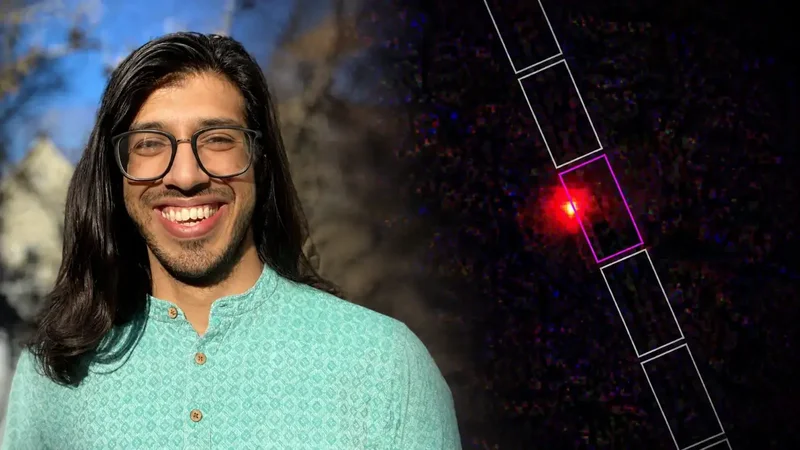
A Hyderabad-born astronomer who left engineering school at 18 and counts Test cricket among his favourite pastimes is now helping scientists look deeper into the earliest chapters of the Universe. Rohan P. Naidu, an MIT Pappalardo Fellow in Physics, is the lead author of a new Nature study that examines an extraordinary object from just 660 million years after the Big Bang. Published on 12 August 2026 as â
A gas-enshrouded and gas-reddened black hole at cosmic dawnâ, the research describes MoM-BH-1*, an exceptionally red and luminous source observed with NASA's James Webb Space Telescope. Naidu and his collaborators model the object as a supermassive black hole surrounded by an extremely dense, turbulent, dust-free envelope of gas. The finding could offer a glimpse of how enormous black holes grew so rapidly in the young Universe and may help explain the mysterious population of âlittle red dotsâ discovered by Webb.
From Hyderabad to MIT, Rohan Naidu took an unconventional route
Naidu's path to astrophysics did not begin with a straightforward journey through an engineering degree. According to his MIT biography, he grew up in Hyderabad, India, and at 18 made the unusual decision to drop out of engineering school.
He then bought his first-ever plane ticket and joined the founding class of 150 students at Yale-NUS College in Singapore. That change in direction eventually led him towards astronomy. During his undergraduate years, he became interested in the Universe through research on blazars and later pursued a PhD at Harvard University under astronomer Charlie Conroy. His doctoral work examined the distant reaches of the Milky Way and ancient galaxies that became incorporated into our own galaxy. Today, Naidu is a Pappalardo Fellow in Physics at MIT, with his research focused particularly on the first galaxies that formed after the Big Bang. MIT describes his work as combining direct observations of extremely distant galaxies with archaeological studies of ancient systems within the Milky Way. Outside astronomy, his interests are notably different: he is a trivia enthusiast, published poet and someone who is âalways down to watch test cricketâ.
By spotting the earliest black hole star to date at the dawn of the Universe, the team can better understand little red dots and may ultimately solve the mystery of supermassive black holes in the deep past. (Image: Institute of Science and Technology Austria/LinkedIn)
JWST revealed an object unlike an ordinary early galaxy
The object at the centre of the new study, MoM-BH-1*, was identified through the James Webb Space Telescope's Mirage or Miracle programme. It immediately stood out because it was unusually red, remarkably luminous and essentially unresolved at wavelengths above 3 micrometres. At shorter wavelengths, it appeared to disappear almost completely. Follow-up observations with Webb's NIRSpec instrument revealed an enormous Balmer break, along with unusual hydrogen spectral features. The object also showed broad, multi-peaked Hβ emission and absorption in several Balmer transitions, characteristics that are difficult to reconcile with an ordinary population of stars. The observations placed the object at a time when the Universe was only about 660 million years old. That makes it especially valuable for studying the period known as cosmic dawn, when the first galaxies and massive black holes were beginning to emerge. Rather than interpreting the source as simply another young galaxy, Naidu and his collaborators developed a model in which a black hole is hidden within an extraordinarily dense envelope of gas.
The âblack hole starâ could explain mysterious little red dots
The researchers propose that MoM-BH-1 contains a rapidly growing black hole surrounded by a thick, turbulent and dust-free hydrogen-rich envelope. In this scenario, the radiation we observe is dominated almost entirely by material surrounding the black hole rather than by stars in a conventional host galaxy. This configuration is important because it could represent a stage of unusually rapid black hole growth. The dense gas envelope may allow the black hole to accrete matter at super-Eddington rates, potentially helping explain how billion-solar-mass black holes appeared so early in cosmic history. The object is also connected to one of Webb's most intriguing discoveries: the population of extremely compact, red sources known as âlittle red dotsâ. The study suggests that if MoM-BH-1 were to merge with its brighter neighbouring galaxy, it could eventually resemble these enigmatic objects. Importantly, the study suggests that the object's red colour comes from gas rather than dust, while the unusual shapes and brightnesses of its spectral lines arise from scattering rather than simply from the motion of the emitting material. This could mean that black-hole masses estimated from such observations have sometimes been substantially overestimated.
A discovery that could reshape our understanding of early black holes
The significance of Naidu's research extends beyond one unusual object. Astronomers have long struggled to explain how some black holes reached billions of solar masses within the first billion years of cosmic history. Conventional growth models can struggle to produce such enormous objects quickly enough. MoM-BH*-1 offers a possible piece of that puzzle by providing observational evidence for a theoretical configuration in which an early black hole is deeply embedded within dense gas. If similar objects are found in greater numbers, they could represent an important phase in the evolution of the earliest supermassive black holes. For Naidu, the result also reflects the scientific possibilities opened by the James Webb Space Telescope. Its ability to collect infrared light from extremely distant objects allows astronomers to examine the Universe when it was hundreds of millions of years old, an era that was previously far more difficult to study directly. From leaving engineering at 18 in Hyderabad to leading research into some of the Universe's earliest black holes, Naidu's journey has taken an unconventional route. His latest Nature paper adds a remarkable object to that journey, one that could help scientists understand how the first giant black holes began their extraordinary growth.