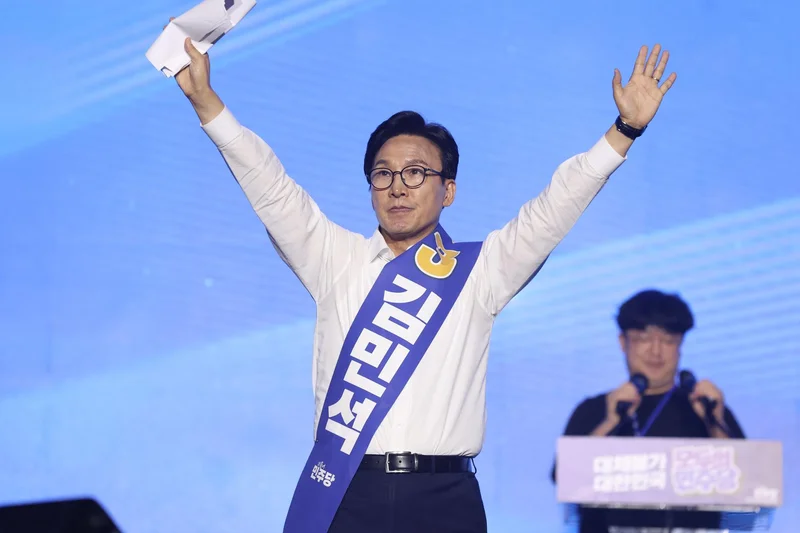
For President Lee Jae Myung, the election of Kim Min-seok as ruling party leader removes one potential source of political friction, even as it leaves the unity within the party unresolved.
Kim, who served as the first prime minister of the Lee administration, is expected to maintain close coordination with the presidential office as he takes the helm of the ruling Democratic Party of Korea (DPK). Having worked alongside Lee on key policy issues, Kim enters the job with an established working relationship with the president.
Kim made close coordination with the Lee administration a key campaign message, arguing that friction between the ruling party and the presidential office would hurt the government as well as the president.
His message appears to have resonated particularly as approval ratings for both Lee and the ruling party have weakened in recent weeks. Kim campaigned as a leader who would work in step with the government rather than seek to differentiate the party from the president.
Political commentator Eom Kyeong-young, director of the Zeitgeist Institute, said the leadership race had taken on the character of a confidence vote in Lee as the president’s approval rating declined.
“With the president’s approval rating falling and the ruling bloc facing an overall crisis, the leadership race is unfolding almost like a confidence vote in the president,” Eom said.
Kim’s victory shows that many party members favored closer coordination with the administration over further friction with the presidential office. His experience as Lee’s first prime minister could also make it easier for the two sides to coordinate major policies and legislation.
The new leader will lead the DPK during a crucial stretch of Lee’s presidency, with the party tasked with pushing the administration’s legislative agenda while preparing for the 2028 general elections.
Stable relations between the party and Cheong Wa Dae could help Lee regain political momentum after his approval ratings fell to the lowest levels of his administration.
However, Kim's more immediate challenge may come from within his own party. The leadership race sharpened a split between those aligned with Lee and supporters of former chief Jung Chung-rae, who built a distinct base of support among lawmakers and party members over the course of the campaign. Those divisions are unlikely to disappear with the end of the contest, raising questions over whether the factional tensions will persist beyond the convention.
Jung’s defeat is also unlikely to mean the disappearance of the political bloc that has formed around him. Political observers say Jung, who faced criticism for pursuing his own political agenda while serving as party leader, could continue to differentiate himself from Lee as he seeks to strengthen his standing as a potential presidential contender.
Political commentator Lee Jong-hoon said Jung had effectively begun positioning himself for the next presidential race during his term as party leader.
“Regardless of the outcome of the convention, discord between Jung and Lee will only grow,” Lee Jong-hoon said.
“To become a presidential candidate within the ruling party, you either have to follow the president’s lead or clearly distance yourself from him. Jung has chosen the latter, so internal conflict within the DPK is bound to intensify.”