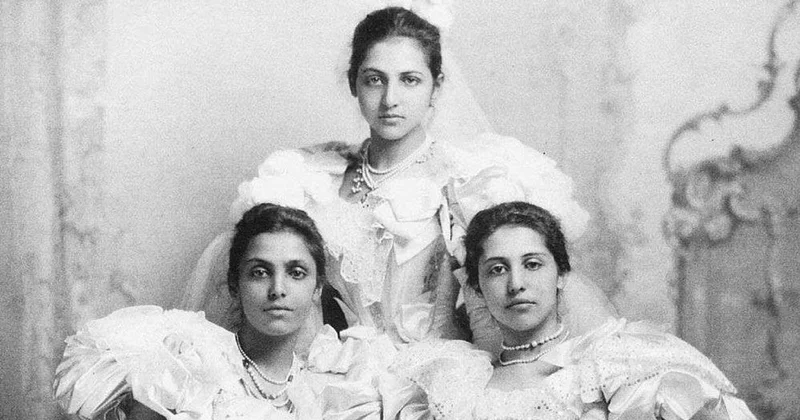
Thank you for writing (“In London, an exhibition reveals the fascinating lives of the Duleep Singh princesses”). It’s a beautifully written and moving piece. I liked the way it began with Peter Barrall’s memories of Sophia and Bamba. The detail about the dupattas mistaken for saris was a good addition too.
If I may, I wanted to offer some constructive feedback, in the spirit of the underrepresented histories this exhibition is trying to recover.
I was disappointed that the piece, like much coverage of the Duleep Singh family, did not extend its attention to Maharajah Duleep Singh’s two youngest daughters, Princesses Pauline and Irene, the last-born Duleep Singh princesses. They are in the exhibition, albeit marginalised.
Princess Victor Duleep Singh, Lady Anne Coventry, who married into the Sikh Punjabi royal family, was also excluded from the exhibition, even from the family tree.
As a British Sikh and Punjabi woman, I also find it disappointing that so much of the Duleep Singh archive is in a private collection. Private collections are a hot topic in heritage circles because they enable gatekeeping and hierarchy. Sikhi discourages hierarchy, instead promoting ideas like langar. – Sundeep Braich
‘Upper castes don’t discriminate’
Should India also apologise for all the unaccounted and forgotten brutal crimes against Brahmins or “ the other privileged castes” (“Should India apologise for caste injustice, like Nepal did?”)? Should it also apologise for all the land and amenities inherited by people who never faced any discrimination and still have the perks of being so called “oppressed classes”?
What about those who have converted to other unoppressing religions of the world from Hinduism claiming discrimination? It is not the upper castes that discriminate, but the others that love being called oppressed. Grow up, focus on better issues at our doors. – Pragya Tiwary
In Rama’s land, law will prevail
It’s very sad to see these things (“‘She had stepped out to buy food’: Another Bengali woman forcibly pushed to Bangladesh from Mumbai”). Our forefathers had chosen this land and we were born and brought up in a free India. This government’s sole propaganda is religious politics – they don’t want any development. But no one can escape the consequences of their deeds. In the land of Rama, the corruption at the Ram temple will be exposed and they will be prosecuted by the laws and people of India. – Anzar Hussain
Bhutan’s ‘mindfulness city’
Before complaining about Bhutan, think carefully about why things happened like that (“The dark shadows of Bhutan’s Gelephu ‘mindfulness city’ project”). Without any cause, nothing happened. Fake news or fake stories can easily show up but the reality will always be unknown. Many people are misled by the false leaders. It is very common for us to give mistakes to others. *– Pemba Herrmann *
Marathi rule for cab, auto drivers
It is sad to note that Maharashtra’s regional politics is discriminating against ordinary taxi and autorickshaw drivers (“Taxi, auto drivers who fail Marathi test to lose license starting August 16, says minister”). Plain bullying is the trend in India. – Atul Agarwal
The problem with economics
This article was well written and worth a read (“‘Markets know best’ and other 20th century economic theories are harming the world”). The reference to Nobel laureates and their awards made it easy to understand the historical structural incentives that lead to over-mathematisation and the wrong approach to improving the wellbeing of complex living systems.
This is almost never emphasised even in the country’s top economics colleges like the Delhi School of Economics, where I graduated from this year, and this topic was never discussed in our lectures.
The article would have been more complete had the author included the debate of whether economics is a natural science, like physics, or a social science. I find that this debate is at the core of the discipline’s nature and the sidelining of other major social sciences like sociology. – Santhosh Kumar M
Women writers and Indian patriarchy
This was a wonderful account of the patriarchal mindset in the middle-class household towards gifted women during that period (“Ramachandra Guha: In Mannu Bhandari’s memoir, an unflinching spotlight on Indian patriarchy”). Ashapurna Devi, a famous Bengali writer, had to fight the same conservative mindset to establish herself. Her husband, however, was supportive of her endeavour. – Rajib Sarkar
We welcome your comments at letters@scroll.in.