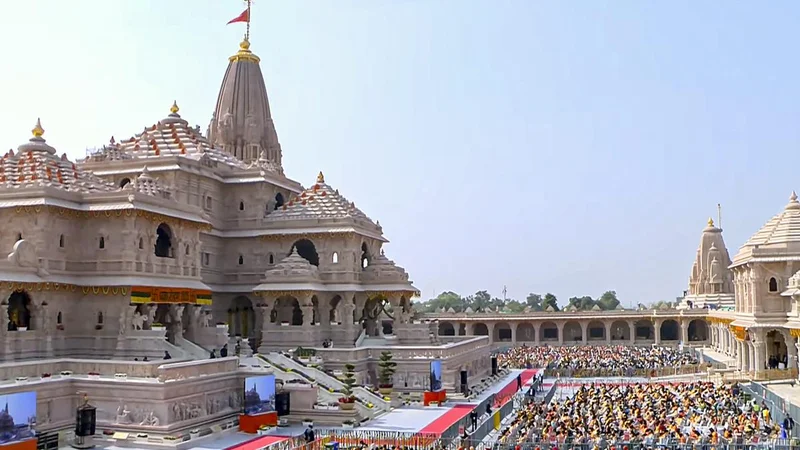
The Supreme Court on Monday (August 17, 2026) conveyed a hands-off approach on the investigation into the Ram Temple donations’ misappropriation case, saying a Special Investigation Team (SIT) is expected to take the probe to its logical conclusion, and anyone with further suggestions could approach the office of the Solicitor General of India directly.
“Let the SIT conclude. They must take it to its logical conclusion,” Chief Justice of India Surya Kant, heading a three-judge Bench, addressed petitioners and intervenors.
Petitioners complained that even the contents of the First Investigation Report (FIR) on the misappropriation of funds managed by the Shri Ram Janmabhoomi Teerth Kshetra Trust had not been shown, while others flagged that the data on donations needed to be revealed. “We are also concerned how donations are to be maintained,” one of them said.
Mr. Mehta, appearing for the State of Uttar Pradesh, said the “donations are being maintained”. The petitioners and any other “bona fide persons” could approach the office of Mr. Mehta with their suggestions if they felt “any aspects need to be thoroughly investigated by the SIT”, the court said, and these suggestions or aspects would be “objectively considered” by the top law officer’s office and passed on to the SIT.
The Bench made it clear that if the SIT was “doing its job satisfactorily, well and good, but if more is required, we will intervene”.
On July 27, 2026, the apex court had taken on record the Uttar Pradesh government’s office memorandum of July 25, constituting the SIT chaired by Kiran S., Inspector General of Police, Lucknow Range, Lucknow. The other members of the SIT, as recorded in the July 27 order, include Somen Barma, Deputy Inspector General of Police, Ayodhya Range; Gaurav Grover, Senior Superintendent of Police, Ayodhya district; and Ritesh Kumar Singh, Additional Superintendent of Police, Barabanki district.
The State confirmed the inclusion of a forensic auditor as the nature of the investigation involved allegations of misappropriation of Trust funds.
The Nirmohi Akhara, represented by senior advocate Sushil Jain, urged the court to hear its application for the restructuring of the Shri Ram Janmabhoomi Teerth Kshetra Trust into a public trust. The Akhara argued that the present Trust lacked proper accountability, and the 2019 Ayodhya verdict regarding its representation in the Trust had not been implemented.
The present hearings were only concerned with the investigation into the allegations of misappropriation, the court said. The Bench said the Akhara could raise the issue separately.
In an earlier hearing, the court had cautioned the petitioners against politicising the alleged embezzlement of Ram Temple donations, saying it would only treat the matter as a “simple case of commission of offence”.
The petitioners had sought a Central Bureau of Investigation probe, and publication of the complete financial details of the Shri Ram Janmabhoomi Teerth Kshetra Trust, including foreign contributions.
Appearing for Rashtriya Janata Dal (RJD) MP Sudhakar Singh, senior advocate Devadatt Kamat urged the court to direct the temple Trust to publish records of the donations made since inception, and be transparent towards devotees.
Mr. Singh’s petition has sought a direction to the Trust to produce a complete statement of cash donations, bank transfers, digital payments, foreign contributions, gold, silver, and other valuables, together with the particulars of their accounting, custody and utilisation since its inception.
The MP had submitted it was of “exceptional public importance” that the truth came out in the case. “The preservation of public confidence in one of the most revered religious institutions of the country, and the need for constitutional safeguards to ensure that the ongoing investigation into allegations concerning the handling of devotees’ offerings must be fair, independent and inspire the confidence of the nation,” Mr. Singh’s petition said.
Another petition filed by Supreme Court advocate N.K. Goswami has sought the protection of electronic evidence, including CCTV footage, which could be “quietly lost”, erased, overwritten or corrupted in the coming days.
Published - August 17, 2026 04:21 pm IST