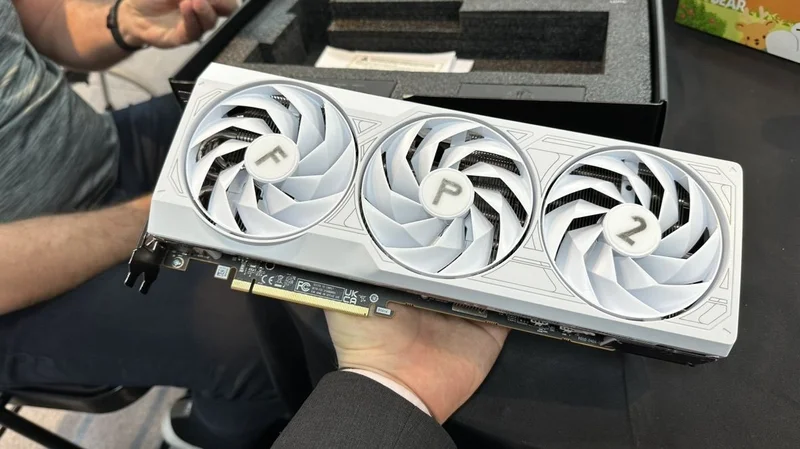
PC Partner, the maker of AMD, Inno3D, Manli, Sapphire, and Zotac-branded graphics cards, expects its costs to rise meaningfully in the second half of the year, which will in turn increase graphics card pricing, particularly for entry-level budget cards. The price hike is expected to happen amid dropping shipments of add-in boards (AIB). Meanwhile, analyst Jon Peddie tells us that he doubts that shipments of consumer graphics cards are going down, but claims that the profits of graphics card makers are on the rise.
"In addition, graphics memory costs are expected to rise further, leading to a substantial increase in VGA Card* costs in the second half of the year," a statement from PC Partner in its financial results for the first half of the year reads. "The quantity of VGA Card shipments declined substantially in the first half of FY2026 as compared with the second half of FY2025, and availability of VGA Cards is likely to decline further in the second half of FY2026."
GPU prices have increased massively in the recent quarters primarily due to high demand amid shortages of components. But just when you thought that AIB prices cannot get any higher due to the risk of a collapse in demand, GPU producers say otherwise. While the increase is not completely unexpected, what looks a bit unexpected is that entry-level graphics cards will increase the most, according to PC Partner.
"Beyond the price increases, entry-level VGA Cards are expected to face even more severe shortages, which may further drive ASP upward in the second half of FY2026," the statement by PC Partner reads.
Jon Peddie, the head of Jon Peddie Research, is a bit skeptic about whether the volume of graphics cards sold is going down, at least when it comes to consumer products.
"In Q1 2025, 9.25 million AIBs were sold, and in Q1 2026, 11.82 million; that is an increase of 28% in units, not dollars," Jon Peddie told Tom's Hardware. "AIB sales ($) will also increase, driven by higher memory costs. Our POS tracking of AIBs shows Q1 2025 at $6.18 billion and Q1 2026 at $ 10.85 billion, a 76% increase."
The question is whether price increases have benefited anyone beyond those early in the supply chain. Jon Peddie, who has been tracking the graphics industry for about 25 years, does not seem to believe that all the graphics card prices are due to increased costs.
Get Tom's Hardware's best news and in-depth reviews, straight to your inbox.
"[This all does] not necessarily equal an increase in profits, although I suspect it does, and the AIB suppliers are taking advantage of all of the press reports on higher memory prices and shortages to raise AIB prices more than the delta in memory costs," Peddie said.
The current 2026 graphics card price surge has been very uneven by segment. The percentage increase has generally been much larger on high-end AIBs that carry a lot more memory than entry-level boards. However, it seems that the situation is going to change and even 'cheap' graphics cards are going to get more expensive. There is a more alarming trend: the drop in sales of graphics cards.
PC Partner's own brand business — principally consisting of Zotac, Inno3D and Manli that work exclusively with Nvidia — saw unit shipments fall 18.4% in the first half of the year while seeing its average sales price increase by only 10.7% YoY.
This hugely contrasts with PC Partner's financial results in its ODM/OEM graphics-card business — mostly consisting of AMD and Sapphire-branded products — that has weakened substantially. PC Partner says unit volume actually fell 38.4% year-over-year, yet its revenue increased 73.9%, from HK$853.3 million to HK$1.4843 billion. The reason: average selling price jumped 181% YoY as PC Partner received substantially more orders for high-end AIBs. Since PC Partner's ODM/OEM produces cards for AMD, Sapphire, and plenty of PC makers, this could indeed be a bad sign, but not necessarily, according to the renowned analyst.
"The ODM/OEM suppliers get closer scrutiny from the big companies (Dell, HP, etc), and those companies know the actual costs of the memory," Peddie said.
*Being an established maker of graphics cards, PC Partner still uses the 'video graphics array,' or VGA, term from the 1980s to describe graphics cards.
Anton Shilov is a contributing writer at Tom’s Hardware. Over the past couple of decades, he has covered everything from CPUs and GPUs to supercomputers and from modern process technologies and latest fab tools to high-tech industry trends.