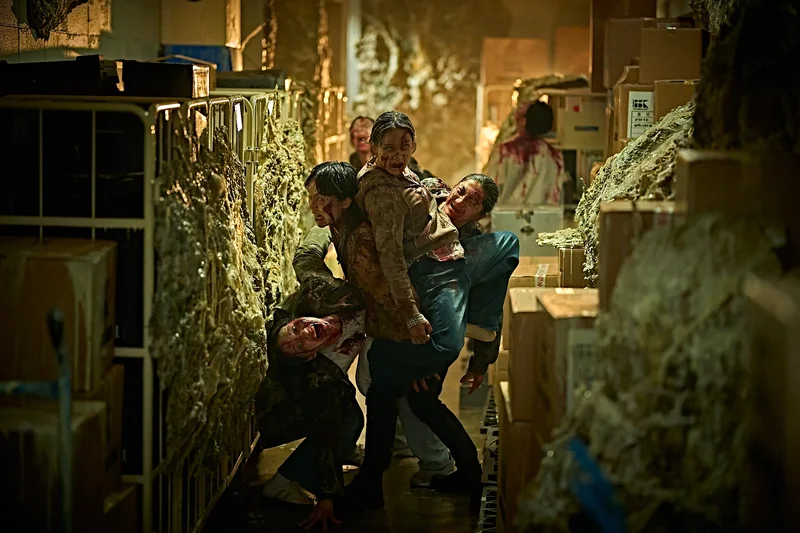
Yeon Sang-ho broke into the movie industry with Train to Busan, a pulse-pounding zombie thriller with emotion and inventiveness to spare. Now, 10 years later, Yeon is back with a brand-new zombie movie that trades Busan's train setting for a sprawling shopping mall and swaps the aggressive 28 Days Later-esque undead from that film for something even scarier.
In Colony, which arrives in U.S. theaters on Aug. 28, the undead are actually infected with a scientifically engineered fungus that turns them into a hivemind capable of sharing information. As the zombie horde grows and evolves, they become smarter. Yeon cleverly juxtaposes this evolution against his human characters, who succumb to panic and infighting as the situation escalates.
"It becomes an allegory to those contrasting groups," Yeon tells Polygon.
Yeon borrows liberally from classic stories like Dawn of the Dead, The Last of Us, and even Invasion of the Body Snatchers, but remixes everything to create a uniquely horrifying addition to the undead canon. In a conversation over Zoom, the director answers three questions about the inspiration for Colony, and the meaning behind his excellent new movie.
1 How video games inspired Colony
In previous interviews, Yeon has said that he directed Colony to feel like a video game. So which games inspired the director?
"I feel like the games I'm about to refer to are too old," Yeon says, "and even if I say them, you won't know what they are. I will say there is a game that came out a while ago called Road Runner. It's more of like a puzzle-type game where you're going through very complicated structures and every time you go through one of them, you get another complicated structure."
Colony doesn't borrow from any one video game in particular, according to Yeon. Instead, the entire structure of the film is inspired by the experience of playing any game where the difficulty increases over time.
"What I honed in on was that the zombies in Colony, they evolve, their collective intelligence evolves," he says, "and I wanted to feel like every time they evolve, you are in a new stage of the game."
The director also hints that if Colony gets a sequel, it may not be a movie at all.
"One of the companies that we co-produced this with is called Smilegate," Yeon says, "and they are actually an online game company. They developed a game called Crossfire. And so when I was in the production stages, we were talking about maybe the sequel to Colony could be a game and that could be a game that comes from Smilegate. So I will say there were definitely some more gamifying elements that I wanted to incorporate into this film."
2 Was Colony inspired by The Last of Us?
Any zombie movie where the zombies are created by a fungus will automatically draw comparisons to The Last of Us, which uses a similar premise to create a post-apocalypse setting. However, while Yeon is very familiar with that franchise, he says it wasn't a direct inspiration for Colony.
"I have seen The Last of Us," he says. "I'm a fan of the game and I also remember having a lot of fun playing the second game. I wouldn't say that The Last of Us was a direct influence on this film. A closer reference would be Invasion of the Body Snatchers, the '70s film. I honed in on the collective intelligence they're working with, as well as the very unique signature gestures that they make when discovering a human being."
3 What about Dawn of the Dead?
George A. Romero famously set his second zombie movie, Dawn of the Dead, in a shopping mall as an unsubtle commentary on consumerism. Colony also takes place in a mall. So is Yeon trying to make a similar statement?
"In Colony, it's essentially a contrast and a fight between zombies versus humans," he says. "I wanted to contrast the change that happens within each group. With the zombies, they start primitive, but they quickly evolve using their collective intelligence. On the other hand, humans start civilized and then, due to their individual desires and selfishness, they come into a more barbaric or primitive state. Setting the scene inside a shopping mall, that actually does represent human civilization, but seeing that shopping mall just covered in the goo of the zombies, it becomes an allegory to those contrasting groups."
Colony releases in U.S. theaters on Aug. 28.