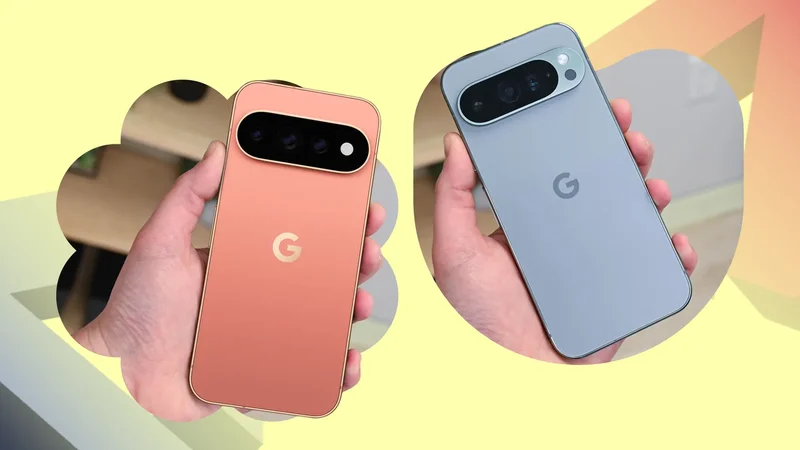
For months now, I have been eyeing an upgrade from my Google Pixel 9 Pro XL to the newer Pixel 11 Pro.
I prepared my wallet for the hit. I double-checked my local backups to guarantee a seamless transfer when the time came. All was set.
Then the big Pixel announcement arrived, and reality set in quickly. The Pixel 11 Pro is far from the giant leap forward I was holding out for.
Or maybe my trusty Pixel 9 Pro XL is holding up so well that upgrading to the Pixel 11 Pro feels like a hard sell, despite the two-year gap.
The Google Pixel 11 brings fresh perks
But they feel more like refinements
I have owned my Pixel 9 Pro XL for over a year, so I wasn't in any rush to replace it.
Persistent software quirks, such as erratic battery drain after updates and unstable cellular drops, initially pushed me to upgrade.
A month before the Made by Google showcase, I had mentally committed to pulling the trigger on the Pixel 11 Pro.
When the Made by Google curtain lifted, we finally learned the official Pixel 11 hardware and features.
On paper, the Pixel 11 Pro packs enough paper specs to turn heads among enthusiasts and fresh buyers alike.
It houses larger ultrawide and telephoto sensors for boosting Night Sight performance in these scenarios.
The Tensor G6 processor also promises notable gains in speed and thermal efficiency compared to the aging Tensor G4 under the hood of my Pixel 9 Pro XL.
Plus, Google threw in flashy hardware touches like HiLight — a multicolored, enlarged LED array that lights up as visual cues during incoming calls and when Gemini is listening.
There's also a brighter Super Actua display and faster Qi2 charging. These spec sheets paint an alluring picture.
On top of that, there are other fresh software features such as Magic Capture, Camera Looks, and 120x Super Res Zoom.
Still, all of these feel more like incremental polish than genuine upgrades, even after two generations.
Google Pixel's durability and style are unchanged
The Pixel 11 Pro is even more prone to cracks than before
The Pixel 9 features an overhauled design, which departs from the edge-to-edge camera visor and sharper corners of the Pixel 8.
By contrast, the Pixel 11 offers minor aesthetic refinements rather than notable visual changes.
Refinement is welcome, but after two years, it makes for an uninspiring upgrade.
The display bezels remain surprisingly chunky, and the front cover glass is the same Gorilla Glass Victus 2 from 2024.
That means if you expect the Pixel 11 Pro to fare better under daily stresses and accidental bumps, you'll only be disappointed.
I could look past the beefy bezel if it meant a sturdier chassis, but that trade-off never materialized.
Moreover, we are left with the same footprint, which feels jarring when rival manufacturers spend every cycle slimming down and hardening their hardware.
For instance, Samsung continuously introduces a tougher build or a custom Gorilla Glass on every Galaxy S. This year's Galaxy S26 Ultra is not only thinner but also sports a more durable Armor Aluminum 2.
So Google has little excuse to be lazy. With a two-year gap, it should have had enough time to bring sturdier hardware, or at least shave off a few millimeters.
Worse, documentation from the European Product Registry for Energy Labeling (EPREL) shows the Pixel 11 Pro scored worse in standardized drop tests than the Pixel 10 Pro.
In contrast, the Pixel 10 Pro and Pixel 9 Pro earned an A for drop resistance, while the new Pixel lineup earned a B. This indicates lower durability against accidental drops in the new Pixel.
Google reduced the battery capacity
A bigger cell should have solved my battery woes
After daily driving the Pixel 9 Pro XL for over a year, the battery is my biggest complaint. I hate that I need to charge my Pixel phone twice a day, just to make sure it won't die overnight.
While buggy updates can also be blamed, a bigger capacity should have addressed this shortcoming.
Google equipped the Pixel 10 Pro with a larger 5,200mAh battery, a modest improvement over my Pixel.
That makes it all the more baffling when both the Pixel 11 Pro and Pro XL feature smaller batteries.
The Pixel 11 Pro XL packs a 5,115mAh battery, which is 85mAh smaller compared to its direct predecessor.
Granted, battery size doesn't tell the full story. However, early official battery benchmarks indicate a runtime difference of less than an hour, which falls well short of solving my day-to-day charging anxiety.
I would much rather hold on to my existing device for another year than spend a grand on the new Pixel 11 Pro that offers relatively unchanged endurance.
Camera upgrades aren't enough
My Pixel 9 Pro is still an excellent camera phone
The camera setup on my Pixel 9 Pro XL was the central reason I bought the phone. Even after over a year, it remains an exceptionally reliable camera.
I had hoped Google would deliver meaningful hardware this year, but when it announced the Pixel 11 Pro, the changes feel partial.
While the telephoto and ultra-wide modules gain slightly larger sensors, the Pixel 11 Pro still relies on the same primary 50MP sensor that has been used for over five years.
Technically, it's a new sensor with an f/1.68 aperture, but its size is unchanged at 1.3-inch, and so each individual pixel is 1.2 micrometers.
To its credit, Google refines image output every year through an upgraded ISP, tuned algorithms, or wider lens apertures. That's true in the Pixel 11 Pro, which received a new faster Night Sight capture and 5x portrait mode.
I wasn't expecting Google to chase a 200MP sensor like Samsung and other Chinese manufacturers do, but the main sensor deserved a genuine upgrade beyond the software additions.
Sure, the new software tricks and extended digital zoom are neat perks, but pairing them with aging hardware makes the real camera progress feel stale.
Swapping on a larger main sensor would have delivered better overall results than marginal spec bumps on secondary snappers.
My Pixel 9 Pro XL already shoots incredible photos and crisp videos, so there's very little reason to pay for a comparable camera setup.
Pixel generation feels less transformative each year
By opting for incremental refinements year after year, Google has created an unusual predicament for itself.
Upgrading every two or three Pixel generations no longer delivers the transformative leap it once did, nor is it economical given recent price hikes.
The silver lining is that Google built my Pixel 9 Pro XL so well that it easily holds its ground today.
Sure, I have to contend with unpredictable battery drops, occasional modem hiccups, and missing out on Google's newest agentic Gemini gimmicks and a more efficient processor.
But as an everyday driver, my phone feels like a reliable machine for both everyday and demanding tasks.
I will happily keep using my current device until the battery truly gives out, or until Google learns how to make an upgrade that actually feels like one.
Google Pixel 11
-
**Brand** -
**SoC** - Google Tensor G6
-
**Display** - 6.3-inch Actua display
-
**RAM** - 12GB
-
**Storage** - 256 or 512GB
-
**Battery** - 4985 mAh
The Google Pixel 11 is the latest, more compact, and more affordable flagship in the trio. For many, it might actually be a more compelling upgrade than the Pixel 11 Pro.