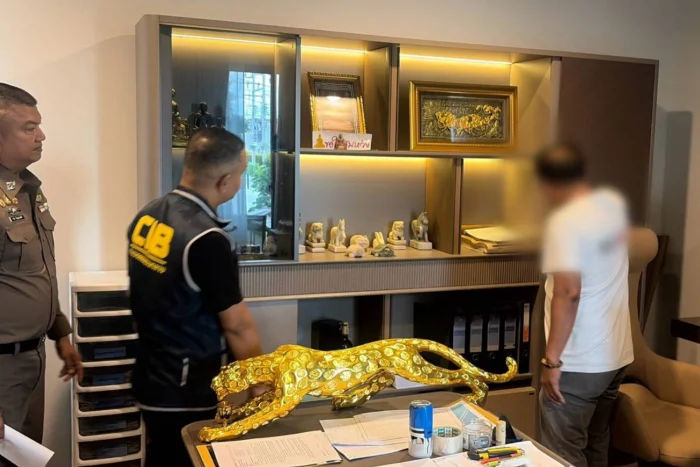
Economic crimes police have arrested three people allegedly involved a network that issued and sold fake tax invoices, costing the state 360 million baht in lost revenue, the Central Investigation Bureau (CIB) announced on Monday.
The network had been operating for about five years, with most of its clients being petrol station operators and construction firms, CIB chief Pol Lt Gen Natthasak Chaowanasai, said at a press conference on the outcome of operation "Anti Ghost bill".
At least 100 officers were deployed in raids on 10 targeted locations - four in Bangkok, three in Nothaburi, and one each in Nakhon Ratchasima, Samut Prakan and Chaiyaphum provinces.
The raided premises included residences and companies linked to people issuing fraudulent documents, companies allegedly buying and using the fake invoices, and accounting firms involved in the network.
One woman and two men were arrested on warrants issued by the Central Tax Court and face charges of jointly issuing tax invoices without legal authority to do so.
They were identified as 61-year-old Ratha, 50-year-old Khanaphot and 33-year-old Pandecha. No other personal details were released.
Pol Lt Gen Nattasak said the Revenue Department had earlier received information about a group of individuals and companies selling tax invoices without actual transactions involving goods or services.
Ms Ratha was found to be the sales agent of the network, and was known as "Aor Ratha". She contacted potential customers through an online group that allowed only close networks and individuals, Pol Lt Gen Nathasak said.
An undercover officer had infiltrated the network. On gaining the members’ trust, the officer negotiated for and purchased fake tax invoices from them on several occasions.
The invoices were issued in the name of a company whose authorised director was the 33-year-old suspect, Pandecha.
After customers specified the value they wanted on the invoice, payments were transferred to a bank account belonging to another suspect, Khanaphot, which was believed to act as a mule account for Ratha, to conceal her identity.
Pol Lt Gen Nathasak said the gang used other people to mail the fake invoices through Thailand Post, with third-party names used on the envelopes.
Investigators allege Ms Ratha sold fake tax invoices to numerous customers nationwide and then shared the proceeds with Mr Pandecha. He was found to also use an accounting firm to increase the company’s registered capital, which stood at 400 million baht.
Over the five-year period, Mr Pandecha allegedly filed annual financial statements reporting revenue of 300-400 million baht in a bid to make the company appear credible.
Investigators would expand the probe and take legal action against all the companies involved, Pol Lt Gen Nathasak said.
The group's illegal activities had caused damage to the country’s economic system and development, totalling about 360 million baht.
Authorities seized more than 200 items during the raids - 105 sets of documents related to tax invoices, 12 files of input and output tax reports, 31 files of postal delivery records, 17 files of contracts, sales and money-transfer documents, 18 bank passbooks, 18 company stamps, 20 computers and other electronic devices, with 15 mobile phones.