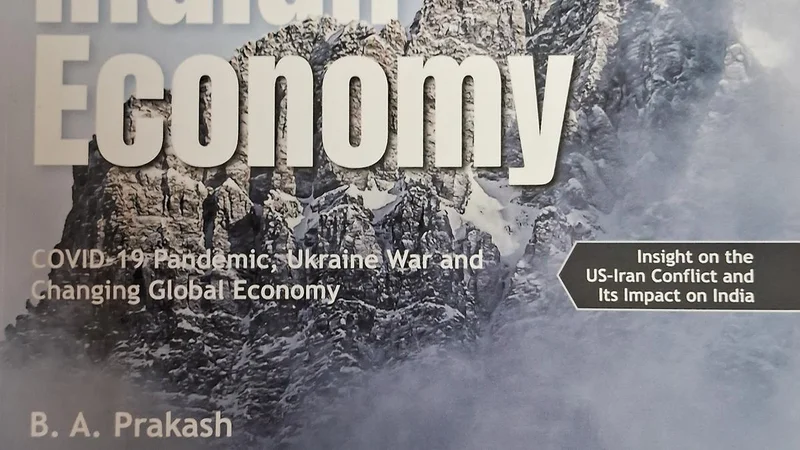
The global turmoil and changes in the economic system caused by the COVID-19 pandemic and conflicts such as the Russia-Ukraine war have, in fact, created a favourable environment for the Indian economy to emerge as a “world economic power,” a new book argues.
Indian Economy: COVID-19 Pandemic, Ukraine War and Changing Global Economy authored by B.A. Prakash, former chairperson of the Kerala State Finance Commission and the State Expenditure Review Committee, points to changes such as deglobalisation and the transformations in international trade, and India’s strengths in key areas as the basis for this argument.
Talking points
“During the post-COVID-19 period, India emerged as the largest populous country in the world, the global leader of international migration, the recipient of the largest amount of remittances, and the fastest-growing economy among the top 10 countries in the world. India has succeeded in developing a world-class digital infrastructure. The global changes such as deglobalisation, shift to a mixed economy, fragmented markets for international trade etc. have created a favourable environment for India’s economic development,” the book notes. The book, published by Pearson, will be released at the YMCA here at 3 p.m. on Tuesday (August 18, 2026).
Other advantages include the use of the English language as a language for higher education and India’s existence as a “stable democracy” with democratic institutions, it notes. “An assessment of the performance of the Indian economy by the World Bank during the post-COVID-19 period also indicates a better performance.”
The book further argues that the structural adjustment reforms introduced in 1991 and the post-2014 economic reforms provide a solid foundation for giving India the big development push.
Structural changes
At the same time, Prof. Prakash calls for structural changes to the Indian economy that allows it to be market-friendly and a robust mixed economy, promote foreign trade and a shift from the GDP development strategy to one that focuses on Sustainable Development Goals.
Bearing the characteristics of a dual economy—a backward rural economy and a developing urban one—India faces a “persistent backwardness” of the rural economy, poor living conditions of the people and high incidence of rural poverty, he notes. India also needs strong policies to address regional disparities, unemployment, farmer distress and climate change issues while promoting international migration and conserving biodiversity, according to him.
Published - August 17, 2026 06:24 pm IST