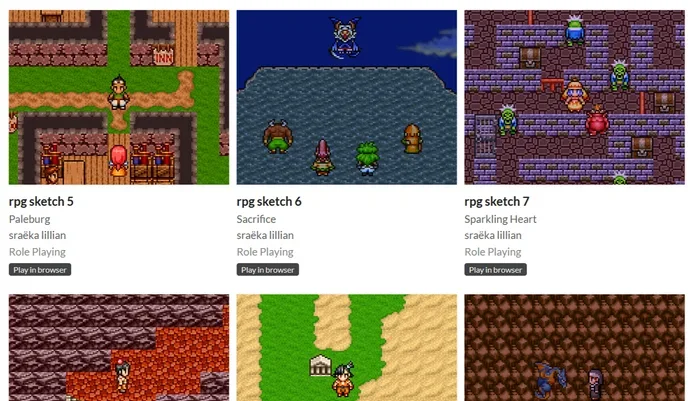
There's a running joke in the world of THEA-TAH that Shakespeare's Hamlet is a play made up entirely of quotations. I often get the same feeling when I play a fantasy RPG, and especially a fantasy RPG created with toolkits such as EasyRPG or RPG Maker that come with their own freely reusable assets, resulting in a slew of homebrew RPGs that can seem interchangeable, on the surface.
A lot of RPGs are rearrangements of certain conventions and stereotypes popularised by behemoths like Dragon Quest and Final Fantasy: geographical clichés, such as the starting village, the forest labyrinth, the bustling hub city, or the endgame airship. And then, smaller recurring devices such as rat-killing tutorials, or the fact that villages always have just the one item shop, just the one armory, just the one inn.
If you adore RPGs because they can be so flagrant in picking and choosing from a library of musty old mechanics and narrative devices, you might be interested in Sraëka Lillian's series of "RPG sketches" on Itch.io. They are "miniature RPG experiments", each knocked together inside a week, and often accompanied by some copious design notes that are themselves a delight to read.
While some of the "sketches" are sillier and looser in focus – see Mencollector, in which you have a couple of moments to run around a map scooping up blokes, including blokes who may initially present as monsters – others pick on and flesh out a specific thumb-worn convention, such as healing springs or heist levels.
A few are more overt studies of, say, religion or racism. Many are a bit ramshackle, by virtue of the short development time. Some are, I think, unfinishable. All are very much exercises in developing Lillian's craft, rather than perfect execution.
The heist sketch, Keep Wishing, is a wonderful and whimsical bit of potted stealth puzzling. "I love the Dragon Quest tradition of 'the castle' as it matures across the first four or five games," writes Lillian in the accompanying notes, "opening up as you find keys, letting you sneak into vaults, unlock prison doors, and sneak into kings' bedrooms through oblique routes. These spaces don't typically (or ever? my memory fails me) have enemy encounters or stealth mechanics, resisting you only through locked doors and level geometries."
Shortest Path, meanwhile, uses high encounter difficulty as a club to push you search for shortcuts, which I like inasmuch as I've never really thought about how the threat of random battles teaches you to move through a space.
"The idea was for the dungeon to have, in addition to its visible main entrance, several hidden entrances which are discovered by progressing through the dungeon," Lillian writes. "The path from the main entrance to the objective is much farther than your meager resources will take you, and success requires finding a closer entrance to shorten your path through the dungeon."
There are 31 of these sketches as of writing. Rather than trying each one in succession, I've been enjoying dipping in and out over the past couple of months. Here's another excerpt from the author notes for the first instalment, Butterfly's Big Knife Fight, which serves as manifesto for "sketchiness" in general:
"My anxieties about the quality of my work are deep and old; when people lack these anxieties, or rather when they share them but aren't deterred by them, I feel something sort of electric. It looks charismatic, graceful, fearless (whether or not fear is actually absent). It makes my world feel bigger, like more things are possible, like I don't need to be stay curled up in a motionless ball to hide my less-than-prodigal powers of creation. I want that fearlessness for myself. Like anything else, I guess, if you want it, you have to work at it. So I guess I have to post another game next week."
I should mention that Lillian is the developer of the amazing Cataphract OI, in which you escort a Supplicant through a dungeon, questing against the clock while limiting your charge's exposure to the Fray. If you enjoy these sketches, absolutely give that a whirl.