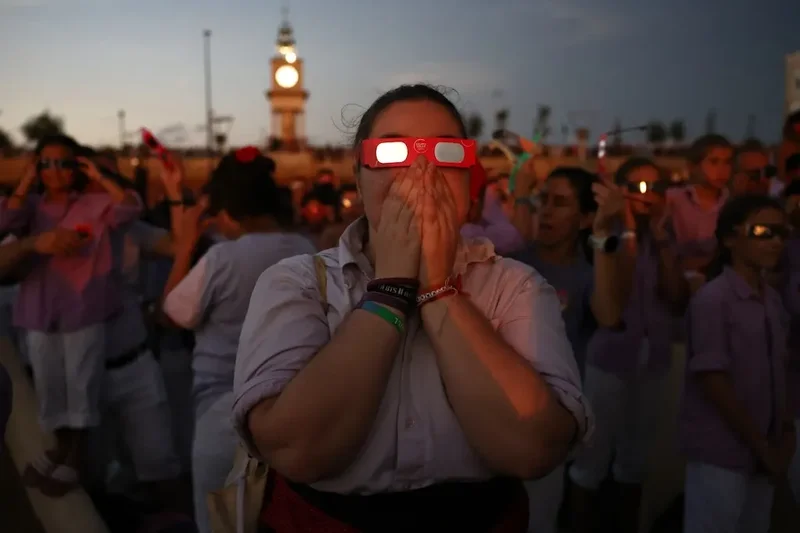
There was a lot of hype surrounding last week's total solar eclipse in Spain, not to mention amazing stores and incredible photos.
The problem is, however, were several reasons you could have missed it due to being too far south, not in the line of totality or there was too much cloud cover.
There's no need to be jealous though as there are two more eclipses coming up next year and the year after.
READ ALSO - IN IMAGES: Solar eclipse plunges large swathe of Spain into total darkness
Q: When will the eclipse take place next year?
A: Another total solar eclipse will take place next year on August 2nd 2027. This time it will occur in the morning, around 10:50 a.m., so the sun's high position will make it easier to see, rather than the one last week, which happened just before sunset.
Q: Where will I be able to see it from?
A: In Spain, totality will be able to be seen from Ceuta and Melilla, almost the entire province of Cádiz, part of the province of Málaga, and the southernmost areas of the provinces of Granada and Almería . In the rest of the country, it will be seen as partial at around 70 percent.
**Q: How long will it last? **
A: While the total eclipse last week could only be seen for around a minute or less in most places, next year it will last much longer. In Cueta it will last for 4 minutes and 48 seconds, while in Cádiz it will be seen for just under 3 minutes and in Málaga for just under 2 minutes.
READ ALSO - 'It was the most beautiful thing I've seen in my life': Your photos of the eclipse in Spain
Q: Should I book in advance if I want to see it?
A: Yes, given the hype of the total solar eclipse last week, you should definitely start booking far in advance if you hope to see the next one. Hotel prices in Zaragoza, León and Burgos for example surged by 500 to more than 800 percent during the recent eclipse. Trains from the north are also expected to book up quickly for next year's date.
Q: What’s happening in 2028?
A: In 2028 another eclipse will take place, but this time it will be an annular eclipse. This means that the moon will pass between the Earth and the sun, as before, but without completely covering it. This creates a bright ring around the moon called the ring of fire.
Q: When will it take place?
A: This eclipse will take place in the winter instead of the summer, on January 26th, 2028, so you’ll only have around six months to wait between the one in 2027 and the one in 2028. Like the one this year, it will occur in the evening, shortly before nightfall, when the sun will be low in the sky and observation will be more difficult.
Q: Where will I be able to see it from in Spain?
A: It will be visible across almost all of Andalusia, as well as southern Extremadura and Castilla-La Mancha, parts of Madrid, Aragón, Murcia and Valencia, as well as parts of Catalonia, and the westernmost Balearic Islands. From the rest of the country, it will be seen as a partial eclipse.
Some of the cities where the eclipse can be enjoyed for the longest time are Seville, Córdoba, Albacete and Valencia. The annular phase will last an impressive 7 minutes in some of these places.
Q: Any more chances to see another total eclipse after these two dates?
A: There is, but you’ll have to wait a long time. It won’t be until 2053 that another total solar eclipse will be visible from Spain.