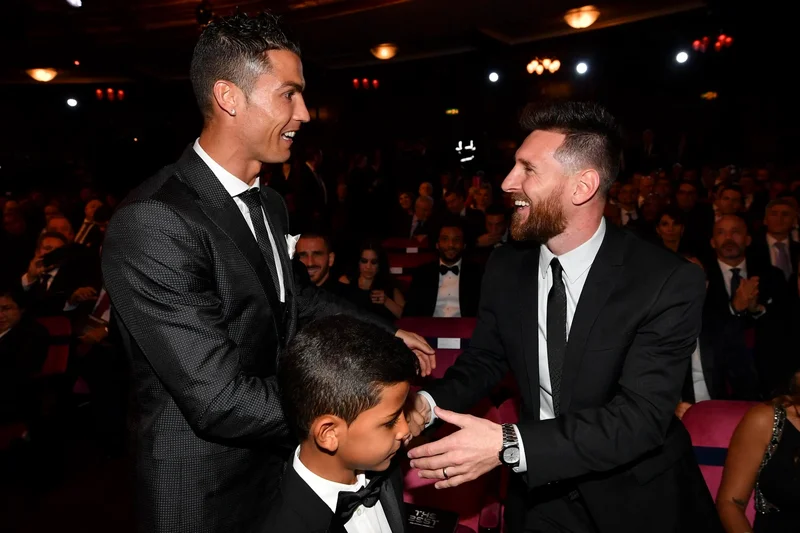
For almost two decades, Lionel Messi and Cristiano Ronaldo have been soccer’s ultimate business proposition: Two extraordinary athletes, two competing brands and one endless argument over who was better.
This summer’s World Cup was supposed to be their final shared stage. The idea that either could survive another four-year cycle (Messi is 39 and Ronaldo 41) and play at the 2030 World Cup seemed implausible. That both might do so was nearly unthinkable.
Instead, the tournament provided two very different reminders that neither player was quite ready to surrender the spotlight.
Messi recorded eight goals and four assists, delivering another reminder that his genius has proved remarkably resistant to age as Argentina finished runners up. Messi did not talk to reporters after the game – his future with the national team very much in doubt.
Ronaldo, meanwhile, appeared increasingly conscious that the end was approaching. After Portugal’s meek last-16 defeat to Spain, Ronaldo spoke about his legacy, insisting that he had given everything to his country. His comments at the time sounded less like a victory lap than a negotiation with himself.
That changed this week. In an interview with Vogue, Ronaldo said he expects his current contract with Saudi club Al-Nassr to be his last.
“This is probably my last year of football, and I want to leave a spectacular legacy,” he said.
The important word was not “last.” It was “legacy.”
For the first time, Ronaldo sounded as though he was contemplating life beyond the game rather than simply resisting it. The timing was striking because Messi is also confronting his own mortality, both personally and professionally.
Messi’s contract with Inter Miami runs through 2028, but the recent death of his father, Jorge Messi, has introduced another uncertainty into his future. Jorge was there from the start, helping broker his son’s Barcelona trial and overseeing much of the career that followed. Messi’s tribute suggested that the end of their shared journey is now painfully close.
“I don’t know how to keep going,” Messi wrote following his father’s death on Aug. 8.
The timing is significant because Messi and Ronaldo have spent 18 years defining each other. Since first meeting in the Champions League in 2008, they played 36 competitive matches against one another, sharing almost 3,000 minutes on the pitch. Between 2009 and 2018, their rivalry transformed El Clasico into a global TV event and turned La Liga into a weekly referendum on individual greatness.
For 10 straight years, from 2008 through 2017, the Ballon d’Or belonged exclusively to one of them. Messi eventually won eight, while Ronaldo won five.
Their statistical achievements are almost impossible to separate from their commercial value. Ronaldo has scored almost 1,000 goals and holds the records for international appearances and international goals. Messi scored a record 91 goals in a calendar year and has won the most European Golden Boots as the continent’s top scorer.
Messi’s World Cup triumph with Argentina in 2022 removed the last major objection to his claim as the greatest player of his generation, possibly even of all time. Add two Copa America titles and the remaining debate has become less about Messi versus Ronaldo and more about where Messi belongs in the game’s history.
That does not diminish Ronaldo. Quite the opposite. Messi may have been the more naturally gifted player, but Ronaldo’s extraordinary career was partly built on the challenge of competing with him. He conquered England, Spain and Italy, won the European Championship with Portugal in 2016 and continually reinvented himself.
Their rivalry created value because neither was content simply to be great. They had to be greater than the other.
Now, however, the two superstars are also symbols of soccer’s changing commercial geography. Neither chose a nostalgic final chapter. Messi did not return to Barcelona or Newell’s Old Boys. Ronaldo did not finish at Sporting CP or in Madeira.
Instead, Messi moved from Paris Saint-Germain to Inter Miami, helping turn MLS into a global commercial proposition. Ronaldo became the face of Saudi Arabia's increasingly ambitious project after joining Al-Nassr.
Indeed, both made bets on emerging markets. Ronaldo’s is particularly consequential. Saudi Arabia has been accused of using sports investment to burnish its international image, a criticism that will remain part of the discussion around his legacy.
If the Saudi Pro League succeeds in becoming a major global sports market, Ronaldo will have been more than its most famous player. He will have been one of its most important marketing assets.
Messi’s move to Miami carries a similarly significant commercial dimension. His presence has demonstrated how one superstar can alter the visibility, sponsorship potential and global perception of an entire league.
That may ultimately be the most important legacy of the Messi-Ronaldo era. They did not simply dominate soccer. Instead, they demonstrated the extraordinary economic power of the individual athlete.
Stroll through any city on the planet and it is now common to see Inter Miami shirts with Messi's name or Al-Nassr shirts carrying Ronaldo's. Fans increasingly follow players as brands, not merely clubs as institutions.
The next generation of players — Kylian Mbappe, Lamine Yamal and Erling Haaland among them — will inherit a soccer economy built for superstar personalities. But they also face an impossible comparison. Messi and Ronaldo were not merely famous players. They were the protagonists of the same story for nearly two decades.
The sport will survive Messi and Ronaldo. It will produce new stars and new commercial icons. But it may never again produce two players capable of occupying the same sporting and cultural space for such a long stretch of years.