When I wear my Pixel Watch 4 on my wrist every day, I know I'm putting a lot of faith and trust in its ability to detect dangerous and health-critical moments in my life and then either notify me or call emergency services on my behalf.
It can sense if I fall, if I've been in a car crash, if my heart stops, if I have any signs of Afib — all of these are crucial safety features that I've come to absentmindedly rely on, hoping I would never need them but knowing they're working in the background.
A couple of weeks ago, my Pixel Watch 4 surprised me by triggering another notification I'd almost forgotten about during a moment of extreme stress. That helped me better navigate the next hour, calm down, and probably saved my heart from something more dangerous.
How the Pixel Watch 4 came in clutch for me
The high heart rate notification felt like a slap
A couple of Saturdays ago, I was up early but still in bed browsing on my phone, waiting for my partner to wake up. I was just chilling, doing nothing all that serious, mostly checking a cool online community, where chats went from fun banter to very serious topics.
The previous night, one of the channels had "lightheartedly" discussed military topics, and I, the Lebanese child of war, had signaled that that topic discussed that way wasn't safe for me. Saturday morning, the chat had resumed with more levity and detachment.
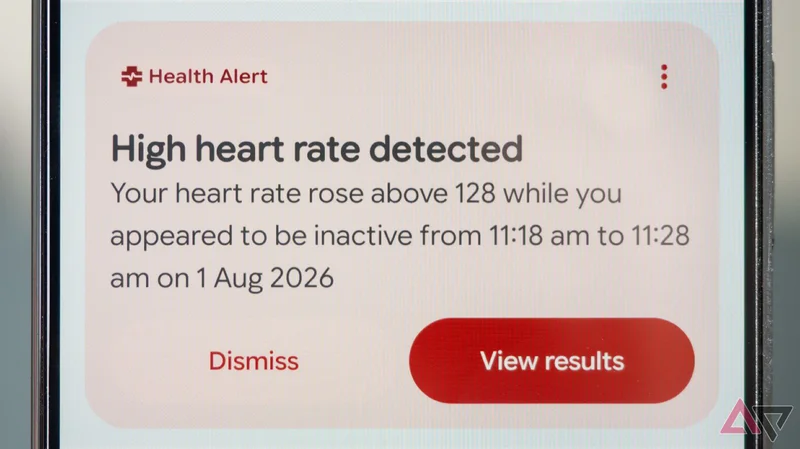
I knew I was getting angry, stressed, anxious; I just didn't suspect how much. A few minutes after I saw those messages, I got a bright red notification on my Pixel phone: High heart rate detected, that you can see at the top of the article. I'd never seen that one before.
Of course, I took it seriously. I tapped the notification and found the graph in the Google Health app. My heart rate had shot up to 140bpm while still lying in bed and using my phone. It had stayed above the safe threshold long enough to trigger the Pixel Watch's warning.
I, sadly, know trauma. I know that it sometimes washes over you like a gentle wave, and sometimes, it hits you like an earthquake followed by a tsunami. You can't choose which option gets triggered when, and this was clearly the latter.
My Pixel Watch had detected that my body wasn't handling the stress of that moment and that discussion, and it alerted me. On my own, I might've dismissed it as some passing anger and tried to ride it through — who knows whether I would've calmed down or gotten worse?
I took the Pixel Watch 4's warning very seriously
Don't dismiss these notifications if they pop up
In the Google Health app, I was able to look at the graph to see what had gone wrong. It clearly started the moment I read those messages: my heart rate shot up without any warning and remained high.
The graph said something was off, but I had not been paying attention to my own body. Ridiculous. My only excuse is that when you experience enough stress, you stop differentiating between serious and not, even when you have a background in health, like I do.
My Pixel Watch 4's warning forced me to drop my phone and actually listen to my body for a second. I realized this wasn't normal anger or disappointment, I was feeling distinct heart palpitations. It felt like I was running a 10K while casually lying in bed.
In 2025, I had an episode of extremely high blood pressure caused by personal grief and compounded by the latest happenings back home in Lebanon, so I knew not to take this new "simple" heart rate warning lightly.
It took me less than five minutes to write a quick message to the community and leave it. I chose my own safety and mental health. Then I put my phone down, I opened the Relax app on my Pixel Watch 4 and started a breathing relaxation session.
I repeated that a couple of times over the next hour to help myself calm down, then again over the rest of the day and the next day. I coupled that with some meditation, and I talked about what happened with my partner and some friends. I managed to get through it.
Turn on high and low heart rate notifications now
Your Pixel Watch or your Fitbit likely offers this feature
Almost every Fitbit-powered tracker offers the feature to monitor for high or low heart rates and warn you about them. It's one of the most basic heart safety features of wearables and doesn't require any special hardware besides the heart rate monitor.
The list includes every single Pixel Watch model, from the original to the latest Pixel Watch 5, as well as most modern Fitbits. The Fitbit Air, Charge 3 and above, Sense and Sense 2, Versa 3 and 4, Inspire 2 and 3, and Luxe all offer it. To enable it, follow these steps:
-
In the Google Health app, go to the **Heath**tab at the bottom right. -
Scroll down to the **Health checks**section. -
Check both the **High heart rate**and**Low heart rate**options. They should be on. - If they're not, tap and follow the guide to enable them. You can customize both thresholds.
Once they're set, you can always tap the overflow ⋮ button on the top right to go to their Settings and change them. Google also explains there how these episodes are detected and when the alert is triggered.
A high heart rate isn't lethal, but it reminded me to listen to my body
A minor episode of high heart rate isn't necessarily dangerous. We all go through periods of stress and difficulty and the Pixel Watch 4 tends to detect stress all the time. But persistent or repetitive episodes of high heart rate are a sign that you should pay attention.
What one high heart alert like this tells you, based on experience, is to stop and listen to your body. Is there any factor causing that stress, anger, or anxiety? Can you do something about it to stop it from getting worse?
If so, immediately do that. Get yourself out of a normally supportive and fun community. Walk away from an argument. Close a work email or leave a work meeting. Do what you need to do to get yourself back to normal. Nothing is worth a life.