Thailand would maintain its neutral position between the United States and China and resist pressure to choose sides in the global race for artificial intelligence (AI), Prime Minister Anutin Charnvirakul said on Monday.
Mr Anutin was responding to reports that the US was considering excluding countries that join a China-backed AI framework from a US-led coalition.
Reuters reported on Aug 14 that the US was considering the move, citing a US official and an internal draft. The draft letter was reportedly prepared by the State Department for the 35 signatories of a US “AI Opportunity Statement” signed in June this year.
Asked whether Thailand's neutral position could affect trade negotiations with the US, Mr Anutin, also the interior minister, said the two issues were unlikely to be linked.
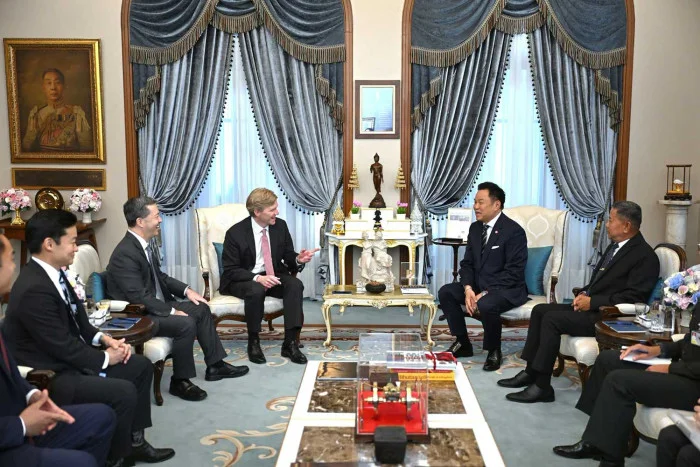
He said Thailand's security cooperation with the US was also separate from trade talks. He cited a meeting last week between US defence officials, led by Pentagon policy chief Elbridge Colby, and the Thai government in Bangkok.
Mr Anutin said both sides had confirmed that security cooperation, including the Cobra Gold military exercise and US military support, was unrelated to trade negotiations.
Asked whether the US delegation had pressured Thailand to take a position on China, he dismissed the suggestion.
“Not at all. Didn't you see the atmosphere? It was all about appreciation for our cooperation. Why say they came to pressure us? They simply came to meet us,” the prime minister said.
Higher Education, Science, Research and Innovation Minister Yodchanan Wongsawat said Thailand should focus on building its own AI capabilities rather than choosing between the US and China.
He said Thailand had discussed AI-related issues, including semiconductors, with several countries and attended an AI meeting in China under the World Internet Conference.
The government would consider whether to join the initiative, he said.
Thailand should strengthen its own capabilities and avoid becoming dependent on any major power, Mr Yodchanan said.
The government has been working with countries including France, Japan and South Korea in areas where Thailand lacks sufficient capacity.
He said Thailand also needed to invest in basic science, technology, hardware, data and cybersecurity rather than focusing solely on AI.
A strong national database would give Thailand greater flexibility in choosing which AI systems and foreign partners to work with, he added.
Foreign Affairs Ministry spokesperson Jaithai Upakarnitikaset said Thailand had not received the letter reportedly being sent to US allies and would monitor developments.
The China-backed initiative, known as Pax Silica, aims to secure supply chains for AI models, semiconductors and critical minerals amid growing technological rivalry between Washington and Beijing.