The deep blue seas harbor a wide variety of fascinating, almost alien-like forms of life, from the tiniest of creatures to massive predators that dominate the ocean. This year’s finalists from the Ocean Photographer of the Year Awards celebrate the otherworldly beauty hidden beneath Earth’s waters, from rare scenes of courtship between two octopuses to a male cardinalfish sheltering his young inside his mouth.
The annual competition selects finalists in different categories like adventure, conservation, and human connection, highlighting the changing habitats of sea creatures and offering hope for ocean life. Below are Gizmodo’s favorite picks from this year’s winners.
Fish food
Photographer Andrea Michelutti captures a haunting moment as a scorpionfish consumes a lizardfish, with the prey poking out of its hunter’s gaping mouth. The image highlights the hunt, using direct light to isolate the two fish while the reef fades into the dark background, capturing one of the powerful encounters that shape life on a reef in the Philippines.
Arms of connection
In this fascinating display of courtship, a male octopus extends his specialized mating arm, known as a hectocotylus, to transfer spermatophores to the female. The interaction took place on a shallow coral reef at Lady Elliot Island, part of Australiaâs Great Barrier Reef. The male continued his approach for several minutes while the female moved across the reef before finally accepting his offer to mate.
Curious pups
In this photo, a group of young seals investigate their surroundings on Sea Lion Island in the Falkland Islands. Photographer Matty Smith captured a particularly curious pup approaching the camera lens as the group journeyed on to explore the shallow rock pools. After being weaned by their mothers, seal pups must quickly learn to swim and transition independently from land-bound pups to ocean dwellers.
A shared meal
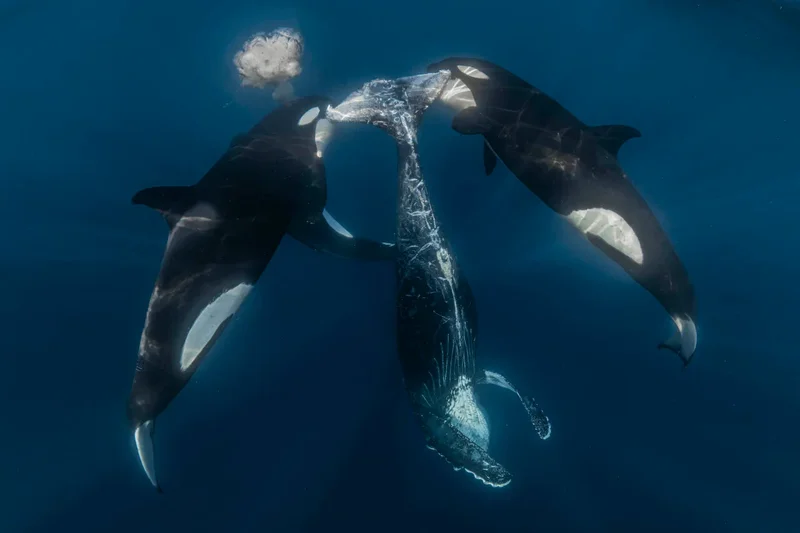
Photographer Rafael Caballero captured two orcas sharing a meal after a successful hunt. In the Pacific waters of Mexico, a pod of orcas separated a humpback whale calf from its mother. Nearly an hour later, the orcas resurfaced carrying the prey. The image highlights the cooperative hunting strategies of orcas, working together to isolate and capture large prey. The kill drew other scavengers to the scene, including silky sharks, highlighting how one event can influence an entire marine food web.
Safe haven
This photograph offers some hope for ongoing conservation efforts. Photographer Leighton Lum entered a sheltered sea cave on Maui, Hawaii, and watched as more sea turtles arrived with the rising tide at sunset. The Hawaiian green sea turtles were once heavily hunted, but their population has managed to recover through decades of protection. The above image highlights the progress made as 17 sea turtles huddle inside a sheltered cave.
Tiny life
This colorful image celebrates the hidden diversity of reef life, capturing a ladybug amphipod resting on a blue sea squirt in the coral reefs of Komodo, Indonesia. The tiny marine crustaceans measure just 3 millimeters (0.3 centimeters) wide and are famous for their bright red spots that mimic terrestrial ladybugs. The photographer isolated the amphipod using a super-macro lens, revealing intricate details that are otherwise invisible to the naked eye and allowing its translucent body to pop against the soft background of the corals.
Memorable encounter
Photographer Anita Verde captured a captivating encounter between a giant oceanic sunfish (mola mola) and a freediver in the clear waters of Mexico’s Baja Peninsula. The image was taken during the final hour of a sardine run expedition when the large, pale fish approached a group of freedivers on its own as the sunlight gave its rounded shape a soft glow.
Human impacts
While the annual competition captures the beauty of the ocean, it also highlights the stark impact of human activity on marine life. In this photograph captured in the Gulf of California, Mexico, a silky shark swims helplessly with a steel hook in its mouth. The shark was roped in after taking bait from an illegal longline less than 48 hours after Baja California’s seasonal shark fishing ban ended. The image also highlights how the loss of one animal can have an effect on its surrounding ecosystem as a small group of pilot fish remains beside the captured shark.