- See more Daily Mail on Google - save us as a Preferred Source
The Kremlin has fired a top Russian banker for warning Vladimir Putin he was leading the country into 'social crisis' and a failure to gain victory in the Ukrainian conflict.
Andrei Klepach, a longtime Moscow insider, insisted Russia 'will not win' its 'war of attrition' with Ukraine.
He forecast Putin was leading Russia into the same turmoil that triggered revolutions in 1917 and 1992.
Klepach was dismissed as chief economist at Kremlin-controlled development giant VEB.RF, formerly known as Vnesheconombank, which finances major Putin projects and plays a central role in supporting Russia's war-ravaged economy.
The boss of VEB.RF, Igor Shuvalov, fired Klepach after 'a call from above', local media reported.
A leak of the top economist's explosive comments in a speech led to his firing.
He challenged Putin's belief that Ukraine will eventually collapse in a speech, which is published on the website of the Nikitsky Club - a forum of economists, academics and government officials.
It marked a rare public critique by a senior figure at a state institution of the costs of continuing the war that Moscow launched in 2022.
'We have this illusion that everything there will collapse. It has not collapsed and will not collapse,' he said, pointing to huge Western support.
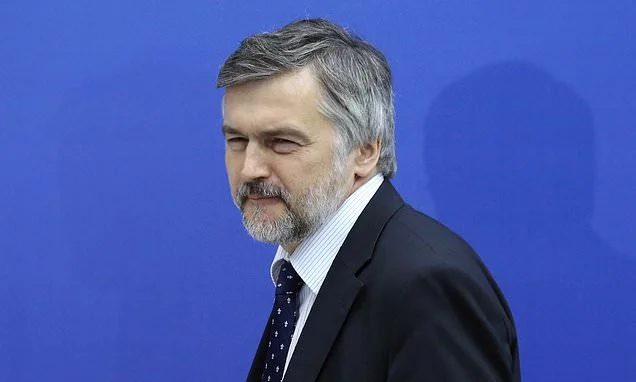
Andrei Klepach, a longtime Moscow insider, was dismissed from his top role following a 'call from above'
'We are losing both technological and economic competition globally.'
He warned: 'We are losing it not only to China and the US. In some respects, we are losing it to Ukraine.'
'The conflict in Ukraine with the participation of NATO has already lasted longer than [Soviet involvement in the Second World War], and so far its end is not in sight,' said Klepach.
'Both sides are increasing the intensity of strikes, including on each other's economies.'
Putin could make the same mistake as last Tsar Nicholas II and the Soviet gerontocracy which both steered the country in the wrong direction, he said.
He compared the danger with the February Revolution of 1917, which toppled the Romanov dynasty, and the crumb ling of the USSR in 1991.
'No one expected the February Revolution [1917] either,' he said, recalling that Soviet founder Vladimir Lenin had doubted he would live to witness a revolution only weeks before it began.
'The situation in the Soviet Union in 1991 — we had been heading towards it slowly and consistently, and everyone understood that we were heading towards a crisis, but there was no fatal inevitability that the Soviet Union would collapse,' he said.
The site of a recent Russian fiber-optic FPV drone strike that left two cars in flames in Sloviansk in the Donetsk area, Ukraine, 17 August 2026
Ukrainian rescuers work at the site of a Russian strike in Kyiv on August 16, 2026
'I believe Russia will not fall apart,' he concluded, 'but I am almost certain that we will face a social crisis.'
Veteran insider Klepach held key posts in the Russian government and the central bank as well as at arms-maker Almaz-Antey, the Tactical Missiles Corporation and state nuclear energy corporation Rosatom.
In the speech in May, Klepach highlighted Russia's resilience to Western sanctions but said pressures were mounting due to Ukrainian strikes on energy and logistics infrastructure.
He pointed to rising income inequality and a slower GDP growth rate than in the U.S. and Ukraine.
In July, the Russian central bank suggested the economy might not grow at all this year.
Over the summer, repeated Ukrainian attacks on Russian oil refineries and warehouses of top online retailer Wildberries have created supply shocks, raising inflation risks and public unease.
President Vladimir Putin has said the economy is stable despite what he called external attempts to undermine it.
'Economically we will not collapse, but our lag will continue to grow, with all the resulting consequences,' Klepach said in his speech, predicting a social crisis could arise 'precisely when nobody is particularly expecting it.'
Ukrainian rescuers work at the site of a recent Russian fiber-optic FPV drone strike that left two cars in flames in Sloviansk in the Donetsk area, Ukraine, 17 August 2026
Ukrainian rescuers use a water hose as they work to extinguish a fire at the site of a Russian strike in Kyiv on August 16, 2026
There is currently no sign of serious social unrest in Russia, amid tight wartime censorship, protest bans, long jail sentences for dissidents and the growth in influence of the Federal Security Service, the main successor agency to the Soviet-era KGB.
Klepach also criticised what he called Russia's over-dependence on China and said uncoordinated monetary, budgetary, and industrial policy had contributed to this year's economic slowdown.
'The quality of governance is almost constantly deteriorating,' he said. 'Decisions are being made all the time that have an extremely low level of justification but long-term strategic consequences.'