Friends who studied in English-speaking countries such as the U.S. and Canada could find corporate internships relatively easily. International students in Korea face difficulties with language, residency status and employment.
HANOI — “After working for a Korean company, I began to think that Korea might actually be a better fit for me.”
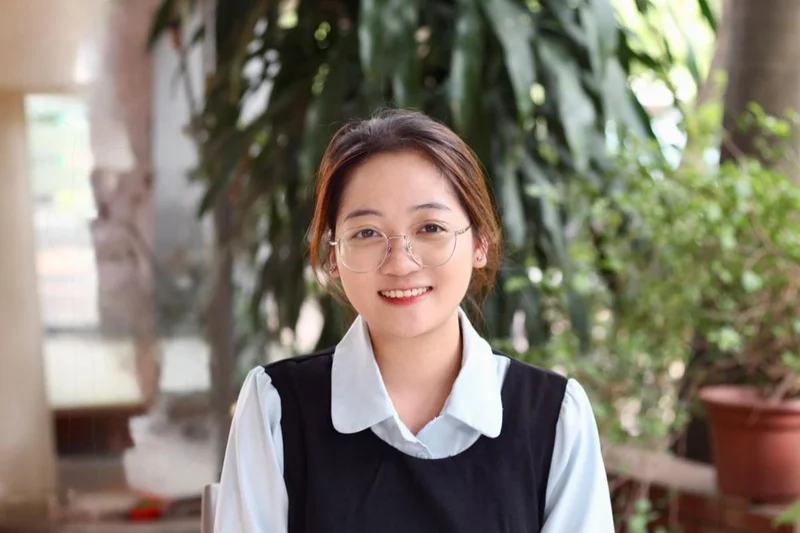
Nguyen Minh Hoa, 25, majored in finance at the University of Economics under Vietnam National University, one of Vietnam’s leading universities. As a recipient of the Korean government’s Global Korea Scholarship (GKS), she plans to study green finance, environmental, social and corporate governance (ESG) issues, and digital transformation at Seoul National University’s Graduate School of Technology Management and Economics.
Hoa had dreamed of studying in Europe when she was younger. But after working at the Vietnamese subsidiary of Woori Bank, she began seriously considering Korea as her next destination.
Speaking with the Hankook Ilbo in Hanoi, Aug. 7, Hoa said she was impressed by the way universities, companies and the government in Korea work together to tackle problems facing society.
“Some people asked me why I would give up a stable job,” she said. “But to me, stability means continuing to learn and grow while contributing to society.”
She said she hopes to find solutions to challenges facing Vietnam’s financial sector while studying at SNU and eventually become an academic who can serve as a bridge between Korea and Vietnam.
Growing interest among Vietnam’s elite
Vietnam’s top students are increasingly knocking on the doors of Korean universities. Although universities in the United States and Europe, as well as Japan, remain their preferred destinations, schools such as Seoul National University, the Korea Advanced Institute of Science and Technology (KAIST) and Pohang University of Science and Technology (POSTECH) are increasingly being added to their list of options.
In the past, many Vietnamese students went to Korea primarily to study the Korean language or to combine academic studies with part-time work. The trend is now expanding to include elite students seeking advanced technological education and a path toward becoming highly skilled professionals.
Vietnam has already become the largest source of international students in Korean higher education. According to the Korean Educational Development Institute, 75,198 Vietnamese students were enrolled in Korea last year, making Vietnam the No. 1 source country for the first time, narrowly surpassing China’s 74,820 students.
Alongside this explosive quantitative growth, a qualitative shift is also emerging.
“Studying in Korea is moving beyond simple language training toward enrollment in undergraduate and graduate degree programs,” said Catherine Hoa, vice president of MAP Education, a study-abroad agency in Hanoi. “Last year, visas for regular degree programs (D-2) accounted for 51 percent of all student visas issued, surpassing language-training visas (D-4) for the first time.”
Vietnam’s top students, graduates of prestigious universities head to Korea
In particular, top-performing students in science and engineering are turning their attention to Korean universities.
A notable example is Hoang Huong Giang, 18, who ranked first nationwide in Vietnam’s university entrance examination this year and scored a perfect 1,600 on the SAT. She has decided to study computer science at KAIST.
Speaking with the Hankook Ilbo, July 9, she said Korea’s advanced level of science and technology and its strong links with industry made the country attractive.
Pham Hai Long, 24, a graduate of the National Economics University in Hanoi, also chose Korea after turning down a scholarship to study in Europe. He received a GKS scholarship and will attend KAIST’s Graduate School of Global Digital Innovation.
“I made Korea my first choice because of its heavy investment in cutting-edge technologies and the presence of companies such as Samsung and LG,” he said. “My friends and younger students at my university are also increasingly interested in studying AI, semiconductors and data-related fields in Korea.” The National Economics University is considered a major training ground for Vietnam’s economic and business elite.
Students are also starting their preparations at a younger age.
“The age at which students begin preparing to study abroad is gradually falling,” Catherine Hoa said. “In the past, many students started looking into studying abroad after graduating from high school. Recently, however, many have begun preparing for the Test of Proficiency in Korean (TOPIK) as early as their first or second year of high school.”
Korean universities step up efforts to attract Vietnamese talent
Korean universities are also stepping up efforts to recruit gifted students from Vietnam, seeing them as a potential solution to talent shortages caused by a declining population and a growing aversion to science and engineering fields.
Professors from the College of Engineering at Seoul National University visited Hanoi University of Science and Technology (HUST) in October last year to hold an admissions information session.
“Vietnam’s top students have traditionally wanted to study in the U.S. and Europe, but Korea’s standing has improved significantly in recent years,” said Hwang Won-tae, a professor of mechanical engineering at SNU and chairman of its international exchange committee.
Universities are also offering scholarships. “Major Korean universities, including Konkuk University, Sungkyunkwan University, Chung-Ang University and Hanyang University, are working with study-abroad agencies to select outstanding students and offer them scholarships,” Catherine Hoa said. “Over the past three years, around 200 students have received scholarships and chosen to study in Korea.”
The Korean government is also providing support. The Korean Education Center in Hanoi, under Korea’s Ministry of Education, offers Korean-language courses at major Vietnamese science and engineering universities, including HUST and the University of Transport and Communications.
“We are providing Korean-language education to attract talented science and engineering students to Korea,” said Kim Hyun-dong, director of the Korean Education Center in Hanoi. “If cooperation in education is strengthened alongside the Korean wave and employment opportunities, relations between the two countries can advance to another level.”
Next challenge: Keeping graduates in Korea
Nguyen Linh, 25, graduated from the gifted class at Nguyen Thi Minh Khai High School, one of Ho Chi Minh City’s prestigious schools, before enrolling in KAIST’s computer science program.
Looking back on her time at KAIST, Linh said she found little to criticize about the university’s academic environment.
“The faculty included professors from some of the world’s top universities, and the school had abundant computing resources,” she said. “I got the impression that if students had the will to conduct research, the university was willing to invest in them.”
Linh graduated from KAIST last year and returned to Vietnam, where she joined Microsoft Vietnam. She had hoped to find a job in Korea but was held back by her Korean-language skills.
“Friends who studied in English-speaking countries such as the U.S. and Canada could find corporate internships relatively easily,” she said. “International students in Korea face difficulties with language, residency status and employment.”
Her experience highlights the need for Korea to improve the conditions for highly talented foreign students to settle in the country after graduation.
Countries that experienced declining school-age populations and labor shortages earlier than Korea are already working to retain international students after graduation.
The National University of Singapore (NUS) and Nanyang Technological University (NTU), for example, recruit talented students every year from HUST, the University of Science in Ho Chi Minh City and specialized high schools in Vietnam. In particular, students who receive scholarships from the Singaporean government are required to work for a local company for three years after graduating from university. The system is designed to connect overseas education directly to employment and long-term settlement.
France signed an agreement with the Vietnamese government in 2009 and established the University of Science and Technology of Hanoi (USTH) in cooperation with around 40 French universities. The system allows students to continue directly into master’s and doctoral programs and research positions in France after completing their education in Vietnam.
Japan, meanwhile, has significantly eased permanent residency requirements for highly skilled professionals through its “highly skilled professional” system, reducing the eligibility period for some technical talent from 10 years to just one year. According to the Japan External Trade Organization (JETRO), the number of Vietnamese professionals and technical workers in Japan surged from about 12,000, or 7.2 percent of the total, in 2016 to 120,000, or 19.8 percent, as of October last year.
This article from the Hankook Ilbo, the sister publication of The Korea Times, is translated by a generative AI system and edited by The Korea Times.