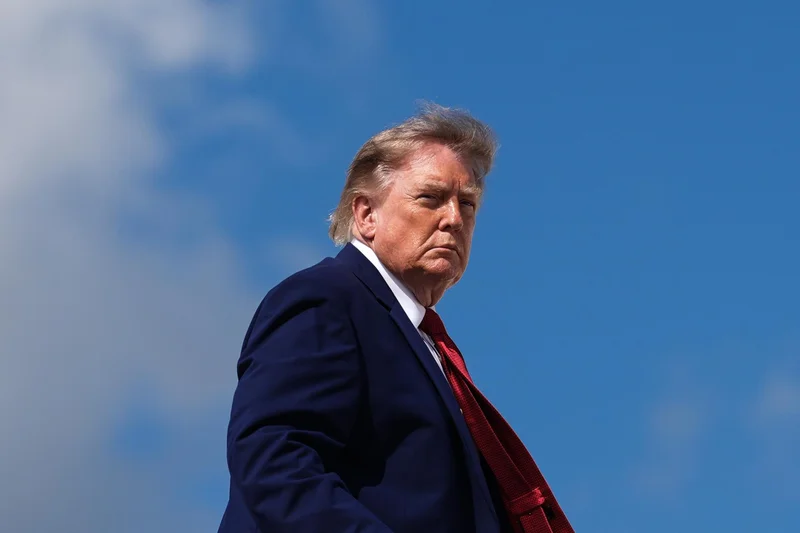
WASHINGTON — U.S. President Donald Trump's order to reduce South Korea-U.S. military exercises is raising both hopes and concerns, as it could help ease tensions with North Korea but affect the allies' defense readiness amid Pyongyang's growing nuclear and missile threats.
In a social media post on Sunday, Trump said he has instructed Defense Secretary Pete Hegseth to "substantially" scale back exercises with the Asian ally, noting that the drills are not only "costly" but also send a "totally inappropriate and hostile" signal to the North.
The post came just as South Korea and the United States kicked off their annual Ulchi Freedom Shield (UFS) exercise intended to strengthen the allies' capabilities against potential North Korean aggression and test Seoul's ability to lead combined forces in a process to retake wartime operational control from Washington.
Trump's directive raised cautious optimism for a resumption of diplomacy with North Korean leader Kim Jong-un. But questions arose over whether it could hurt the allies' efforts to counter the North's advancing military threats, as deepening cooperation between Moscow and Pyongyang has complicated the security landscape.
"Trump suggested in his social media post that he believed he had a very good relationship with Kim, and that North Korea has been 'unthreatening and respectful,'" Andrew Yeo, SK-Korea Foundation chair at the Brookings Institution's Center for East Asia Policy Studies, told Yonhap News Agency via email.
"He therefore doesn't see the need for joint military exercises. Trump seems to be taking another crack at diplomatic engagement with Kim Jong-un."
Yeo also pointed out the potential impact of reduced allied drills on military preparedness.
"North Korea has arguably learned much from its combat experience fighting on the Ukraine front and gained access to new technology and battlefield tactics in areas such as precision strike and drone warfare," he said.
"Reduced exercises may make U.S. and ROK forces less prepared to counter potential North Korean hostilities. The U.S. and ROK militaries would have probably preferred not to use joint exercises as a bargaining chip to restart diplomacy," he added. ROK stands for South Korea's official name, the Republic of Korea.
It marked the first time in Trump's second term that he had ordered a scaling back of military drills with South Korea.
During his first term, Seoul and Washington suspended or scaled down joint exercises to facilitate diplomatic engagement with Pyongyang, with Trump calling the exercises "provocative, inappropriate and expensive."
Amid concerns over the scaled-down drills in 2018, then U.S. Forces Korea Commander Vincent Brooks noted the need for restraint at a time of diplomacy with Pyongyang, repeating his calls to "put the sword in the sheath for right now, but never forget how to use it."
The order to reduce drills this time came as doubts linger over the U.S.' security commitment to South Korea and other Asian allies when Washington has focused on the continuing war in Iran and instability in the broader Middle East region, as well as domestic economic and other issues ahead of the U.S. midterm elections in November.
Rob Rapson, former acting U.S. ambassador to South Korea, said he does not see much impact on the Seoul-Washington alliance's overall military readiness in the short term.
"Recall that Trump unilaterally cancelled or scaled back key training exercises on the peninsula back in 2018, after his initial meeting with Kim in Singapore, and the readiness effects of those decisions were arguably relatively minimal," he told Yonhap News Agency via email.
However, Patrick Cronin, chair for Asia-Pacific security at the Hudson Institute, said Trump's decision to reduce a key allied exercise "undermines deterrence and readiness without altering Kim's calculations."
"Dialogue is fine, but we should negotiate from strength. Don't expect Kim to reward weakness," he told Yonhap News Agency via email.
Analysts largely agreed that the order to reduce drills reflects Trump's apparent desire to resume dialogue with the North Korean leader, as the White House has repeatedly stated that Trump remains open to talks with the North "without any preconditions."
Trump had three in-person meetings with Kim during his first term: the first meeting in Singapore in June 2018, the second in Hanoi in February 2019 and the third at the inter-Korean border village of Panmunjom in June 2019.
"Trump's announcement suggests that he may be seeking a return to direct diplomacy with Kim, an item of unfinished business from his first term," Emma Chanlett-Avery, director of political-security affairs at the Asia Society Policy Institute, said in her comments released by the institute.
She added, "The problem is that Kim has little appetite for negotiations with Trump, given his increased leverage in recent years."
Doubts have continued over whether Trump-Kim summitry could resume given Kim's bitter memory of the no-deal Hanoi summit, Pyongyang's deepening economic, diplomatic and military cooperation with Moscow and its improved ties with Beijing.
But Victor Cha, Korea Chair at the Center for Strategic and International Studies (CSIS), said in a recent analysis that Kim could seek renewed summitry with Trump, potentially after the U.S. midterm elections, if Pyongyang adopts a "revisionist" approach to help cement its status as a nuclear-armed state.
"The main driver relates to the extent to which Kim Jong-un is revisionist, and not status-quo oriented," Cha said.
"If he is revisionist in his outlook, he would look to capitalize on any available opportunity to advance the core goal of cementing his status as a nuclear weapons state."
Some observers said Trump's order to scale down the exercises could be part of an effort to divert attention from the Iran war, which has dragged on for more than five months and left energy costs high — a sensitive economic issue ahead of the U.S. midterm elections.
Trump has said in a recent interview with Axios that his administration is "low-keying" the Iran negotiations in an apparent shift away from conducting new military strikes on the Iranian Republic. The move apparently underscored difficulty in reaching a peace deal with Tehran.